
TRW Insight / Bangladesh
A 2026 guide to restaurant business registration in Bangladesh, covering entity setup, trade, tax, restaurant, fire and food-safety compliance.
Restaurant registration: a 2026 operating framework
A restaurant opening requires more than an entity and a trade licence: food safety, premises, fire readiness, tax, employment and operating controls should be sequenced before service begins.

Current position notice — checked 19 October 2026: This Insight reflects legislation and regulator information available on the date checked. A restaurant launch in Bangladesh is not completed by incorporating a company or obtaining a local trade licence alone. Where the establishment falls within the statutory definition of a restaurant, the Bangladesh Hotels and Restaurants Act, 2014 requires a separate registration certificate and licence. Requirements, forms, classifications, fees and online service arrangements can change; the relevant authority should be checked before any filing or opening. [1] [2]
Restaurant registration in Bangladesh involves a chain of legal decisions, not a single registration event. The promoter must first choose an operating vehicle, secure a lawful site, complete the appropriate entity and tax formalities, and obtain the restaurant-specific permissions that apply to the premises and proposed service. Fire, building, food-safety, consumer, employment, import and brand questions may then affect whether the restaurant is ready to trade.
This article explains the current framework for restaurant business registration Bangladesh in practical sequence. It is written for local founders, overseas investors and operators considering a new outlet, franchise or food-service concept. The point is to distinguish the corporate record from the permission to operate a restaurant. For restaurant registration in Bangladesh, the filing plan should reflect the actual site, menu, supply chain and ownership model.
Table of contents
The legal starting point: what counts as a restaurant
The Bangladesh Hotels and Restaurants Act, 2014 is the central sector-specific statute. It defines a restaurant as a commercial establishment at which 30 or more customers can be seated and receive standard food service for payment. The Act also uses a broad definition of “person” that includes an institution, company, partnership firm and other organisation. Its regime therefore concerns the food-service establishment and its operator, not merely a particular corporate form. [1]
That definition matters at the planning stage. A sit-down dining concept designed for at least 30 seats should be analysed on the basis that the Act’s registration-and-licence regime applies. A small café, cloud kitchen, takeaway counter or delivery-only operation that does not meet the stated seating element should not simply be described as exempt. Its trade licence, tax, food-safety, building, fire, employment and consumer obligations can still be substantial; location-specific permissions may also apply. The sensible approach is to map the business model against the statutory definition and consult the relevant district and local authorities before committing to the premises.
The Act gives its provisions overriding effect where another law says otherwise. It identifies the District Commissioner for each district as the registrar and places licensing functions for all restaurants with the District Commissioner or another controller appointed by government. Controllers may inspect restaurants regularly and investigate where necessary to control service standards. [1]
Registration is not the same as licensing
The 2014 Act prohibits operating a hotel or restaurant without a registration certificate and licence. These are sequential but distinct permissions. The prospective operator applies for registration to the relevant registrar in the prescribed manner and on payment of the prescribed fee. Once the registrar has checked the application information and is satisfied as to its accuracy, a certificate may be issued subject to conditions. If the application is refused, the Act requires the applicant to be notified with reasons within the stated decision period. [1]
For a restaurant, the registration certificate is not a permission to defer the operating requirements indefinitely. The Act requires the business to begin and obtain its licence within one year from the certificate date. If it does not, the certificate automatically cancels, although a fresh certificate application may be made. This is one reason to sequence site acquisition, construction or fit-out, core registrations and the sector licence realistically rather than treating the certificate as a placeholder. [1]
The licence is a separate application to the controller. The controller must assess the information and undertake the inspection or investigation necessary to be satisfied that the licensing qualifications are met. The statutory licence period is three years and it is renewable. The 2016 Rules require a renewal application at least three months before expiry and contain consequences for later filing; operators should calendar the applicable date in their own licence rather than rely on an informal renewal practice. [1] [2]
Choose the operating vehicle before applying
Entity selection determines liability allocation, governance, ownership records, bank arrangements and how filings will be made. It does not eliminate the need for a trade licence, tax registrations or the restaurant certificate and licence. The structure should follow the commercial reality: number of owners, financing, investor rights, franchise terms, leased-property commitments, intended number of outlets and the position of foreign shareholders.
Sole proprietorship
A sole proprietorship is often considered for a single-founder local venture because it can be operationally straightforward. It does not create a separate company registered at the Registrar of Joint Stock Companies and Firms (RJSC). The owner and business are not legally separate in the way a limited company is. That can be important when signing a lease, supplier contracts, employment documentation, personal guarantees or finance documents.
The underlying legal permissions remain establishment-specific. An operator using a proprietorship still needs the applicable local trade licence, e-TIN and tax treatment, and must assess the restaurant legislation, fire, food-safety and other permissions. The relevant person named across the business records should be consistent with the trade licence, tax profile, lease and restaurant application. Where a business later adopts new ownership or moves the establishment, the documents should be reviewed rather than assumed to transfer automatically.
Partnership firm
A partnership can suit founders who want agreed profit-sharing and management arrangements without forming a company. The Partnership Act permits registration of a firm by application to the Registrar, and RJSC’s stated partnership filing materials are Form I and the partnership deed. The deed should be treated as an operating document, not a formality: decision rights, capital contributions, signing authority, withdrawals, restrictions on competing activity, admission or departure of partners and dispute provisions affect the restaurant’s ability to function. [3] [5]
Name clearance is not a prerequisite for a partnership firm under RJSC’s published name-clearance process. That point should not be confused with the restaurant’s trading identity or with a local authority’s approach to a trade-licence name. A proper name and brand review remains commercially sensible. [4]
Private limited company
A private limited company is often considered where there are multiple investors, external funding, a franchise relationship, a multi-outlet plan or a desire to ring-fence business obligations within a separate legal person. It requires incorporation through RJSC under the Companies Act framework. RJSC’s current guidance lists the memorandum and articles of association, Form I, the registered-office notice in Form VI, director-consent Form IX, Form X, Form XII, evidence of name clearance, and applicable stamp and treasury documentation for a private-company registration application. RJSC issues a certificate of incorporation once it is satisfied that applicable requirements have been met. [5]
For a new company, name clearance is a pre-registration step. RJSC says an application may propose from one to ten names, only one may be cleared, and the clearance normally lasts 30 days. It can be extended, on application, to a maximum period of 90 days from original issue. Promoters need to have their constitutional documents and filing information ready during that window. [4]
A company certificate of incorporation shows that the company exists. It is not a restaurant operating licence. The company should have objects, ownership arrangements and authorised signatories that support its actual activities, and it must obtain the site-based permissions discussed below.
The lease or site must fit the proposed use
Before filing a restaurant application, the operator should test the proposed site against the intended kitchen, seating capacity, utilities, waste arrangements, customer access, building approvals and fire-safety needs. For a restaurant constructed on the applicant’s own land, the 2016 Rules call for ownership evidence, relevant building approval and condition documents, a detailed structural plan and layout/facility information, as well as certified copies of the trade licence and TIN. For a leased or rented property, the Rules call for a certified long-term lease or lease deed together with certified trade-licence and TIN copies. [2]
This means that a lease signed before regulatory diligence can create avoidable exposure. The premises document, landlord permissions, construction or fit-out scope, and the operator’s proposed licence description should work together. A site that cannot demonstrate the required safety, hygiene, utility or approval position may delay the restaurant licence even when the company, TIN and trade licence are already in place.
A practical sequence for opening
Although the right order can vary with the property, entity and investment structure, the following workstreams usually make the process more coherent:
- Define the operating model. Record seating capacity, dine-in/takeaway/delivery model, kitchen plan, proposed menu, alcohol or imported items if any, brand ownership and whether food will be manufactured or packaged for sale.
- Choose the legal vehicle and ownership model. Prepare the partnership deed or company constitutional and shareholder documentation, and consider foreign investment routing before capital is remitted.
- Secure the premises on a compliance-informed basis. Review title or lease, building and layout records, landlord consents, utility arrangements, and the route to local, fire and restaurant approvals.
- Complete entity formation where relevant. For a company, obtain name clearance and incorporate through RJSC. For a partnership, settle and file the appropriate particulars and deed if registration is to be pursued.
- Obtain the local trade licence and tax registrations. These are core business records and are expressly among the restaurant-registration materials under the 2016 Rules. [2] [8]
- Apply for the restaurant registration certificate. Compile the ownership or lease documents, trade licence, TIN, plans and fee evidence required for the chosen site model.
- Close the licence-readiness gap. Put in place the documentary and on-site conditions needed to satisfy the Act’s structural, fire, electrical, gas, hygiene, safety, building and other-government-permission requirements.
- Apply for the restaurant licence before trading. The Rules link the licence application to the registration certificate, fee proof and a formal undertaking on compliance; the controller may inspect or investigate. [1] [2]
- Operationalise continuing controls. Set up supplier traceability, invoice and VAT processes, price/menu controls, staff documentation, cleaning and health protocols, licence renewal diary and incident escalation.
BanglaBiz now presents a Business Starter Package that integrates certain start-up steps for supported entity types: name clearance, a temporary account where there is a foreign shareholder, company incorporation, corporate e-TIN and a local-authority trade licence. It may simplify those foundational applications, but it does not displace a restaurant operator’s independent duty to obtain the sector certificate and licence or meet the Act’s licensing conditions. [6] [1]

Restaurant registration certificate and licence
Registration application: build the evidence pack around the site
The registration application should be a coherent record of the establishment, not a collection of unrelated certificates. For a property owned by the applicant, the Rules distinguish between land and building documents, a detailed structural plan, design and facilities information, and tax/trade credentials. For premises held under lease or tenancy, the long-term lease or lease deed is a central document. In both cases, the Rules refer to the prescribed Form 1 and supporting fee challan. [2]
Because the exact materials differ by location and property position, the operator should obtain the live prescribed form from the competent office and test every field against the operating structure. For example, the legal owner of the lease may not be the proposed restaurant licence holder; a company might operate from a building owned by a shareholder; or an outlet may be in a shared commercial development. These need a documented route that the authority can accept.
Licensing qualifications: safety and permissions are central
Section 11 does not treat a restaurant licence as merely administrative. A proprietor is not eligible if the building is not structurally safe or is not sufficiently protected from fire, electrical or gas accidents; if the environment is not hygienic and customer safety is not assured; if registration-certificate conditions are unmet; if relevant building approvals and conditions are missing; or if required permissions and conditions from government institutions for operating the business have not been met. Other prescribed conditions also apply. [1]
The 2016 Rules require a licence application in Form 3, including a copy of the registration certificate, fee-payment proof and an undertaking executed on a BDT 300 non-judicial stamp that the statutory qualifications and Rules requirements have been met. Depending on the category and circumstances, additional supporting material may be relevant. The application should therefore be made only after a site-readiness review rather than as a paper exercise. [2]
The Rules also classify restaurants and prescribe minimum services and facilities. Their schedules address matters such as a clean cooking area, safe and clean water for cooking and washing, food-price lists, waste disposal, sanitary washing arrangements and staff awareness of health and hygiene. These are useful operating controls, not just fit-out targets to consider on the day of inspection. [2]
Fees, timing and changes of ownership
The 2016 Rules contain fee schedules that vary according to restaurant class, seating, air-conditioning status and location. Fees should be confirmed against the latest schedule and competent authority before an applicant fixes a budget or files a challan. It is not prudent to rely on a historic article, another operator’s receipt or a generic online fee table. [2]
The law gives the registrar and controller decision frameworks and timelines, but an applicant should not make commercial opening commitments on the assumption that a statutory processing period is a guaranteed project deadline. Completeness, inspection findings, required changes and the availability of other permissions can affect the path to a licence.
If restaurant ownership is transferred, the outgoing owner must inform the controller and deposit the issued registration certificate and licence. The transferee must obtain a new licence through the prescribed process and fee. Corporate share transfers, management contracts, brand licences and asset sales can raise different questions, but none should be used to assume that the existing restaurant licence silently follows the business. [1]
Core registrations beyond the restaurant licence
Local trade licence
A trade licence comes from the relevant local government authority: City Corporation, Paurashava or Union Parishad. The local authority controls its forms, fees, documentary requirements and renewal practice. Official digital services are available for some areas, including the Local Government Division’s e-Trade Licence service; BIDA notes that services for certain major city corporations are also available through its platform. [7] [8]
For a restaurant, the trade licence should accurately describe the business and premises. It is also expressly required as a certified supporting document for the restaurant registration application under the 2016 Rules. It is a vital foundational permission, but it is not a substitute for the registration certificate and licence required by the Hotels and Restaurants Act. [2] [1]
e-TIN, VAT registration or turnover-tax enlistment
The National Board of Revenue administers tax registration. An e-TIN establishes the taxpayer profile; VAT registration or turnover-tax enlistment has its own statutory test and administrative route. NBR’s VAT guidance explains that a Business Identification Number, or BIN, is issued through VAT registration and that payment liability depends on the business’s annual turnover. Its FAQ describes an application for registration or enlistment using VAT 2.1, with verification followed by issuance of BIN in VAT 2.3, which can be obtained online or through a VAT Online help centre. [9] [10]
The current consolidated VAT and Supplementary Duty Act also imposes record, invoice and display obligations on registered or enlisted persons. For example, it requires a tax invoice for taxable supplies, and sets a BDT 10,000 penalty for failure to apply for registration or enlistment on time and for not displaying a registration or turnover-tax certificate in a visible place. The correct treatment for a particular restaurant depends on the current statutory thresholds, tax period, type of supply and applicable orders. Turnover forecasts and the live NBR rules should therefore be checked before opening and then monitored as sales grow. [11]
For a restaurant with branches, delivery operations, catering or a food-production arm, VAT registration architecture and invoice systems should be designed before customers are served. A separate legal entity, separate outlet, central registration or changed economic activity can affect the analysis. NBR’s current online guidance should be cross-checked against the current Act and the operator’s actual structure, rather than copied from a template.
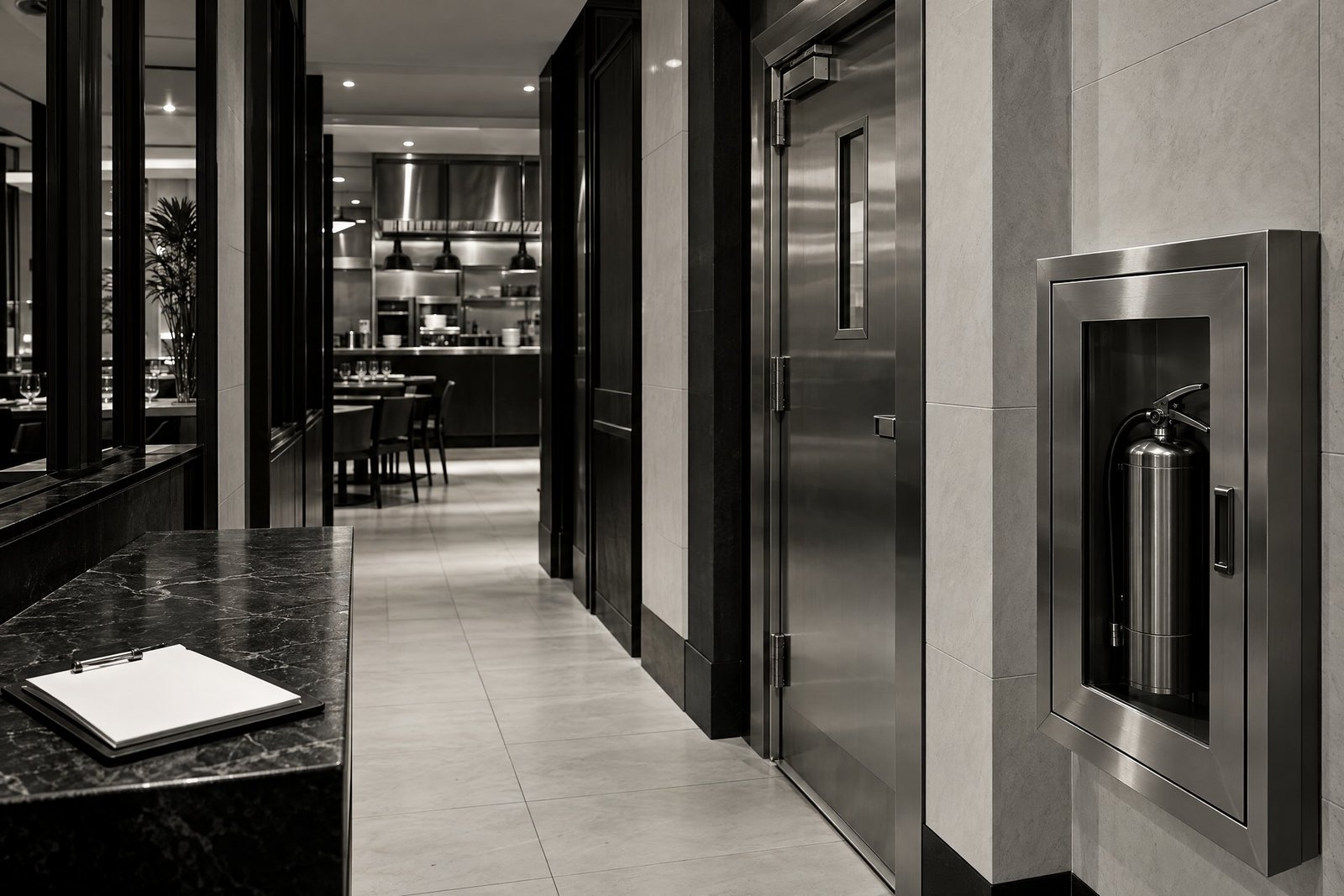
Premises, fire and food-safety readiness
Fire, electrical, gas and building compliance
The restaurant licensing test itself requires adequate structural safety and protection from fire, electrical and gas accidents, as well as the necessary approvals related to the building and other government permissions. The Fire Prevention and Fire Fighting Act, 2003 provides the wider fire-safety framework. This is why fire readiness needs to be planned with the premises, kitchen equipment and building management, not left until after the restaurant certificate has been issued. [1] [12]
The Fire Service and Civil Defence launched an e-fire-licence system on 1 May 2026 and says it is progressively bringing all fire licences into that system in financial year 2026–27. Existing licences are to be brought into the electronic system through reassessment rather than the former renewal process, and the portal supports new applications, reassessment and application tracking. Operators should use the live FSCD channel and confirm which fire permission, inspection or reassessment applies to their specific site. [13]
There is no single “restaurant checklist” that safely fits every building. A high-street leased unit, a food court, a rooftop venue and a stand-alone building may present very different issues. The project team should identify the party responsible for building-wide systems, confirm the approved use of the space, preserve inspection correspondence and ensure that restaurant plans align with the permissions under which the building is being used.
Food safety is a continuing operating discipline
The Safe Food Act, 2013 is especially important for restaurant operations. It prohibits production, processing, storage, supply or sale of food through processes that breach prescribed hygienic conditions and may harm human health. It also prohibits preparing, storing or selling food using diseased or rotten fish, meat, milk or eggs, and prohibits restaurant-service conduct that causes a diner’s health harm through irresponsibility, negligence or carelessness contrary to applicable standards. A person with a communicable disease must not be used to prepare, serve or sell food. [14]
The Act also requires food businesses to preserve the names and addresses of relevant parties and receipts or challans associated with production, import, processing, storage, supply or sale, and to show them to the authority or an authorised person. Food businesses must assist in inspections, investigations, sampling and testing. Where a business reasonably believes that food or an ingredient it supplied is non-compliant or unsafe, the Act requires immediate steps to notify the authority and arrange withdrawal in the prescribed way; the authority can also direct withdrawal. [14]
In practical terms, a restaurant should maintain an evidence trail from supplier to dish: supplier identity, purchase document, date, batch or lot information where available, storage decision, staff handling controls and disposal records. This supports food-safety management and makes a response to a complaint or inspection more reliable. It also reduces the risk of a menu promise or delivery listing being inconsistent with the ingredient actually used.
BSTI, imported goods and packaged products
The Bangladesh Standards and Testing Institution maintains an official list of mandatory products. Its current public page states that the list covers 328 products and records updates including 2025 and 2026 additions. A restaurant that manufactures, packages, imports or markets a listed product should identify the specific product and applicable standard, including whether a Certification Mark requirement is engaged. [15]
That is deliberately narrower than saying that every restaurant needs a BSTI certification for every ingredient. The answer depends on the product, the business’s role and the current mandatory-product notice. Procurement teams should keep approved-supplier and product-compliance records, especially where the restaurant private-labels bottled items, packaged sauces, bakery goods or ready-to-retail food.
Tax, records and customer-facing controls
A restaurant’s registration plan should flow into its operating records. The legal name, BIN or tax status where applicable, registered address, trade-licence details, premises address, invoices and supplier documents should be reconciled. The operator should decide who can approve purchases, receive goods, issue VAT documents, sign lease correspondence, handle customer refunds and respond to inspectors.
The Consumer Rights Protection Act, 2009 expressly includes residential hotels and restaurants within “services.” It treats false or misleading advertising, unsafe conduct, sale above a price fixed under law or rule, and failure to provide the promised product or service as consumer-rights concerns. It also creates sanctions where a required product or service price list is not kept and displayed in a readily visible place. [16]
For a restaurant, this points to several practical habits: use menus and digital listings that state the price and essential descriptions accurately; control optional and compulsory charges; keep price-list copies and effective dates; match served portions and menu claims to the offering; and preserve records of refunds, complaints and corrective actions. The 2016 Rules’ restaurant-classification schedule likewise refers to food price lists and reasonable food-price lists. [2] [16]
Packaged food offered for sale raises further requirements. The Safe Food Act regulates packaging and labels, including required marking and information, and prohibits false or misleading information about quantity, nutritional value, origin or other matters. It also addresses expiry information and alteration or removal of label information. A restaurant selling branded packaged goods should not treat those goods as outside its compliance scope merely because most sales are prepared meals. [14]
Employment and workplace controls
Restaurant operations are labour-intensive. The Bangladesh Labour Act, 2006 is the overarching statute covering employment, employer-worker relations, wages, workplace injuries, health, safety, welfare and conditions of employment. The Bangladesh Labour Amendment Act, 2026 is now also in force as an amending Act. Hiring documents, working-time arrangements, wages, leave, registers, safety measures and grievance practices should therefore be tested against the up-to-date statutory text and rules. [17] [18]
A carefully drafted appointment letter is useful, but it cannot displace mandatory employment protections. An operator should establish clear kitchen and service roles, training records, wage/payment controls, accident reporting, anti-harassment processes and a system for updating staff policies as the law changes. Food-handler health and hygiene controls should be coordinated with the Safe Food Act obligations, not relegated to an informal HR file.

Foreign investment, imports and franchising
Foreign participation changes the documentation but does not remove the local permissions. Bangladesh Bank states that foreign investors can open a Temporary Non-Resident Taka Account with an authorised dealer in the name of a proposed Bangladeshi venture, to hold foreign equity and meet preliminary expenditure before incorporation; no prior Bangladesh Bank permission is required for that account. For shares issued to a non-resident, the foreign remittance must be received through formal banking channels before issuance, and Bangladesh Bank’s Foreign Exchange Investment Department must be informed through the authorised dealer within 14 days after the share issue or transfer and completion of RJSC formalities. [19]
The funding trail matters. Incorporation documents, bank records, encashment evidence, allotment records and RJSC filings should tell the same story. Bangladesh Bank says no prior approval is needed to remit cash dividends, net of tax, to non-resident shareholders, but the relevant documentation must be retained for potential inspection. Foreign shareholders should not assume that a company incorporation certificate alone is sufficient to support later capital or dividend movements. [19] [20]
BIDA’s current FAQ makes a useful distinction: registration with Invest Bangladesh is not a requirement for commercial and trading activities, while domestic, foreign and joint-venture projects may use its services in appropriate circumstances. A branch, liaison, representative or project office of an overseas company follows a different BIDA approval route and is not simply interchangeable with a locally incorporated restaurant company. The correct vehicle should be selected before lease, staffing and franchise commitments are made. [8] [20]
An Import Registration Certificate, or IRC, becomes relevant if the business will import goods rather than purchase them locally. It should be treated as import-specific, not as a universal restaurant registration. The Chief Controller of Imports and Exports’ online licensing platform instructs IRC/Export Registration Certificate holders to apply for renewal at least 60 days before expiry to avoid penalty, while requiring current tax documentation in the live process. Importers should check commodity-specific import permissions, food controls, customs classification and product standards in addition to the IRC. [21]
For a franchise or licence of an international restaurant brand, contracts must be read alongside the regulatory map. Questions include ownership of the mark, permitted use, supply restrictions, quality-control rights, data and technology arrangements, remittance structure, tax treatment, import responsibilities and the identity that appears on local restaurant, trade and tax records. Brand protection can also be pursued through the Department of Patents, Designs and Trademarks: its published forms include TM-1 for a trademark-registration application and TM-4 for a trademark search. Filing a trade-mark application is distinct from receiving permission to trade as a restaurant. [22]
Ongoing compliance after opening
Opening day is the beginning of the compliance cycle. Licence renewal, changes in ownership, business address, tax profile, menus, product lines, staffing and fire-safety arrangements can all require action. A practical compliance calendar should include the restaurant licence’s expiry date, renewal lead time, trade-licence renewal, VAT or turnover-tax returns and certificates where relevant, annual corporate filings for a company, food-safety reviews, fire-system checks, insurance and lease milestones.
The restaurant licence is renewable for three years. The Act allows operation while a pre-expiry renewal application awaits an approval or refusal order, but that is not a reason to leave renewal until the last moment. The 2016 Rules specify an earlier filing expectation and consequences for delay. A business that has undergone a change in ownership should follow the transfer provisions and obtain the new owner’s licence, rather than seeking to use the outgoing owner’s document. [1] [2]
The potential consequences are material. Operating without the required registration certificate and licence, or breaching the Act or Rules, is an offence that can attract up to six months’ simple imprisonment, a fine of up to BDT 200,000, or both. Where a company is involved, the director, executive, manager, secretary or other officer/employee directly concerned can be treated as having committed the offence unless the statutory defence is made out. A registration certificate or licence may also be suspended or cancelled after investigation and an opportunity to be heard, for reasons including breach of law, conditions or service standards, unnotified closure or ownership transfer, or failure to protect guests’ or customers’ life and property. [1]
The strongest approach is to assign named responsibility for each register and licence, retain the underlying documents, and review the matrix whenever the site, seating capacity, business model, investors, brand, product range or kitchen layout changes. Readers looking for broader corporate, commercial, regulatory and dispute-related context can explore TRW’s practice areas. For a discussion of a particular planned structure or regulatory issue, contact TRW.
Frequently asked questions
Does incorporation of a company permit it to open a restaurant?
No. RJSC incorporation establishes the company as a legal entity; it does not replace a local trade licence, tax registration/enlistment where applicable, or the registration certificate and licence required to operate a restaurant under the Bangladesh Hotels and Restaurants Act. The premises and operating conditions must also satisfy the sector-specific licensing test. [1] [5]
Is a trade licence enough for restaurant business registration in Bangladesh?
No. A trade licence is a core local-authority permission and is required as a supporting document under the restaurant-registration Rules, but a qualifying restaurant must separately hold the certificate and licence required by the 2014 Act. Treating the trade licence as the whole restaurant permission set is a common but consequential mistake. [1] [2] [8]
Is the restaurant registration certificate the same as the restaurant licence?
No. The certificate and licence are separate. The certificate is obtained first from the registrar; the owner then applies to the controller for a licence. For a restaurant, the business must begin and obtain the licence within one year after certificate issuance or the certificate automatically cancels. [1]
How long does a restaurant licence last in Bangladesh?
Do all food businesses need the restaurant licence?
The Act defines a restaurant as a commercial establishment where at least 30 customers may sit and receive standard food service for payment. Businesses outside that exact definition should obtain a current authority view of their status. They should not infer that no approvals are needed, because trade, food-safety, fire, tax, building, consumer and local requirements can still apply. [1] [14]
Can a foreign investor own a Bangladeshi restaurant company?
Foreign investment may be made through a Bangladeshi company, subject to the applicable company, banking, foreign-exchange and operational requirements. Bangladesh Bank describes the authorised-dealer route for foreign equity and the post-issue reporting requirement. The investment route must be aligned with the actual ownership, remittance, RJSC and operating-permission documents. [19] [20]
Does every restaurant need an Import Registration Certificate?
No. An IRC is relevant where the business imports goods. A restaurant sourcing ingredients and equipment only from domestic suppliers should not assume it needs an IRC merely because it operates a restaurant. If it will import, it should verify the appropriate IRC category, current CCI&E process, customs and product-specific permissions before contracting or shipping. [8] [21]
What food-safety records should a restaurant keep?
The Safe Food Act requires food businesses to retain relevant parties’ names and addresses and receipts or challans connected with food production, import, processing, storage, supply or sale, and to produce them to the authority or an authorised person. In practice, preserve supplier, batch, delivery, storage, staff training, cleaning, complaint and withdrawal documentation in an organised form. [14]
Source register
Primary legal and regulatory sources
Source materials were checked on 19 October 2026. Statutory interpretation should be confirmed against current official texts and the facts of the matter.
- Bangladesh Hotels and Restaurants Act 2014
- Bangladesh Hotels and Restaurants Rules 2016
- Partnership Act 1932
- RJSC name clearance process
- RJSC registration process and documents
- BanglaBiz Business Starter Package
- Local Government Division e-Trade License service
- Invest Bangladesh frequently asked questions
- NBR VAT registration and enlistment guide
- NBR VAT frequently asked questions
- Value Added Tax and Supplementary Duty Act 2012 consolidated text
- Fire Prevention and Fire Fighting Act 2003
- Fire Service and Civil Defence e-fire licence system
- Safe Food Act 2013
- BSTI mandatory products list
- Consumer Rights Protection Act 2009
- Bangladesh Labour Act 2006
- Bangladesh Labour Amendment Act 2026
- Bangladesh Bank foreign direct investment guidance
- Bangladesh Bank foreign investment frequently asked questions
- Chief Controller of Imports and Exports online licensing system
- DPDT trademark forms
Related TRW assistance
Move from information to a defined next step
Explore TRW practice areas or contact TRW to discuss the current facts and applicable requirements.