
Divorce case process in Bangladesh: the full journey, step by step
The divorce case process in Bangladesh depends on who ends the marriage and how: a Muslim husband's talaq, a wife's delegated talaq-e-tafweez or a khula all run through written notice to the Chairman or Mayor, an Arbitration Council and a ninety-day wait, while a wife without the husband's cooperation sues for dissolution in the Family Court under the Dissolution of Muslim Marriages Act 1939.
Dower, maintenance and custody are claimed in the same Family Court, with appeal to the Family Appellate Court and revision in the High Court Division. Hindu law has no divorce, and Christian divorce is a District Judge petition confirmed by the High Court Division.
- Where it starts
- Written notice to the Union Parishad Chairman, Paurashava or City Corporation Mayor (talaq, tafweez, khula); or a suit…
- Main law
- Muslim Family Laws Ordinance 1961 (ss.2, 7-10); Dissolution of Muslim Marriages Act 1939; Family Courts Act 2023 (Act No. 26 of…
- Typical duration
- Talaq by notice: about 3-4 months. Contested Family Court suit: roughly 8-24 months at first instance; 1-3 more years…
- Who can file
- Husband (talaq); wife with a delegated right (talaq-e-tafweez); either spouse by agreement (khula, mubara'at); wife by…
Divorce case process in Bangladesh: walk through every stage
Press next, use your arrow keys or tap a court on the map. The gold marker shows where your case is, and the green trail shows the route it has taken. For the immersive version, play it full screen.
Read every step as text
 Step 1 · Before anything is filed
Identify the route and the personal law
The first meeting decides which legal route applies. For Muslim spouses the options are a husband's talaq, a wife's talaq-e-tafweez if clause 18 of the kabinnama delegates the right of divorce to her, a khula or mubara'at by agreement, or a wife's suit in the Family Court. Hindu spouses cannot divorce under their personal law, and Christian spouses follow the Divorce Act 1869.
The lawyer also checks whether dower, maintenance or custody claims need to be filed, because the divorce case process in Bangladesh often turns more on money and children than on the divorce itself.
Where: Lawyer's chamber · Time: 1-2 weeks · Law: s.7 and s.8 Muslim Family Laws Ordinance 1961; s.2 Dissolution of Muslim Marriages Act 1939; s.5 Family Courts Act 2023 · Documents: Kabinnama or certified copy of the marriage register entry, National ID cards of both spouses, Children's birth registration certificates
Tip: Read clause 18 of the kabinnama first. If the right of divorce was delegated to the wife, she can end the marriage herself through the notice route without suing.
 Step 2 · Before anything is filed
Collect marriage, dower and income evidence
Before any notice or plaint is drafted, the lawyer assembles the evidence that will matter later. That means the registered kabinnama showing the amount of dower and how much was paid at marriage, proof of where each spouse lives (which fixes the competent Chairman and the Family Court's territorial jurisdiction), evidence of the husband's income for maintenance, and any record of cruelty, desertion or non-payment if the wife intends to sue under the 1939 Act.
Where a spouse is abroad, a power of attorney or authorisation is prepared and attested so that a representative can act.
Where: Lawyer's chamber · Time: 1-3 weeks · Law: s.10 Muslim Family Laws Ordinance 1961; s.2(ii), (iv) and (viii) Dissolution of Muslim Marriages Act 1939 · Documents: Kabinnama with dower details, Proof of residence, Salary slips, bank statements or business records of the husband, Medical reports, police complaints or messages showing cruelty, Power of attorney (if a spouse is abroad)
Tip: Under s.10 of the 1961 Ordinance, if the kabinnama does not say how dower is to be paid, the whole dower is payable on demand. Note what the document actually says.
 Step 3 · Divorce by notice (talaq, tafweez, khula)
Draft and sign the written talaq notice
A husband who pronounces talaq in any form must, as soon as may be, give the Chairman written notice and send a copy to the wife. A wife exercising a delegated right, or spouses ending the marriage by khula or mubara'at, use the same machinery because section 8 applies section 7 with necessary changes. The High Court Division held in November 2025 that notice is mandatory even in a mutual khula, and that a khula without it is void.
Failing to give notice is also an offence punishable with up to one year's simple imprisonment, a fine of up to Tk 10,000, or both.
Where: Lawyer's chamber · Time: 1-7 days · Law: s.7(1) and (2) Muslim Family Laws Ordinance 1961; s.8 Muslim Family Laws Ordinance 1961; Md Parvej Hossain v Mst Shohana Shohgi, HCD Civil Revision No. 973 of 2021 (16 November 2025) · Documents: Signed talaq notice (or tafweez or khula notice), Khula or mubara'at settlement agreement, if any, Copy of kabinnama
Tip: Keep proof of delivery of the wife's copy, such as a registered post receipt. Disputes about whether she was told are common years later.
 Step 4 · Divorce by notice (talaq, tafweez, khula)
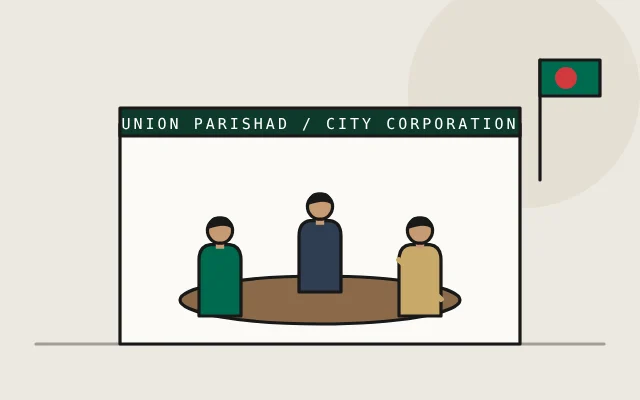
Deliver the notice to the Chairman or Mayor
The notice goes to the 'Chairman' as defined in section 2(b) of the 1961 Ordinance: the Union Parishad or Paurashava Chairman, the City Corporation Mayor or Administrator, or the person appointed for a cantonment area. In Dhaka the two City Corporations receive these notices through their zonal or regional offices. The office should give a dated receipt, because the ninety days run from the day the Chairman receives the notice, not from the day talaq was pronounced or a notice was signed.
Where: Arbitration Council (Union Parishad / City Corporation) · Time: 1 day · Law: s.2(b) Muslim Family Laws Ordinance 1961; s.7(1) and (3) Muslim Family Laws Ordinance 1961 · Documents: Original notice, Copy for acknowledgment, Proof of address showing the competent area
Tip: Ask the office which zone covers the wife's address before filing; a notice sent to the wrong office invites a later challenge.
 Step 5 · Divorce by notice (talaq, tafweez, khula)
Arbitration Council attempts reconciliation
Within thirty days of receiving notice, the Chairman must constitute an Arbitration Council made up of the Chairman and one representative of each spouse. Its only statutory task is to try to reconcile the parties. If a spouse fails to nominate a representative, the Council can still be formed without one. The Council does not decide dower or custody, but the meeting creates a useful record of each side's position. If the spouses reconcile, the talaq can be revoked before the ninety days run out.
Where: Arbitration Council (Union Parishad / City Corporation) · Time: Within 30 days of notice; meetings over 1-2 months · Law: s.7(4) Muslim Family Laws Ordinance 1961; s.2(a) Muslim Family Laws Ordinance 1961 (Arbitration Council) · Documents: Council notice, Nomination of representative, Any written settlement proposal
Tip: Attend the meeting even if the divorce is agreed. Non-attendance does not stop the divorce, but the record helps in any later dower or maintenance case.
 Step 6 · Divorce by notice (talaq, tafweez, khula)
Ninety days pass and the divorce takes effect
Unless revoked earlier, a talaq becomes effective ninety days after the Chairman receives the notice. If the wife is pregnant, it takes effect at the end of the ninety days or the end of the pregnancy, whichever is later. Until then the marriage subsists and the wife remains entitled to ordinary maintenance. After an effective talaq the couple may remarry each other without an intervening marriage, unless this is the third effective divorce. Many offices issue a certificate of effectiveness at the end of the period on request.
Where: Arbitration Council (Union Parishad / City Corporation) · Time: 90 days (longer if the wife is pregnant) · Law: s.7(3), (5) and (6) Muslim Family Laws Ordinance 1961 · Documents: Receipt showing the date of delivery, Application for divorce effectiveness certificate
Tip: Time any settlement payment to the effective date or hold it in escrow, so that nobody pays for a divorce that is later revoked.
 Step 7 · Divorce by notice (talaq, tafweez, khula)
Register the divorce with the Nikah Registrar
Registration creates the official record that embassies, the passport office and later courts rely on. The Nikah Registrar for the area registers the divorce on application and gives the parties an attested copy of the entry. For a talaq-e-tafweez, the Registrar must first see the document delegating the power or an attested copy of the marriage register showing the delegation. Registration does not itself make a divorce valid, and an unregistered divorce is not automatically void, but missing paperwork is the commonest reason foreign authorities refuse to recognise a Bangladeshi divorce.
Where: Nikah Registrar (Kazi) office · Time: 1-7 days · Law: s.6 Muslim Marriages and Divorces (Registration) Act 1974; Muslim Marriages and Divorces (Registration) Rules 2009 · Documents: Chairman's acknowledgment or effectiveness certificate, Kabinnama, National ID cards, Prescribed registration fee
Tip: Use the Nikah Registrar who has jurisdiction where the divorce was effected; registration at an unrelated registry was one reason a khula was rejected in a 2026 High Court Division case.
 Step 8 · Mediation and filing in the Family Court
Mandatory legal aid mediation (notified districts)
Where a wife needs a court decree for dissolution, or either spouse claims dower, maintenance or custody, the dispute falls within section 5 of the Family Courts Act 2023. In districts where section 21B of the Legal Aid Services Act 2000 has been brought into force, the claimant must first apply to the district legal aid office for pre-case mediation. A certified settlement has the effect of a decree; if mediation fails, the office issues a certificate that must accompany the plaint.
Thirty districts were notified from 31 July 2026; Dhaka was not among them at the time of writing, so check the current notification.
Where: District Legal Aid Office (pre-case mediation) · Time: About 1 month (the rules set a short deadline; check the current rules) · Law: s.21B to s.21E Legal Aid Services Act 2000 (inserted by Act No. 45 of 2026); S.R.O. No. 288 of 2026; s.5 Family Courts Act 2023 · Documents: Mediation application, Kabinnama, Mediation failure certificate (if no settlement)
Tip: Time spent in legal aid mediation is excluded from limitation, but keep the dated application receipt to prove it.
- Step 9 · Mediation and filing in the Family Court
File the plaint in the Family Court
The wife's lawyer files a plaint for dissolution of marriage, often joined with claims for unpaid dower, maintenance for herself and the children, and custody. The Family Court is presided over by a Civil Judge or Senior Civil Judge (called Assistant Judge and Senior Assistant Judge until the Civil Courts amendment of 2026). The plaint states the grounds under section 2 of the 1939 Act, such as two years' failure to maintain, three years' failure to perform marital obligations, cruelty, or a second marriage in breach of the 1961 Ordinance.
It lists witnesses and attaches the documents relied on. A fixed court fee is paid.
Where: Family Court (Civil Judge or Senior Civil Judge) · Time: 1-2 weeks to draft and file · Law: s.4(2) and s.6 Family Courts Act 2023; s.25 Family Courts Act 2023 (court fee); s.2 Dissolution of Muslim Marriages Act 1939; s.25A Civil Courts Act 1887 (renaming of Assistant Judges) · Documents: Plaint with schedule of claims, List of witnesses, Kabinnama and documents relied on, Legal aid mediation failure certificate (where required), Court fee
Tip: Plead every ground that fits and every claim you have. Ground (ix), 'any other ground recognised as valid under Muslim law', is the basis for judicial khula when a husband refuses consent.
 Step 10 · Mediation and filing in the Family Court
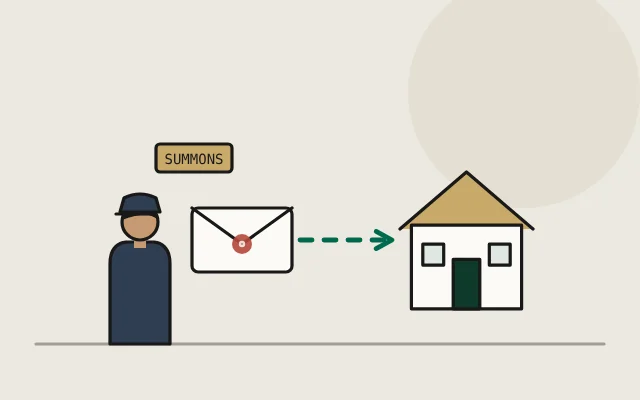
Summons served and written statement filed
The Family Court issues summons and notice to the husband, using the methods the Act allows, including registered post. On appearance he files a written statement answering the plaint. If the husband does not appear after due service, the court can proceed ex parte; he may apply to set aside an ex parte decree within thirty days of the decree. If the wife does not appear, the suit may be dismissed for default, and she may apply for restoration within thirty days of the dismissal.
Where: Family Court (Civil Judge or Senior Civil Judge) · Time: 1-3 months · Law: s.7 Family Courts Act 2023; s.8 Family Courts Act 2023; s.10(5) and (6) Family Courts Act 2023 · Documents: Summons and notice, Written statement, Defendant's list of witnesses and documents
Tip: Give the court every known address for the husband, including his workplace. Defective service is the commonest reason ex parte decrees are later set aside.
 Step 11 · Mediation and filing in the Family Court
Apply for interim maintenance or custody orders
A family case can take a year or more, and the household needs money now. Section 21 of the 2023 Act allows the Family Court, if satisfied that immediate action is needed to stop a party defeating the purpose of the suit, to make any interim order it considers appropriate. In practice this covers interim maintenance for children, interim arrangements for a child's residence or visits, and orders preserving property. The High Court Division has upheld interim maintenance fixed by Family Courts pending trial.
Where: Family Court (Civil Judge or Senior Civil Judge) · Time: 2-8 weeks · Law: s.21 Family Courts Act 2023; Guardians and Wards Act 1890 (Family Court acts as District Court: s.27 Family Courts Act 2023) · Documents: Application for interim order supported by affidavit, Evidence of the child's needs and school costs, Evidence of the other spouse's income
Tip: Ask early. Courts are more willing to fix modest interim support at the start than to order large arrears at the end.
 Step 12 · Trial in the Family Court
Pre-trial hearing and reconciliation attempt
After the written statement, the Family Court holds a pre-trial hearing. It reviews the plaint, written statement and documents, ascertains the points in issue and tries to bring about a compromise or reconciliation between the spouses. Where the parties agree on dower, maintenance or custody, the court can pass a compromise decree on those terms. If there is no settlement, the court fixes a date for trial. Hearings in a Family Court may be held in camera if a party asks or the court considers it necessary.
Where: Family Court (Civil Judge or Senior Civil Judge) · Time: 1-3 months · Law: s.11 Family Courts Act 2023 (pre-trial proceedings); s.12 Family Courts Act 2023 (in camera); s.15 Family Courts Act 2023 (compromise decree) · Documents: Settlement proposals, Draft compromise terms (if agreed)
Tip: Attend in person. The judge often speaks directly to the spouses at this stage, and a reasonable offer on maintenance can end the case months early.
 Step 13 · Trial in the Family Court
Trial: evidence of both sides
At trial each side calls its witnesses, starting with the plaintiff. The Family Court records the evidence, may allow a witness's evidence on affidavit, and allows cross-examination. The wife must prove the facts behind the ground she relies on, for example that the husband failed to provide maintenance for two years or treated her with cruelty as defined in section 2(viii). For dower, the kabinnama and proof of what was paid decide the figure. For maintenance, the court looks at the husband's means and the family's reasonable needs.
Where: Family Court (Civil Judge or Senior Civil Judge) · Time: 3-12 months · Law: s.13 (including s.13(6) on affidavit evidence) Family Courts Act 2023; s.2(viii) Dissolution of Muslim Marriages Act 1939 · Documents: Exhibits: kabinnama, receipts, medical and police records, Income evidence, Witness summonses
Tip: Witnesses who saw events, such as neighbours or relatives, carry more weight than general statements about character.
 Step 14 · Trial in the Family Court
Final reconciliation attempt and judgment
When the evidence closes, the court makes a further attempt at compromise before writing its judgment. If none succeeds, it pronounces judgment, deciding each claim: whether the marriage is dissolved and on which ground, the dower due, maintenance and any arrears, and custody or visiting arrangements. Where a dissolution decree is passed, the court sends a certified copy to the Chairman within seven days, and the dissolution takes effect ninety days after the Chairman receives it. That is a step in the divorce case process in Bangladesh that parties often overlook.
Where: Family Court (Civil Judge or Senior Civil Judge) · Time: 1-2 months after evidence closes · Law: s.14 Family Courts Act 2023; s.16 Family Courts Act 2023; s.26(2) and (3) Family Courts Act 2023 (copy to the Chairman; ninety days) · Documents: Judgment, Decree
Tip: Apply for certified copies of the judgment and decree on the day of judgment. Appeal time runs from the decree, excluding only the time needed to obtain copies.
- Step 15 · Decree, registration and enforcement
Record the court dissolution
Once the decree of dissolution is effective, the parties obtain documentary proof for future use: a certified copy of the decree and, where available, the Chairman's confirmation that the ninety days have run. Many people also present the decree to the Nikah Registrar so that the divorce appears in the register. For spouses abroad or with foreign spouses, the decree and certificates may then need attestation by the Ministry of Foreign Affairs or an apostille before an overseas authority will accept them.
Where: Nikah Registrar (Kazi) office · Time: 2-6 weeks after the decree becomes effective · Law: s.6 Muslim Marriages and Divorces (Registration) Act 1974; s.26(3) Family Courts Act 2023 · Documents: Certified copy of the decree, Chairman's certificate, National ID cards
Tip: Ask the receiving country's authority or embassy in advance what form of attestation or legalisation it needs, so the papers are prepared once.
 Step 16 · Decree, registration and enforcement
Enforce dower and maintenance decrees
If the husband does not pay within the time the court fixed, the wife applies to the same Family Court, within one year, to execute the decree, either as a civil money decree or as if it were a fine imposed by a Magistrate. The court can attach and sell his property, attach salary or bank accounts, issue a warrant, or allow payment in instalments. Maintenance decrees run month by month, so arrears can be recovered in further applications.
The Arbitration Council route under section 9 of the 1961 Ordinance is an alternative for maintenance during the marriage: its certificate is recoverable as arrears of land revenue.
Where: Family Court (Civil Judge or Senior Civil Judge) · Time: 3-12 months · Law: s.17(3) to (8) Family Courts Act 2023; s.9 Muslim Family Laws Ordinance 1961 · Documents: Execution application, Certified copy of decree, Details of the husband's assets, employer and bank
Tip: Name the employer and the bank in the execution application. Courts act faster on a specific salary or account than on a general request.
What if…? How the divorce case process in Bangladesh can change course
Choose a scenario. The map animates the route up the hierarchy and, where a case is sent back, down to the lower court and up again.
What if a spouse wants to appeal the Family Court decree?
- 1District Judge's Court (Family Appellate Court)
Family Appeal to the Family Appellate Court
An appeal lies to the Family Appellate Court, a court of District Judge rank, within thirty days of the decree, excluding the time needed to obtain copies; the court may extend time for good cause. No appeal lies against a decree dissolving the marriage, except one granted on the ground in section 2(viii)(d) of the 1939 Act, and none against a dower decree of Tk 50,000 or less. Maintenance and custody decrees are appealable. The District Judge may send the appeal to an Additional or Joint District Judge.
The appeal rehears facts and law on the record.
6-18 monthss.18 and s.19(1), (2) and (6) Family Courts Act 2023s.27(2) Family Courts Act 2023 (guardianship orders)s.2(viii)(d) Dissolution of Muslim Marriages Act 1939
Where it ends up: The Family Appellate Court affirms, varies or reverses the decree; its decision is final on facts, subject only to revision in the High Court Division.
What if the appellate decision is wrong in law?
- 1High Court Division
Civil Revision in the High Court Division
The losing side can apply to the High Court Division for civil revision under section 115(1) of the Code of Civil Procedure against the Family Appellate Court's decree. A single judge hears whether there is an error of law resulting in an error in the decree that has caused a failure of justice. If a Rule is issued, the other side is served and the record is called for. Revision is not a rehearing of evidence, and stays of execution are discretionary. Recent 2025 and 2026 khula and maintenance rulings came on revision.
1-3 yearss.115(1) Code of Civil Procedure 1908
Where it ends up: The High Court Division discharges the Rule, leaving the appellate decree in place, or makes it absolute and corrects or sets aside the decree.
Can the same court reconsider its own decision?
- 1High Court Division
Review of the High Court Division's revisional judgment
A party may ask the High Court Division to review its own judgment in a civil revision on the narrow grounds of Order XLVII rule 1 of the Code: discovery of new and important evidence that could not be produced earlier despite due diligence, a mistake or error apparent on the face of the record, or another sufficient reason. Review is not a second appeal. The Family Court itself has no general review power: section 28 of the 2023 Act excludes the Code, apart from sections 10 and 11, from Family Court proceedings.
3-12 monthss.114 and Order XLVII rule 1 Code of Civil Procedure 1908Article 173 Limitation Act 1908 (90 days)s.28(1) Family Courts Act 2023
Where it ends up: The review is rejected, or the judgment is corrected and the revision reheard on the point.
What happens in a Christian divorce, where a reference to the High Court Division is built in?
- 1District Judge's Court (Family Appellate Court)
Petition to the District Judge under the Divorce Act 1869
Christian spouses petition the District Court on the fault grounds in section 10 of the Divorce Act 1869, such as adultery, or for a wife, conversion and remarriage, or adultery coupled with cruelty or two years' desertion. There is no consent ground. The District Judge hears evidence and may pass a decree for dissolution. Questions of law can also be referred to the High Court Division during the case.
1-2 yearss.10 Divorce Act 1869s.8 and s.9 Divorce Act 1869 - 2High Court Division
Confirmation by the High Court Division
A District Judge's decree for dissolution does not take effect on its own. Under section 17 it must be confirmed by the High Court Division, sitting as a bench of three judges where available. The High Court Division may direct further inquiry or additional evidence, which the District Judge takes and certifies back, and then confirms or refuses to confirm the decree. Hindu spouses have no divorce at all; a Hindu wife's remedy is separate residence and maintenance under the 1946 Act.
6-24 monthss.17 Divorce Act 1869Hindu Married Women's Right to Separate Residence and Maintenance Act 1946
Where it ends up: The marriage is dissolved only when the High Court Division confirms the District Judge's decree.
What if the higher court sends the case back for a fresh hearing?
- 1High Court Division
High Court Division remands the case
Where the courts below failed to decide a material issue, refused admissible evidence, or decided on a misreading of the law, the High Court Division can set aside the decrees in revision and send the case back to the Family Court, or to the Family Appellate Court, with directions to rehear a specific point. Remand is a last resort: where the record is sufficient, the higher court is expected to decide the matter itself.
Order on the day of judgments.115(1) Code of Civil Procedure 1908 ('make such order as it thinks fit')s.28(1) Family Courts Act 2023 (Order XLI does not apply in the family courts) - 2Family Court (Civil Judge or Senior Civil Judge)
Fresh hearing in the Family Court
The Family Court restores the case to its file under the original number and takes the additional evidence or hears the issue as directed. Evidence already recorded stays on the record. It then passes a fresh judgment and decree on the remanded point. That new decree carries its own right of appeal to the Family Appellate Court, and from there the case can climb back to the High Court Division in revision.
4-12 monthss.13 and s.16 Family Courts Act 2023s.19 Family Courts Act 2023
Where it ends up: The case returns up the chain with a complete record, usually ending at the Family Appellate Court or in a second revision.
Can the case go to the Appellate Division?
- 1Appellate Division of the Supreme Court
Civil Petition for Leave to Appeal
Against the High Court Division's revisional judgment, the aggrieved party files a civil petition for leave to appeal in the Appellate Division within sixty days. Leave is granted only where a substantial question of law or a serious failure of justice is shown. If leave is granted, the petition becomes a civil appeal heard on the record. A stay of the High Court Division's order can be sought from the Chamber Judge. The Appellate Division can later review its own judgment under Article 105, on narrow grounds, within thirty days.
1-3 yearsArticle 103 Constitution of BangladeshOrder XIII rule 1 Supreme Court of Bangladesh (Appellate Division) Rules 1988Article 105 Constitution; Order XXVI Appellate Division Rules 1988
Where it ends up: The Appellate Division's decision is final and binds all courts under Article 111.
How the divorce case process in Bangladesh moves up the court hierarchy
The divorce case process in Bangladesh starts outside court. A Muslim talaq, delegated talaq-e-tafweez or khula needs no judge at all: notice goes to the Chairman or Mayor, the Arbitration Council tries to reconcile, and the divorce takes effect after ninety days. Courts become involved only when a wife needs a decree of dissolution, or when dower, maintenance or custody are disputed. Those claims are heard by the Family Court, presided over by a Civil Judge or Senior Civil Judge, with no upper limit on value.
One appeal lies to the Family Appellate Court, a court of District Judge rank, which rehears facts and law on the record, though dissolution decrees (save one ground) and dower decrees of Tk 50,000 or less cannot be appealed. Above that, the High Court Division hears civil revision on errors of law only, and the Appellate Division hears appeals by leave. Christian divorces start before the District Judge and must be confirmed by the High Court Division.
- Appellate DivisionAppellate Division of the Supreme Court
- High Court DivisionHigh Court Division
- Appellate levelDistrict Judge's Court (Family Appellate Court)
- First instanceFamily Court (Civil Judge or Senior Civil Judge)
- Start · outside courtLawyer's chamber · Arbitration Council (Union Parishad / City Corporation) · Nikah Registrar (Kazi) office · District Legal Aid Office (pre-case mediation)
Where your case is heard
Addresses are for Dhaka. Every district has equivalent courts at its own district judgeship.
Supreme Court of Bangladesh (Appellate Division and High Court Division)
Supreme Court of Bangladesh, Shahbag, Ramna, Dhaka-1000Hears appeals, revisions, references, writ petitions under Article 102, company matters and death references (High Court Division), and appeals by leave from the High Court Division (Appellate Division).
Both Divisions sit in the Supreme Court complex; many High Court Division benches sit in the Annex Building. Check the daily cause list for the bench and court room. Postal contact is the Registrar General, Supreme Court of Bangladesh, Ramna, Dhaka-1000.
Court of the District and Sessions Judge, Dhaka (Dhaka Judge Court)
Dhaka Judge Court premises, 16 Johnson Road, Sadarghat, DhakaSeat of the Dhaka District Judge and Additional District Judges (civil appeals, probate, district-level civil and sessions work outside the metropolitan area) and the civil courts of first instance (Joint District Judge, Senior Civil/Assistant Judge courts).
Official judiciary portal gives '16 Johnson Road, Sadarghat, Dhaka'. Many civil courts (Additional District Judge courts, Joint District Judge and Senior Assistant Judge courts, Artha Rin Adalat No.1, insolvency court) are in the new 8-storey District Judge Court building in the same premises. The 2026 judgeship list names the first-instance civil courts 'Senior Civil Judge' / 'Civil Judge' (formerly Senior Assistant Judge / Assistant Judge); some pages still use the old names. Every district has an equivalent court at its district judgeship.
Family Courts, Dhaka
Dhaka Judge Court premises, 16 Johnson Road, Sadarghat, DhakaHears suits for dissolution of marriage, restitution of conjugal rights, dower, maintenance, and guardianship and custody of children under the Family Courts Ordinance 1985 / Family Courts Act 2023.
Family courts are Assistant Judge (Civil Judge) courts. The judgeship portal lists Family Court-05, Dhaka, and shows the 2nd and 3rd Additional Family Courts on the ground floor of the new 8-storey District Judge Court building; the exact room of each numbered family court is not published, so check the cause list. Every district has family courts at its district judgeship.
Lawyer's chamber
Where this happens depends on your district or the office concerned. Ask us for the exact courtroom and address.
Dhaka South City Corporation and Dhaka North City Corporation
DSCC: Nagar Bhaban, Dhaka-1000; DNCC: Gulshan Centre Point, Plot 23-26, Road 46, Gulshan-2, Dhaka-1212Municipal bodies: holding tax, trade licences, birth and death registration, and the Arbitration Council (Chairman) functions under the Muslim Family Laws Ordinance 1961 through their zonal/ward offices.
DNCC website: https://dncc.gov.bd. Talaq notices and arbitration council matters are handled by the zonal executive officer's office for the ward concerned, not at the head office. The maps link points to DSCC Nagar Bhaban; for DNCC search the Gulshan address.
Nikah Registrar (Kazi) office
Where this happens depends on your district or the office concerned. Ask us for the exact courtroom and address.
District Legal Aid Office (pre-case mediation)
Where this happens depends on your district or the office concerned. Ask us for the exact courtroom and address.
How long each stage takes
These are indicative ranges based on typical Dhaka practice. Adjournments, case backlogs and appeals can stretch them.
Documents checklist and key terms
Tick off what you have. Your ticks stay saved in this browser. Bring the list to your first meeting with your lawyer.
- Talaq
- A Muslim husband's divorce of his wife. In Bangladesh it takes effect only ninety days after written notice reaches the Chairman.
- Talaq-e-tafweez
- Divorce by the wife using a right delegated to her by the husband, usually recorded in clause 18 of the kabinnama.
- Khula
- Divorce at the wife's request with the husband's consent, usually in return for giving up some or all of her dower.
- Arbitration Council
- A body formed by the Chairman or Mayor, with a representative of each spouse, to attempt reconciliation after a talaq notice.
- Dower (mahr or denmohar)
- The sum the husband promises the wife at marriage. Prompt dower is payable on demand; deferred dower falls due on divorce or death.
- Kabinnama
- The registered Muslim marriage contract, recording the dower, delegation of divorce and other terms.
- Family Appellate Court
- The court of District Judge rank that hears appeals from Family Court decrees under the Family Courts Act 2023.
- Iddat
- The waiting period after divorce during which the former wife is entitled to maintenance under Muslim law.
- Rule
- A High Court Division order calling on the other side to show cause why the decree below should not be set aside; the first step of a civil revision.
Divorce case process in Bangladesh: common questions
Does a Muslim divorce need to go to court in Bangladesh?
How long does the divorce case process in Bangladesh take?
What if the husband never sent notice to the Chairman?
Can a wife divorce her husband without his consent?
Does the wife lose her dower if she seeks divorce?
Is mediation compulsory before a Family Court case?
Can a Family Court divorce decree be appealed?
How does the divorce case process in Bangladesh work for Hindus and Christians?
Law and sources
- Muslim Family Laws Ordinance 1961 (ss.2 and 7-10) — Laws of Bangladesh
- Dissolution of Muslim Marriages Act 1939 — Laws of Bangladesh
- Family Courts Act 2023 (Act No. 26 of 2023) — Laws of Bangladesh
- Muslim Marriages and Divorces (Registration) Act 1974 — Laws of Bangladesh
- Divorce Act 1869 (ss.10 and 17) — Laws of Bangladesh
- Legal Aid Services Act 2000, s.21B (inserted by Act No. 45 of 2026) — Laws of Bangladesh
- Civil Courts Act 1887 (s.25A, as amended by Act No. 12 of 2026) — Laws of Bangladesh
- High Court Division, Md Parvej Hossain v Mst Shohana Shohgi, Civil Revision No. 973 of 2021 (16 November 2025)
- High Court Division, Md Mizanur Rahman v Mosammot Rasheda Khatun, Civil Revision No. 4266 of 2015 (16 July 2026)
- Daily Observer, 21 July 2026 — Mandatory pre-litigation mediation extended to more districts
This Case Journey is a general guide to procedure in Bangladesh as of October 2026. It is not legal advice. Procedure, fees and time limits change, and every case turns on its own facts. Timelines are indicative. Speak to a lawyer about your own matter.
Run this case from outside Bangladesh
You can usually start and run this case without travelling. You sign a power of attorney abroad, the Bangladesh High Commission or Embassy attests it, and your attorney and lawyer act for you in Dhaka. Some steps, such as giving evidence in person, may still need you or a commission. See how a case runs through a power of attorney →
Want to know where your case stands?
Book a consultation. A TRW lawyer will place your matter on this map, explain the next step and the realistic timeline, and tell you what to prepare.