
TRW Blog
The government holiday list sets the national calendar, but private employers answer to the Labour Act: a weekly holiday, 13 paid festival holidays and compensation for anyone who works on one.
Public holidays in Bangladesh: the 2026 list and the Labour Act
Public holidays in Bangladesh run on two tracks that employers often confuse. The government publishes an annual list for its own offices, and that list sets the national rhythm of Eid breaks, Durga Puja, Pahela Baishakh and the national days. Private employers, however, are bound by the Bangladesh Labour Act 2006, which gives every worker a weekly holiday and a fixed number of paid festival holidays, now 13 a year after the 2026 amendment. Getting the two to line up is a payroll question, a compliance question and, for foreign companies with a team in Dhaka, a planning question.
Below: the 2026 list as amended, festival holidays under the Labour Act, weekly and compensatory holidays, holiday working, the EPZ regime and planning for 2027.
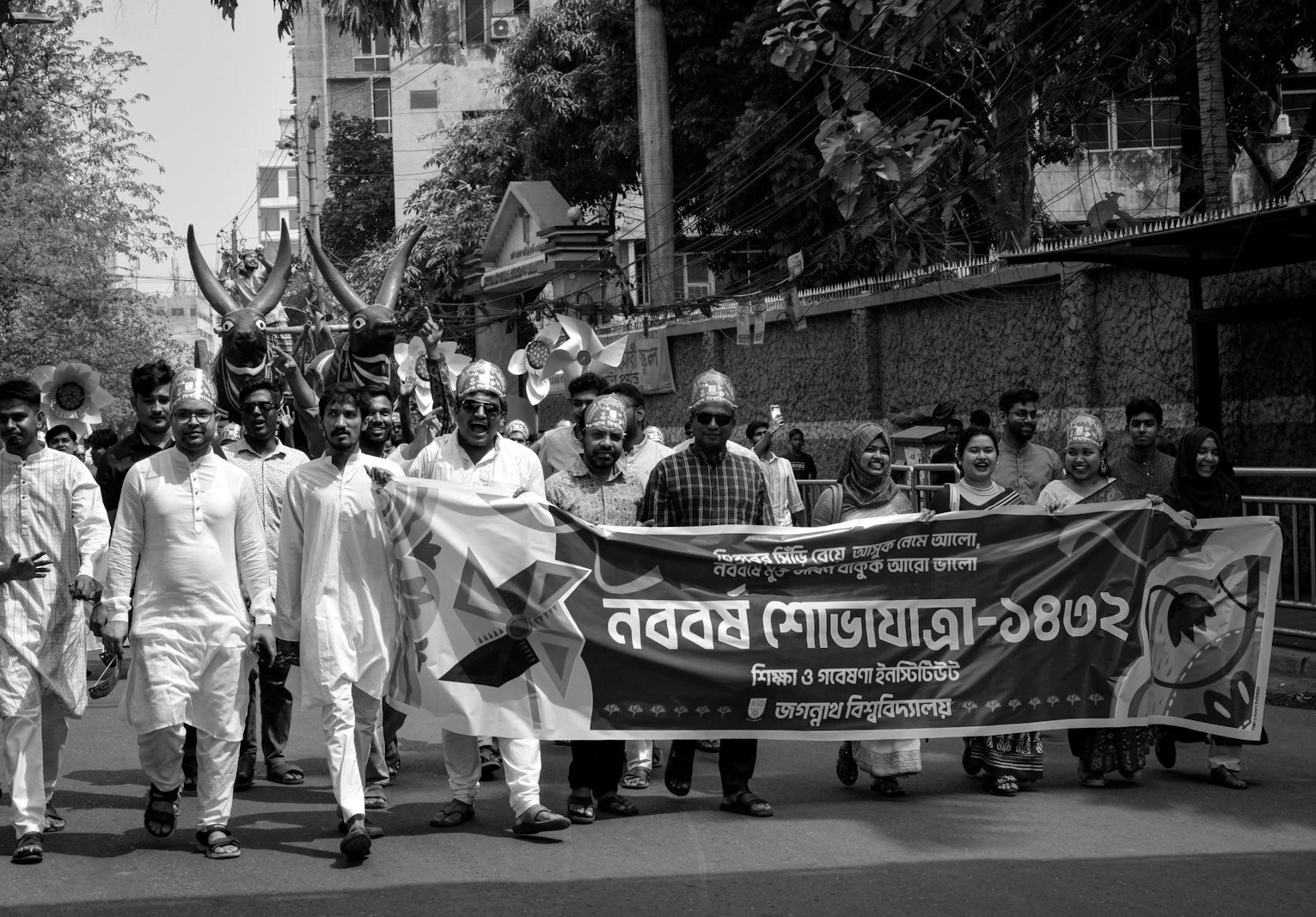
Summary: The government approved 28 holiday days for 2026, nine of which fell on the Friday and Saturday weekend, and then added days during the year, including an extended Eid-ul-Fitr break, an extra Durga Puja day and 7 November as a new annual public holiday. Private employers must give at least 13 paid festival holidays a year under section 118 of the Labour Act, plus a weekly holiday, and must compensate any worker asked to work on one.
Key point: The government holiday list is not, by itself, the legal minimum for a private employer. The minimum is the Labour Act: a weekly holiday, 13 paid festival holidays whose dates the employer fixes, and an alternative day off plus two days' compensatory wages for any worker who works on a festival holiday.
At a glance
28 days in 2026
The Advisory Council approved 28 holiday days for 2026 on 6 November 2025, nine of them on the weekend.
13 festival days
Act No 43 of 2026 raised paid festival holidays under section 118(1) of the Labour Act from eleven to 13.
Weekly holiday
One day a week in factories, one and a half days in shops and commercial establishments, with no wage deduction.
Working a holiday
A worker who works a festival holiday is owed one alternative day off and two days' compensatory wages.
2027 list pending
The 2027 list had not been published by 25 October 2026; it is approved each year, usually in October or November.
Table of Contents
The 2026 list of public holidays in Bangladesh
The 2026 calendar was approved by the interim government's Advisory Council, chaired by Chief Adviser Muhammad Yunus, on 6 November 2025. It provided 28 holiday days, combining general holidays and holidays declared by executive order, and nine of those days fell on the Friday and Saturday weekend.[6] [7] The Ministry of Public Administration then issued the formal notification, which also confirmed that holidays tied to the sighting of the moon may shift, and that offices governed by their own laws on working hours may declare holidays under their own rules.[5]
The 2024 calendar had 22 holidays and the 2025 calendar 26, so the number of public holidays in Bangladesh has risen steadily.[12] [11]
General holidays and executive-order holidays
General holidays cover the national days and the principal religious festivals: Shaheed Day and International Mother Language Day on 21 February, Independence and National Day on 26 March, May Day, Mass Uprising Day on 5 August, Victory Day on 16 December, and the main days of Eid-ul-Fitr, Eid-ul-Azha, Eid-e-Miladunnabi, Buddha Purnima, Janmashtami, Durga Puja and Christmas. Executive-order holidays extend the Eid breaks and add Shab-e-Barat, Shab-e-Qadr, Ashura and Mahanabami.[5] Government employees may also take optional holidays under the declared rules; in the 2025 list that meant up to three optional days for religious occasions and two for ethnic minority festivals.[5] [11]
Changes made during 2026
The elected government that took office in February 2026 adjusted the calendar more than once. On 5 March 2026 the cabinet, chaired by Prime Minister Tarique Rahman, declared 18 March a holiday so that Eid-ul-Fitr became a seven-day break from 17 to 23 March, against the five days from 19 to 23 March originally notified.[8]
On 5 October 2026 the cabinet extended the Durga Puja break to five days, 20 to 24 October, by adding 22 October and keeping offices open on Saturday 17 October; the change was notified on 7 October.[9] [10] The same cabinet meeting made 7 November, National Revolution and Solidarity Day, a public holiday to be observed every year.[10] In 2026 it falls on a Saturday.
Moon-dependent dates in the table can move by a day.
| Occasion | 2026 date(s) | Note |
|---|---|---|
| Shab-e-Barat | 4 February (Wed) | Moon-dependent |
| Shaheed Day and International Mother Language Day | 21 February (Sat) | Falls on the weekend |
| Shab-e-Qadr and Eid-ul-Fitr | 17 to 23 March | 18 March added by the cabinet on 5 March 2026, giving seven days |
| Independence and National Day | 26 March (Thu) | National day |
| Pahela Baishakh | 14 April (Tue) | Bangla New Year |
| May Day and Buddha Purnima | 1 May (Fri) | Falls on the weekend |
| Eid-ul-Azha | 26 to 31 May | Eid on 28 May, with days before and after |
| Ashura | 26 June (Fri) | Moon-dependent |
| Mass Uprising Day | 5 August (Wed) | National day |
| Eid-e-Miladunnabi | 26 August (Wed) | Moon-dependent |
| Janmashtami | 4 September (Fri) | Falls on the weekend |
| Durga Puja | 20 to 22 October | 22 October added; offices open Saturday 17 October |
| National Revolution and Solidarity Day | 7 November (Sat) | Made an annual public holiday in October 2026 |
| Victory Day | 16 December (Wed) | National day |
| Christmas Day | 25 December (Fri) | Falls on the weekend |
Do private employers have to follow the government list?
Not as such. The notification governs government offices. Banks and most private businesses close on the general holidays in practice, and public-sector Eid and Puja breaks shape what staff expect. But for private workplaces the enforceable minimum behind public holidays in Bangladesh for a private employer is the Labour Act, which works in festival holidays rather than public holidays, and leaves the employer to choose the dates.[1] [5]
Festival holidays: 13 days after the amendment
Section 118(1) of the Labour Act gives every worker festival holidays with wages. The Bangladesh Labour (Amendment) Act 2026, Act No 43 of 2026 dated 10 April 2026, replaced the word "eleven" in that subsection with "13 (thirteen)".[2] The increase first came through the 2025 Ordinance and was carried into the Act, as our analysis of the Labour Act amendment 2025 explains. Any service rules, offer letters or HR handbooks that still say eleven festival holidays are out of date.
Festival holidays sit alongside, not inside, the other leave entitlements. A worker also keeps ten days' casual leave, fourteen days' sick leave and annual leave at one day for every eighteen days worked.[3]
Choosing the 13 days
Under section 118(2) the days and dates of festival holidays are fixed by the employer in the manner the Labour Rules prescribe.[3] Most employers give the bulk of the 13 days to the two Eids, then add Pahela Baishakh, the national days and festivals such as Durga Puja or Christmas. Publish the calendar at the start of the year and keep the notice on file for inspectors.
The 13 days are a floor; many Dhaka offices match the full government list. Observing fewer than 13 paid festival days, or treating one as unpaid, is a breach. Our labour law compliance checklist covers the registers and notices that go with the holiday calendar.
Weekly holidays and compensatory holidays
Section 103 of the Labour Act gives an adult worker one day's weekly holiday in a factory or industrial establishment, one and a half days in a shop or commercial establishment, and 24 consecutive hours in a road transport service, with no deduction from wages.[1] Most Dhaka offices use Friday and Saturday, mirroring government offices, but the Act does not fix the day.
Where an exemption deprives a worker of a weekly holiday, section 104 requires an equal number of compensatory holidays. Rule 101 of the Labour Rules 2015 requires those days to be given within three working days, bars more than ten consecutive days without a weekly holiday and requires payment for any compensatory holidays still owed when employment ends.[4] Track them in the leave register.
A 2018 proviso to section 104 lets workers, by their own choice and after discussion with the collective bargaining agent or participation committee, work a weekly holiday and add that day to a festival holiday, with no overtime payable for the day worked.[1] Record the workers' consent in writing.
Working on a holiday: what the worker is owed
A worker may be required to work on a festival holiday, but section 118(3) attaches a price: one alternative holiday and two days' compensatory wages.[1] Paying the wages without granting the alternative day, or the reverse, does not satisfy the section.
Work on a weekly holiday is different. It is governed by the compensatory holiday rule in section 104, and any hours that take the worker beyond the daily or weekly limits are overtime, paid at twice the ordinary rate of basic wage and dearness allowance under section 108.[1] Our guide to working hours and overtime in Bangladesh sets out the limits.
A person employed mainly in a managerial or administrative capacity may fall outside the definition of worker, leaving the contract to set holiday terms. The 2026 amendment widened that definition, so check job descriptions, not titles. Our guide to employment contracts in Bangladesh explains how to draft holiday clauses for both groups.

EPZ, zones and other regimes
Enterprises in export processing zones run on the Bangladesh EPZ Labour Act 2019. The EPZ Act still provides eleven days' festival holiday a year, so a group with one plant inside a zone and one outside now runs two different holiday counts.[13] A single group holiday policy will be wrong for one of them unless it gives 13 days everywhere.
For foreign employers comparing markets, public holidays in Bangladesh work differently. Singapore's Employment Act gives 11 named paid public holidays and, by default, an extra day's pay to an employee who works on one.[14] Bangladesh gives 13 festival holidays whose dates the employer chooses, and a heavier price for working one: an alternative day plus two days' wages.
Planning for 2027 public holidays in Bangladesh
As at 25 October 2026 the government had not published the 2027 list. The calendar is approved each year, usually in October or November: the 2024 list was approved on 23 October 2023, the 2025 list on 17 October 2024 and the 2026 list on 6 November 2025.[12] [11] [6] Until the 2027 notification appears, treat any date for public holidays in Bangladesh next year as provisional.
Two points are already settled. Private employers will owe 13 paid festival holidays in 2027 under section 118, whatever the government list says.[2] And 7 November is now to be a public holiday every year following the October 2026 cabinet decision.[10] Islamic holidays move about eleven days earlier each year and depend on the moon, so build your 2027 budget around 13 paid festival days and confirm exact dates once the notification is out.
Confirm who is a worker
Check job descriptions against the amended definition of worker to see who the Labour Act holiday rules cover.
Set the 13 festival days
Allocate at least 13 paid festival holidays for the year, usually led by the two Eids, and fix the dates in writing.
Align with the government list
Decide which additional government holidays you will observe and how you will handle moon-dependent dates.
Fix the weekly holiday
Record the weekly holiday for each site and category of worker, and the roster for shift workers.
Plan holiday working
Pre-approve who may work festival or weekly holidays and how alternative days and compensatory wages will be given.
Update documents
Bring contracts, service rules and handbooks up to 13 festival holidays, and resubmit service rules where needed.
Keep the registers
Record holidays given, days worked and compensatory days owed, and settle any balance at exit.
Holiday mistakes to avoid
Old templates. Contracts and service rules still showing eleven festival holidays.
No written notice. Copying the government list without a festival holiday notice leaves no record that the 13 statutory days were given.
Half-compensating holiday work. Paying overtime for a festival day worked, without the alternative day and two days' compensatory wages.
Ignoring the EPZ split. Applying one count across zone and non-zone sites.

How TRW helps employers get holidays right
For foreign companies without a local entity, TRW offers an employer of record service: TRW employs staff in Bangladesh on the client's behalf, runs payroll and statutory filings, and handles contracts, work permits and terminations under Bangladesh law, including a compliant holiday calendar. For companies with their own entity, we review service rules, holiday notices and leave registers. See our employment and labour practice and our guide to employee benefits in Bangladesh.
Frequently asked questions
How many public holidays are there in Bangladesh in 2026?
How many festival holidays must a private employer give?
At least 13 paid festival holidays a year under section 118(1) of the Labour Act, as amended by Act No 43 of 2026.[2]
Are private companies bound by the government holiday list?
Who decides the dates of festival holidays?
The employer, in the manner the Labour Rules prescribe, under section 118(2).[3]
What is a worker owed for working on a festival holiday?
One alternative holiday and two days' compensatory wages under section 118(3).[1]
How long is the weekly holiday?
One day in factories and industrial establishments, one and a half days in shops and commercial establishments, and 24 consecutive hours in road transport, without wage deduction.[1]
When must a compensatory holiday be given?
Within three working days under rule 101 of the Labour Rules 2015, and any unused compensatory holidays must be paid on termination.[4]
Do EPZ workers get 13 festival holidays?
No. The EPZ Labour Act 2019 still provides eleven days' festival holiday.[13]
Has the 2027 public holiday list been announced?
Is 7 November now a public holiday?
Yes. In October 2026 the cabinet made National Revolution and Solidarity Day on 7 November a public holiday to be observed every year.[10]
Source register
Primary legal and regulatory sources
Materials checked on 25 October 2026. Confirm the current official text before relying on any provision.
- Bangladesh Labour Act 2006 (Act No 42 of 2006), consolidated text with 2026 amendments, sections 103, 104, 108 and 118 — Laws of Bangladesh
- Bangladesh Labour (Amendment) Act 2026 (Act No 43 of 2026), section 28 amending section 118(1) — Laws of Bangladesh
- Bangladesh Labour Act 2006, English text as amended up to 2018, sections 115 to 118
- Bangladesh Labour Rules 2015, unofficial English translation, rule 101
- The Daily Star, November 2025 — Govt announces official list of public holidays for 2026
- The Business Standard, 6 November 2025 — 28 public holidays for 2026 approved
- Prothom Alo English, 6 November 2025 — Govt holidays: 28 days in 2026
- Dhaka Tribune, 5 March 2026 — Govt approves 7-day Eid holiday
- Jagonews24, 7 October 2026 — 5-day Durga Puja holiday notified
- bdnews24.com, 5 October 2026 — Offices open Saturday before five-day Puja holiday
- The Daily Observer, 17 October 2024 — Govt approves 26 public holidays for 2025
- Prothom Alo English, 23 October 2023 — 22 public holidays next year, two on Fridays
- Bangladesh EPZ Labour Act 2019 (Act No II of 2019), English version
- Ministry of Manpower, Singapore — Public holidays entitlement and pay
Related TRW assistance
Move from information to a defined next step
TRW sets holiday calendars, reviews service rules and leave registers, and runs payroll and employer of record arrangements for teams in Bangladesh. Explore our employment and labour practice, contact our Dhaka lawyers or book a consultation.