
TRW Insight / Bangladesh
Getting bail in a Bangladeshi court is only the start: the accused and a surety must sign a bail bond, the jaminnama, before release. This plain-English guide walks through the printed form, the surety's risks, the release and warrant recall orders, and what happens if a date is missed.
Bail bond in Bangladesh: what the jaminnama is and how it works
A bail bond in Bangladesh is a signed promise to come back to court. When a judge or magistrate grants bail, the accused person is not free yet. First, a one-page form called the jaminnama (জামিননামা) must be signed by the accused and, usually, by a surety (jamindar, জামিনদার): a person who promises the court that the accused will attend. Only then does the court let the person go, send a release order to the jail and tell the police to send back any warrants.
This guide is for families, employers, foreign nationals and anyone suddenly dealing with bail in a Bangladeshi criminal court. In plain words and with made-up examples, it explains who signs, what the surety risks, how release and the warrant recall work, and what happens if a date is missed. It also walks through the two printed forms people sign in Dhaka courts, line by line.
Bail bond, step by step.
The bail bond in Bangladesh: from bail order to walking free.
Suppose Karim gets bail. He is not free yet: a bail bond must be signed first.
Section 499Bail is the court's permission. The bond is the written promise that makes release happen.
Karim signs a one-page form promising to attend court on every date.
Form XLIIThe printed Bangla form follows Schedule V, Form No. 42 of the Code of Criminal Procedure.
His uncle signs too, promising Karim will come, and the lawyer identifies him.
The surety brings an NID card. If Karim disappears, the uncle can be made to pay.
The bond amount is a promise to pay only if Karim breaks his word.
The court may instead allow a cash or Government promissory note deposit under section 513.
If Karim is in jail, the court sends a release order to the jail.
Section 500By August 2026, the e-bail bond sent the papers to the jail electronically in 28 districts.
The court tells the police station to send back any warrants in that case.
Section 75(2)A warrant stays alive until the court cancels it. The recall covers that one case only.
Karim must attend every hearing. Missing one can mean arrest and forfeiture.
Six monthsA person who cannot pay a forfeited bond can be sent to the civil jail for up to six months.
Bail, bond, release order, recall, then every date: keep copies of all four papers.
The numbers and rules that matter.
Summary: Bail is the court's order allowing release. The bail bond is the paper that makes the release happen. Under sections 496 to 502 of the Code of Criminal Procedure, 1898, the accused and any sureties sign a bond for an amount the court fixes, promising attendance on every date. Nothing is paid upfront unless the court allows a cash deposit. If the accused does not attend, the court can have him arrested, cancel bail and order the accused and the surety to pay the bond amount.
Key point: Getting bail is only half the job. Leave court with the signed bond accepted, the release order sent to the jail, a copy of the warrant recall order for the police station, and the next date written down.
At a glance
Order and paper
Bail is the court's permission to release; the bond is the signed promise that makes release possible.
A promise, not a payment
The bond names a sum of taka that becomes payable only if the accused breaks the promise to attend.
The surety vouches
A surety signs the same promise for the accused and can be made to pay if the accused disappears.
Release order to jail
If the accused is in jail, the court sends a release order to the jail once the bond is signed.
Warrants called back
A warrant stays in force until the court cancels it, so the recall order to the police station matters.
Every date counts
Missing a date can bring arrest, cancelled bail and forfeiture of the bond amount.
Table of Contents
Bail and the bail bond: two different things
People often use "bail" and "bail bond" as if they mean the same thing. They do not. Bail is a decision by the police or a court that an accused person may be released while the case goes on. The bond is the written promise that turns that decision into actual release.
The Code of Criminal Procedure, 1898 (the CrPC, Bangladesh's main criminal procedure law) makes this clear. Section 499 says that before anyone is released on bail, a bond "for such sum of money as the police-officer or Court ... thinks sufficient shall be executed by such person" and, where bail is with sureties, by "one or more sufficient sureties". The promise is to attend "at the time and place mentioned in the bond" and to keep attending until the court says otherwise.[4]
Section 500 then says that "as soon as the bond has been executed", the person shall be released, and if he is in jail, the court must send an order of release to the jail.[1] So the order never changes: bail order first, bond second, release third.
A simple example
Suppose Karim is arrested after a fight at a market and taken to court the next day. The magistrate grants bail. Karim still sits in the court lock-up. His lawyer fills in the form, Karim signs it, and his uncle signs as surety. The court accepts it. Only now can Karim walk out. Had he already been sent to jail, he would wait there until the court's release order reached the jail.
Words you will hear
- Jamin (জামিন): bail. Jaminnama (জামিননামা): the bail bond form. Jamindar (জামিনদার): the surety.
- Hazira (হাজিরা): attendance on each court date.
- Okalatnama (ওকালতনামা): the paper appointing a lawyer.
- Parwana (পরোয়ানা): a warrant, the court's written order to arrest someone.
The law behind it: CrPC sections and forms
Almost all the rules sit in two chapters of the CrPC: Chapter XXXIX ("Of Bail"), sections 496 to 502, and Chapter XLII ("Provisions as to Bonds"), sections 513 to 516. The printed forms come from Schedule V, which section 555 says may be used "with such variation as the circumstances of each case require".[1]
Bailable and non-bailable offences
Whether an offence is bailable is shown in column 5 of Schedule II, the table of offences in the CrPC.[2] For a bailable offence, section 496 says a person "prepared ... to give bail ... shall be released on bail", and the court may instead release him on a bond without sureties.[1]
For a non-bailable offence, section 497 gives the court a choice. The person "may be released on bail", but not if there are reasonable grounds to believe he is guilty of an offence punishable with death or imprisonment for life. Even then, the court may release a person under sixteen, a woman, or a sick or infirm person. If the court grants bail under section 497, it must write down its reasons.[5]
The 2026 changes
The Code of Criminal Procedure (Amendment) Act, 2026 (Act No. XI of 2026), dated 10 April 2026, changed the bail chapter. It replaced two 2025 ordinances that first made these changes, so the new rules count as in force from 10 August 2025.
New section 498(2) lets any court releasing an accused on bail impose reasonable and fair conditions "to prevent his abscondence or to ensure his good behaviour".[3] New section 499(3) lets the bond be submitted in person, through a pleader, or "through online system, as permitted by the Court", subject to checking the sureties' identity and eligibility through their National Identification Number (NID) or other means.[4]
Surrender and bail: how a person with a warrant gets to court
Many people meet the bail bond because they learn there is a case, or a warrant, against them. The safest route is usually to surrender: to go to court voluntarily, with a lawyer, and ask for bail. Sections 496 and 497 both apply to a person who "appears or is brought before a Court", so a person who walks in is treated like one brought in by police.[1]
Suppose Karim hears that a complaint case has been filed against him over a business debt and a warrant has been issued. His lawyer checks the case number, signs an okalatnama and prepares a bail petition. On the day, Karim stands before the magistrate and his lawyer explains that he came on his own and will attend every date. If bail is granted, the bond is signed that day. That is why the Dhaka warrant recall form begins: the accused "surrendered in my court ... and has been released on bail".
Warrants that already allow bail
Under section 76, a court issuing a warrant may write on it that if the person signs a bond with sufficient sureties, the officer must release him. The endorsement states the number of sureties, the amounts and when he must attend.[1] Schedule V has a model bond for a person arrested under a warrant: Form III, "Bond and bail-bond after arrest under a warrant", which refers to section 86.[2]
If a person is arrested far from the issuing court and the offence is non-bailable or the warrant has no such endorsement, section 86 lets a local Sessions Judge, Metropolitan Sessions Judge, Chief Judicial Magistrate, Chief Metropolitan Magistrate or specially empowered first class magistrate grant interim bail and direct him to appear before that court by a fixed date.[1]
If bail is refused, the route is a fresh application to a higher court. TRW's guides to the bail process in Bangladesh, bail in the High Court Division and the anticipatory bail process cover those steps. This article starts once bail is granted.
From bail order to release, step by step
Once the judge says "bail granted", a set of small tasks begins. Most can be done the same day if the papers are ready and the surety is in court. Sections 499 and 500 of the CrPC set the order.[1]
Bail is granted
The judge or magistrate makes the bail order and fixes the bond amount, the number of sureties and any conditions.
Fill in the jaminnama
The lawyer writes the accused's name, address, offence, court and amounts on the bail bond exactly as in the case record.
Accused and surety sign
Both sign the bond. The surety brings an NID card and the advocate notes that he identifies the surety.
Court accepts the bond
The court checks and accepts the bond, or allows a cash or Government promissory note deposit instead.
Release and recall orders
If the accused is in jail, the court sends a release order to the jail; any warrants in the case are recalled from the police station.
Write down the next date
The accused must attend every date until the court says otherwise, so the next hazira date is noted before leaving.
When the accused is already in jail
Section 500(1) requires the court to "issue an order of release to the officer in charge of the jail", who "on receipt of the order shall release him".[1] Schedule V Form XLIII, "Warrant to discharge a person imprisoned on failure to give security", is the model order. It tells the jail superintendent to discharge the person "unless he is liable to be detained for some other matter".[2]
Section 500(2) says the same: release in one case does not free a person held for another.[1] If Karim has a second case with a warrant, the jail can keep him until he also gets bail there. Check for other cases before promising anyone a release date.
The e-bail bond
Bangladesh is moving the bail bond online. The government tested an e-bail bond system in Narayanganj from 15 October 2025 and extended it to eight more districts on 21 January 2026.[11] On 13 August 2026 it reached 12 more districts, 28 in total, with all 64 planned; about 120,000 bonds had already been submitted through it in the first 16 districts.[10]
The lawyer submits the bond online and the papers go to the jail electronically. One press report describes a release two days after bail where the papers had to reach a jail in another district, against five to seven days on paper. It also reports server problems, OTP delays, and a release held up because a name did not match the NID record.[9] There is no fixed legal time limit for the whole chain, so plan for a day or two, and longer where the process is still on paper.
The surety (jamindar): who can stand and what they risk
By signing, the surety tells the court: "I know this person, and I promise he will come to every date. If he does not, I will pay." Section 499 calls for "sufficient sureties", and section 501 lets the court order new ones if the sureties turn out to be, or become, insufficient.[1]
Who can be a surety
The CrPC does not list who may stand surety; it only requires them to be "sufficient".[4] In practice courts want an adult with a fixed address, who can be identified and who could pay if needed. The printed note at the foot of the Dhaka form reads "স্থানীয় জামিনদার উপযুক্ত" (the local surety is fit), so local sureties are favoured. On the copy we saw, the surety was a relative from the same area.
What the court checks
- Identity: section 499(3) refers to verifying sureties through their NID "or any other appropriate means".[4] Bring the NID card.
- Identification by the advocate: on the form we saw, the lawyer signed a note that the surety signed "in my presence" and "I identify him" (আমি তাকে সনাক্ত করিলাম).
- Fitness: whether the surety is a real, local and solvent person.
Identification is not a formality. The press has reported a Dhaka cheque dishonour case in which, after the accused missed a date and her bail was cancelled, a stand-in was brought to court pretending to be her. The stand-in was caught, and a criminal case was filed against those said to be involved.[13]
What the surety risks
If the accused misses a date and the bond is forfeited, the court may call on the surety to pay or show cause. If he does neither, the court can attach and sell his movable property and, if that fails, send him to the civil jail for up to six months.[6] Schedule V has forms for each stage: Form XLV (notice to surety), Form XLVII (warrant of attachment against a surety) and Form XLVIII (commitment of the surety to the civil jail).[2]
How a surety gets out
Under section 502, a surety may apply to a magistrate to discharge the bond. The magistrate issues a warrant to bring the accused in. When the accused appears or surrenders, the bond is discharged as to that surety and the accused must find other sufficient sureties, or may be committed to custody.[1] Until then, the surety stays bound. If a surety dies before forfeiture, his estate is discharged.[6] If a surety dies or becomes insolvent, section 514A lets the court order fresh security.[1]
How much is a bail bond? Amounts and cash deposits
There is no fixed table of amounts. Section 498(1) says the amount of every bond "shall be fixed with due regard to the circumstances of the case, and shall not be excessive".[1] On the form we saw, the accused's and the surety's amounts were each written in by hand.
The key point for families: a bail bond is a promise to pay, not money paid upfront. The signer is bound "to forfeit to Government" the sum "in case of my making default".[2] Nobody hands that sum over on the day. It becomes payable only if the court orders forfeiture.
Section 513 is the exception. The court may, except for a bond for good behaviour, allow a deposit of money or Government promissory notes instead of a bond.[1] This can help someone without a local surety, such as a foreign national, but it is the court's choice. If the amount is too high, the High Court Division or Court of Session may reduce bail required by a police officer or magistrate.[1] Lawyers' fees and stamps are separate and vary, so ask for a quote before the hearing.
Reading the bail bond line by line
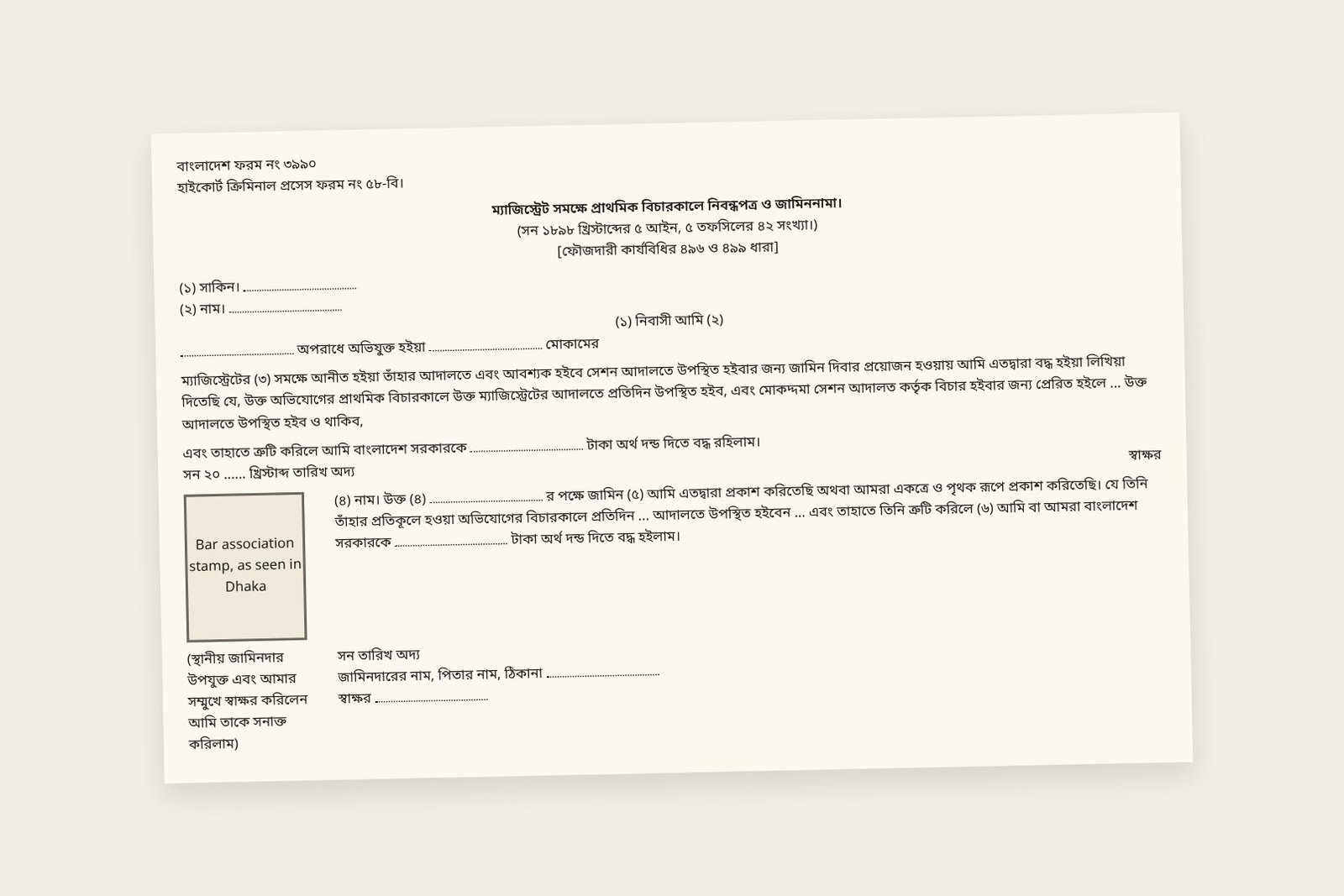
The form most often used in Dhaka courts is a single sheet of white paper, printed in Bangla, with blanks for names and amounts. At the top left it carries the printed references "বাংলাদেশ ফরম নং ৩৯৯০" (Bangladesh Form No. 3990) and "হাইকোর্ট ক্রিমিনাল প্রসেস ফরম নং ৫৮-বি" (High Court Criminal Process Form No. 58-B), and a serial number. It states its source: Act V of 1898, Schedule V, No. 42, and CrPC sections 496 and 499.
হাইকোর্ট ক্রিমিনাল প্রসেস ফরম নং ৫৮-বি।
ভারপ্রাপ্ত কর্মকর্তা
থানা
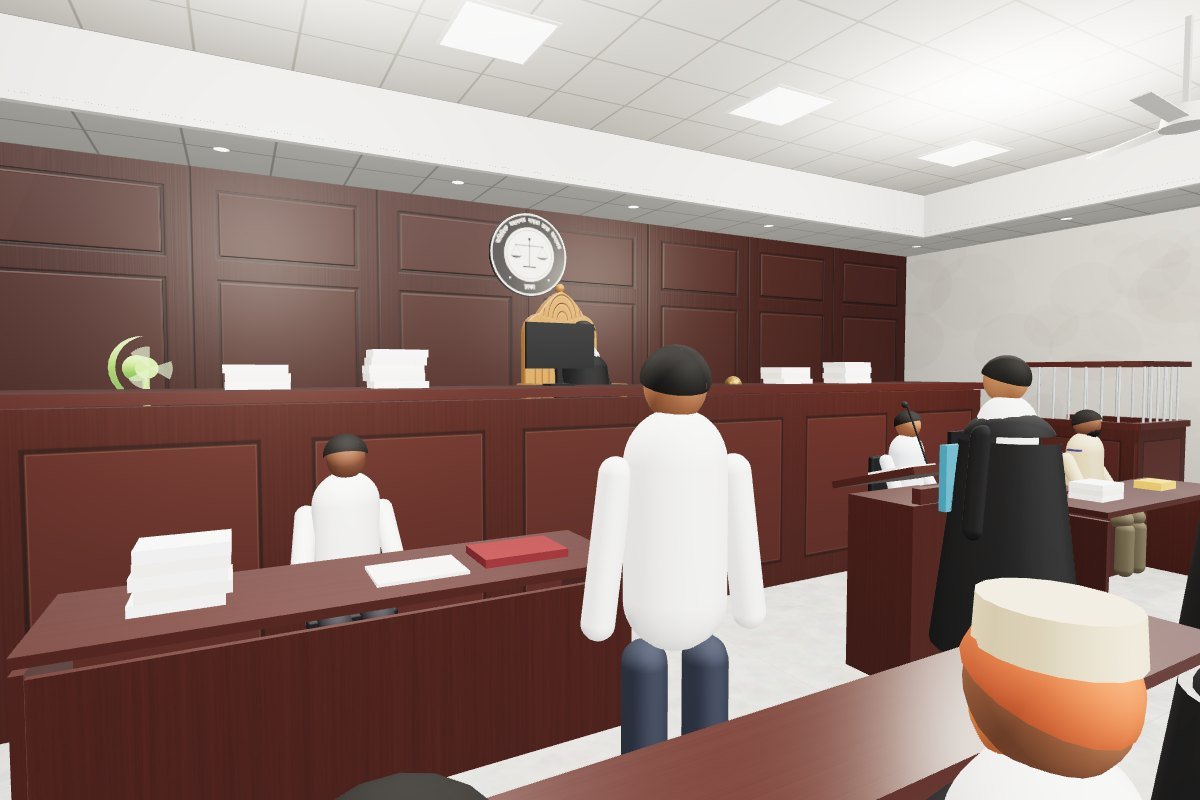
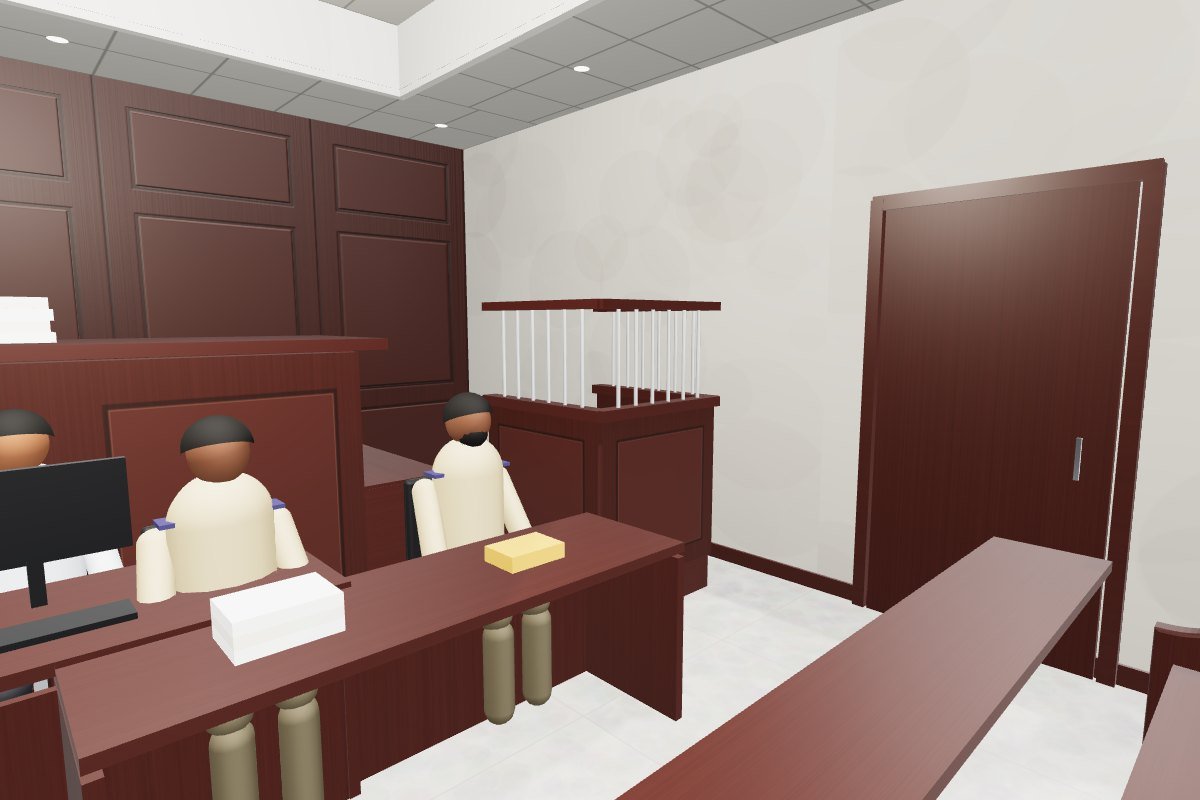
In the official CrPC text, Schedule V Form XLII is headed "Bond and bail-bond on a preliminary inquiry before a Magistrate" and cites sections 496 and 499.[2] The Bangla title matches: "ম্যাজিস্ট্রেট সমক্ষে প্রাথমিক বিচারকালে নিবন্ধপত্র ও জামিননামা". The copy we saw was used before an Additional Metropolitan Sessions Judge in Dhaka, which section 555's allowance for variation permits.[1] To picture the room, see TRW's 3D model of an Additional Metropolitan Sessions Judge court in Dhaka.
Part one: the accused's own bond
- (১) সাকিন / নিবাসী (residence) and (২) নাম (name): must match the FIR, complaint or warrant exactly.
- "...অপরাধে অভিযুক্ত হইয়া" (being charged with the offence of ...): the offence or sections.
- "...ম্যাজিস্ট্রেটের সমক্ষে আনীত হইয়া" (brought before the magistrate of ...): the court; footnote (৩) says to adapt it "as the case may be".
- "প্রতিদিন উপস্থিত হইব" (I will attend every day): the core promise.
- "সেশন আদালত কর্তৃক বিচার হইবার জন্য প্রেরিত হইলে" (if the case is sent to the Court of Session for trial): the promise covers appearing there too.
- "বাংলাদেশ সরকারকে ........ টাকা অর্থ দন্ড দিতে বদ্ধ রহিলাম" (I bind myself to forfeit to the Government of Bangladesh ... taka): the amount.
- "সন ২০ ... খ্রিস্টাব্দ তারিখ অদ্য" (dated this day) and the accused's signature.
This follows the English Form XLII: the accused binds himself to attend "on every day of the preliminary inquiry" and, if sent to the Court of Session, to appear "when called upon to answer the charge".[2]
Part two: the surety's bond
- (৪) নাম (name): the accused's name, now in the surety's promise.
- "আমরা একত্রে ও পৃথক রূপে" (we jointly and severally): several sureties, each liable for the full promise.
- "প্রতিদিন ... আদালতে উপস্থিত হইবেন" (he shall attend court every day): the surety promises the accused's attendance.
- "আমি বা আমরা ... টাকা অর্থ দন্ড দিতে বদ্ধ হইলাম" (I or we bind ourselves to forfeit ... taka): the surety's own amount.
- Surety details: date, name, father's name and address.
"Jointly and severally" is the phrase used in the official form.[2] In plain words, with two sureties each one can be held to the whole promise.
The margin note and the stamp
At the bottom is the advocate's handwritten note: "স্থানীয় জামিনদার উপযুক্ত এবং আমার সম্মুখে স্বাক্ষর করিলেন আমি তাকে সনাক্ত করিলাম" (the local surety is fit and signed in my presence; I identify him). The footer carries a printing order reference. On the copy we saw, a Tk 100 adhesive stamp issued by the Dhaka Bar Association, showing the advocate's member number, name and a QR code, was fixed to the bond. That is Dhaka practice, not a CrPC requirement. The Dhaka Bar began issuing QR-coded digital okalatnamas at the end of 2019 to stop forgery.[12]
The warrant recall form (পরোয়ানা ফেরত)
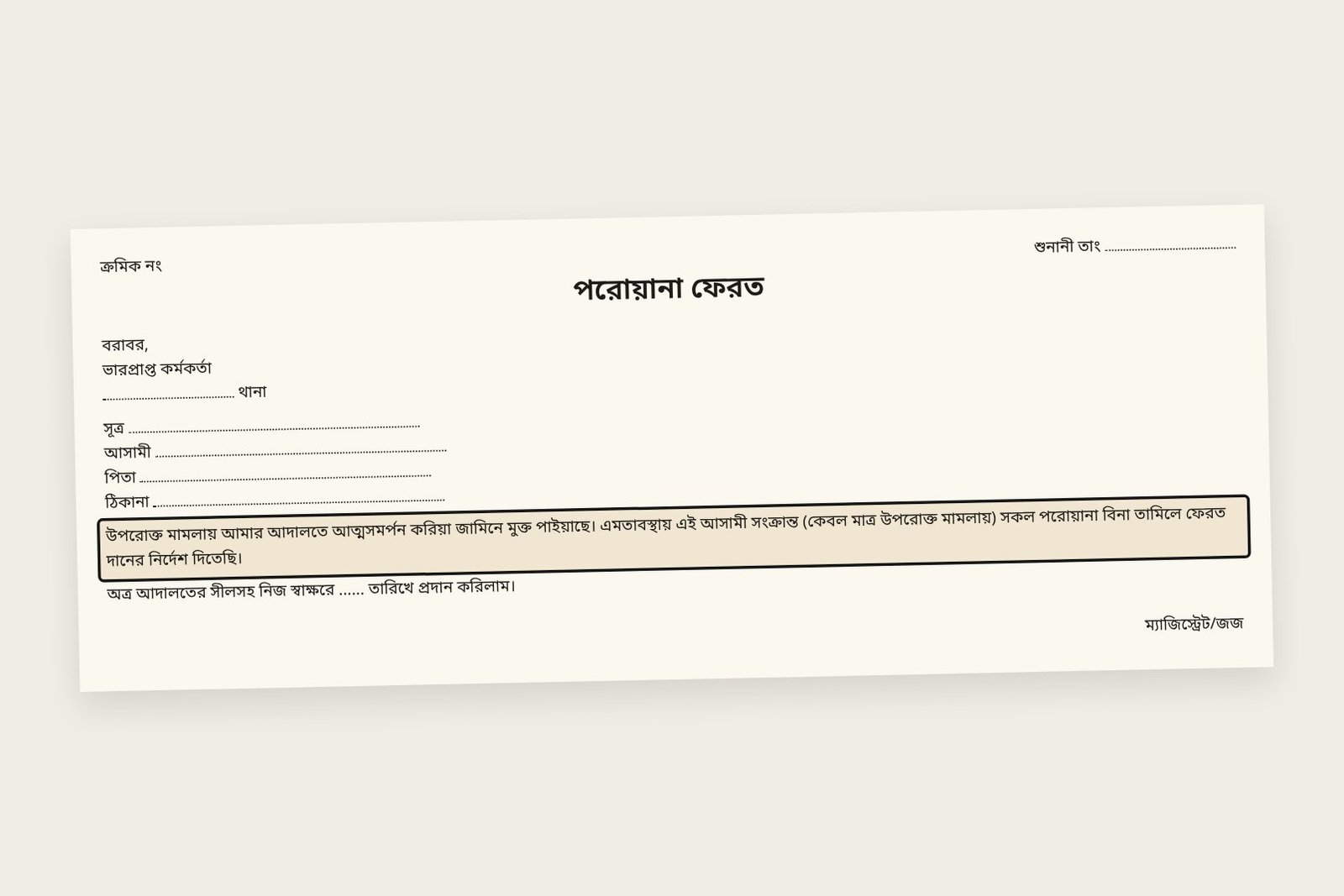
The second form, headed "পরোয়ানা ফেরত" (return of warrant), has a hearing date (শুনানী তাং) and a serial number. It is addressed "বরাবর, ভারপ্রাপ্ত কর্মকর্তা ... থানা" (to the officer-in-charge, ... police station) and lists সূত্র (reference: case number), আসামী (accused, with age), পিতা (father) and ঠিকানা (address).
It says the accused "surrendered in my court in the above case and has been released on bail", and directs that "all warrants against this accused (in the above case only) be returned unexecuted", under the signature and seal of the magistrate or judge. We found no matching form in Schedule V; it is a court-printed form used to cancel the court's own warrants.
Why the warrant recall order matters
A warrant does not die on its own. Section 75(2) says every warrant of arrest "shall remain in force until it is cancelled by the Court which issued it, or until it is executed".[7] If the police station still holds it, officers can act on it even after bail. The recall tells the officer-in-charge to return it "বিনা তামিলে" (unexecuted).
Note the words "কেবল মাত্র উপরোক্ত মামলায়" (in the above case only). If Karim has two cases and gets bail in one, the recall does nothing for the other. Keep a copy or photo of the recall, the bail order and the accepted bond; they help if police act before the recall reaches the station. TRW's guide to the warrant recall petition covers cases where no recall was issued.
The four papers in a bail file compared
A bail file usually ends with four court papers. Each does a different job and goes to a different place.[1] Keep them together.
| Paper | What it does | Who issues or signs it | Where it goes | Legal basis |
|---|---|---|---|---|
| Bail order | Allows release and fixes the amount, sureties and any conditions | Judge or magistrate | Order sheet in the case record | CrPC sections 496, 497 and 498 |
| Bail bond (jaminnama) | Promise to attend every date, with a sum forfeited on default | Accused and surety, identified by the advocate | Filed in the court record | Section 499; Schedule V Form XLII |
| Release order | Tells the jail to release the accused unless held for another matter | The court admitting to bail | Jail superintendent | Section 500; Schedule V Form XLIII |
| Warrant recall (parwana ferot) | Directs the police to return warrants in that case unexecuted | Judge or magistrate | Officer-in-charge of the police station | Section 75(2): a warrant lasts until cancelled or executed |
After release: hazira, conditions and missed dates
The bail bond is a promise to attend "until otherwise directed" by the court.[4] That means hazira on every date. Bail does not end the case; it only lets the accused wait outside jail. TRW's overview of the criminal case process in Bangladesh shows how long that can take.
Read the bail order for conditions. Since the 2026 amendment (in force from 10 August 2025), section 498(2) lets courts impose "reasonable and fair conditions", for example on travel or contact with witnesses.[3] Sometimes attendance is excused. Section 205 lets a magistrate who issues a summons allow appearance by pleader.[1] New section 540A(3) lets a judge or magistrate excuse an accused on bail who has an advocate during investigation, until the date to hear the investigation report.[8] Without such an order, come in person.
What happens if a date is missed
Suppose Karim falls ill and misses a date without telling his lawyer. Several things can follow:
- Arrest and cancelled bail: for a non-bailable offence, section 497(5) says the High Court Division, the Court of Session or the releasing court may have him arrested and committed to custody.[5]
- Forfeiture: the court may find the bond forfeited and call on Karim and his surety to pay.[6]
- Proclamation and attachment: if he hides, sections 87 and 88 let the court publish a proclamation requiring him to appear at least 30 days later, and attach his property.[1]
- Trial in his absence: section 339B(2) lets the court try an accused who absconds after release on bail.[1]
Act fast. The usual course is to return to court with the lawyer, explain the absence with proof such as a medical certificate, and ask for the warrant to be recalled and bail continued. The court decides. TRW's guide to bail cancellation covers the grounds courts use.
Forfeiture: what the court can do
Forfeiture means the court decides the promise has been broken and the stated sum is now owed. Section 514 sets the procedure.[6]
- Proof: the court must be satisfied the bond is forfeited and record the grounds.
- Notice: it may call on anyone bound to pay or show cause.
- Attachment and sale: if neither happens, it may issue a warrant to attach and sell movable property.[6] Schedule V model warrants (Forms XLIV and XLVII) direct sale if the sum is unpaid within three days.[2]
- Civil jail: if the sum cannot be recovered, up to six months in the civil jail.
- Remission: the court may remit part of the penalty.[6]
Under section 515, orders under section 514 by a magistrate can be appealed to the District Magistrate, Sessions Judge or Metropolitan Sessions Judge, or revised where there is no appeal. Under section 514B, if the person who must sign is a minor (a child), the court may accept a bond signed by sureties alone.[1] For forfeiture hearings in detail, see TRW's case journey on bail bond forfeiture in Bangladesh.
Common mistakes and how to avoid them
- Names that do not match. Copy names, father's name and address exactly from the FIR, complaint or warrant. An NID mismatch has delayed an e-bail release by two days.[9]
- A surety who cannot be identified. Bring a local surety with an NID card to sign in front of the advocate.[4]
- Leaving without the papers. Confirm the bond was accepted, the release order has gone to the jail and the recall is ready for the police station.[1]
- Forgetting other cases. Bail and recall in one case do not cover another.[1]
- Missing a date, or thinking bail ends the case. The bond lasts until the court says otherwise.[4]
- A surety who walks away informally. He stays bound until discharged under section 502.[1]
TRW regularly handles bail, surrender and bond formalities for clients: checking the record for warrants, preparing the petition and bond, arranging identification of sureties, following the release order and recall, and tracking each date. We also advise sureties who want to withdraw and people facing forfeiture notices.
Test yourself
Frequently asked questions
What is the difference between bail and a bail bond?
Bail is the court's or police officer's decision to release an accused person while the case continues. The bond is the signed promise that makes release happen. Section 499 of the CrPC requires it before release on bail, and section 500 says release follows as soon as it is executed.[1]
Do I have to pay the bail bond amount to the court?
Who can be a surety for a bail bond in Bangladesh?
The CrPC only requires "sufficient sureties". In practice courts prefer an adult, local, solvent person who can be identified, often a relative. Bring an NID card: section 499(3) refers to verifying sureties through the National Identification Number, and the advocate usually certifies on the form that he identifies the surety.[4]
What happens to the surety if the accused runs away?
The court may find the bond forfeited and ask the surety to pay or show cause. If he does not pay, the court can attach and sell his movable property and, if that fails, send him to the civil jail for up to six months. The court can also reduce the amount.[6]
Can a surety withdraw?
Yes. Under section 502 a surety may apply to a magistrate, who issues a warrant to bring the accused in, discharges the bond as to that surety and asks the accused to find new sureties. If the accused cannot, he may be committed to custody. Until then, the surety remains bound.[1]
Why is a warrant recall order needed after bail?
Because a warrant stays in force until the issuing court cancels it or it is executed.[7] The recall order tells the officer-in-charge of the police station to return the warrant unexecuted. It covers only the case named in it, so keep a copy and check for warrants in other cases.
How quickly is a person released from jail?
Release follows once the bond is executed, and the court must send a release order to the jail.[1] Timing depends on how fast the order arrives and on other cases. In one e-bail district, the press described release two days after bail even though the papers had to reach a jail in another district, against five to seven days on paper.[9]
Can a bail bond be submitted online?
Yes, where the court permits. Section 499(3), added by the 2026 amendment and in force from 10 August 2025, allows submission in person, through a pleader or online, with sureties verified through NID or other means.[4] The government's e-bail system covered 28 districts after its August 2026 expansion, with all 64 planned.[10]
What if I miss a court date while on bail?
The court may order arrest and cancel bail under section 497(5),[5] and start forfeiture under section 514.[6] If the accused absconds after release, section 339B(2) allows trial in his absence.[1] Go back to court quickly with your lawyer and proof of the reason, and ask for the warrant to be recalled.
Which official form is the jaminnama printed from?
The Dhaka form cites Schedule V, No. 42 of the CrPC and sections 496 and 499. Form XLII is "Bond and bail-bond on a preliminary inquiry before a Magistrate".[2] Schedule V also has Form III for bonds after arrest under a warrant and Form XXV for a preliminary inquiry before a police officer; section 555 allows adaptation.[1]
Source register
Primary legal and regulatory sources
Materials checked on 23 November 2026. Confirm the current official text before relying on any provision.
- The Code of Criminal Procedure, 1898 (Act No. V of 1898), Laws of Bangladesh
- The Code of Criminal Procedure, 1898: Schedules II to V, including the Schedule V forms, Laws of Bangladesh
- Code of Criminal Procedure (Amendment) Act, 2026 (Act No. XI of 2026), Laws of Bangladesh
- The Code of Criminal Procedure, 1898, section 499: Bond of accused and sureties, Laws of Bangladesh
- The Code of Criminal Procedure, 1898, section 497: When bail may be taken in case of non-bailable offence, Laws of Bangladesh
- The Code of Criminal Procedure, 1898, section 514: Procedure on forfeiture of bond, Laws of Bangladesh
- The Code of Criminal Procedure, 1898, section 75: Form of warrant of arrest; continuance of warrant of arrest, Laws of Bangladesh
- The Code of Criminal Procedure, 1898, section 540A: Inquiries and trial in the absence of the accused, Laws of Bangladesh
- bdnews24.com: E-bail bond speeds up bail release, reduces delays and harassment (17 September 2026)
- The Financial Express: E-bail bond system launched in 12 more districts to ease bail process (13 August 2026)
- The Business Standard: Govt launches e-bail bond system in 8 districts (21 January 2026)
- Prothom Alo (Bangla): Dhaka Bar Association introduces digital okalatnama (23 December 2019)
- bdnews24.com (Bangla): Proxy accused in a cheque dishonour case; lawyer surrenders and gets bail (24 August 2026)
Related TRW assistance
Move from information to a defined next step
If someone close to you has been granted bail, faces a warrant or has been asked to stand surety, TRW can handle the surrender, bail bond, release order and warrant recall, and advise on anticipatory bail. Contact our Dhaka lawyers with the case number and the court's name.











