
TRW Insight / Bangladesh
Form No. (M) 54, the nakol application, is how parties obtain certified copies of complaints, order sheets and judgments from Bangladesh's subordinate courts. Filling it correctly and filing stamps on time decides how fast the copy arrives and whether an appeal deadline is protected.
Certified copy application in Bangladesh: what Form (M) 54 does
A certified copy application in Bangladesh's subordinate courts usually starts with a sheet of blue paper headed "FORM NO (M) 54, Application for urgent/ordinary copy", known in court corridors as the nakol (নকল, copy) application. Behind that modest sheet sit the Evidence Act, the appeal provisions of both procedure codes and the Limitation Act, which is why a copy obtained late, or with the wrong documents listed, can cost a client an appeal.
This guide is for parties, family members, company officers and foreign clients who need a copy of a complaint, order sheet, judgment or other record for an appeal, a revision, bail, a bank, an embassy, a land office or a later case. It explains what a certified copy is, who may make a certified copy application, how to fill the form box by box, how the dates protect limitation, and how the High Court Division differs. Examples are hypothetical.
Certified copy application, step by step.
Getting a certified court copy in Bangladesh with Form (M) 54.
A certified copy of a court record proves its contents without producing the original.
Section 76The Evidence Act requires a dated, signed and sealed certificate that the copy is true.
In subordinate courts the request is made on Form No. (M) 54, the nakol application.
List the case class, number, year, parties, judgment date and every document you need.
The judge or magistrate allows the application, and the copying section takes over.
Third parties must state on the form why they want the copy.
The copying section estimates stamps and folios, and nothing is copied until they are filed.
Urgent copies and record room searches cost extra.
The copy is compared with the original and signed by at least three officials.
Three signaturesA 2023 High Court Division circular sets out who signs.
A criminal appeal to the Sessions Judge must be filed within 30 days, plus excluded copy time.
30 daysSection 12 of the Limitation Act excludes only the time requisite for obtaining the copy.
Apply on judgment day, file stamps at once and check every page before you leave.
The numbers and rules that matter.
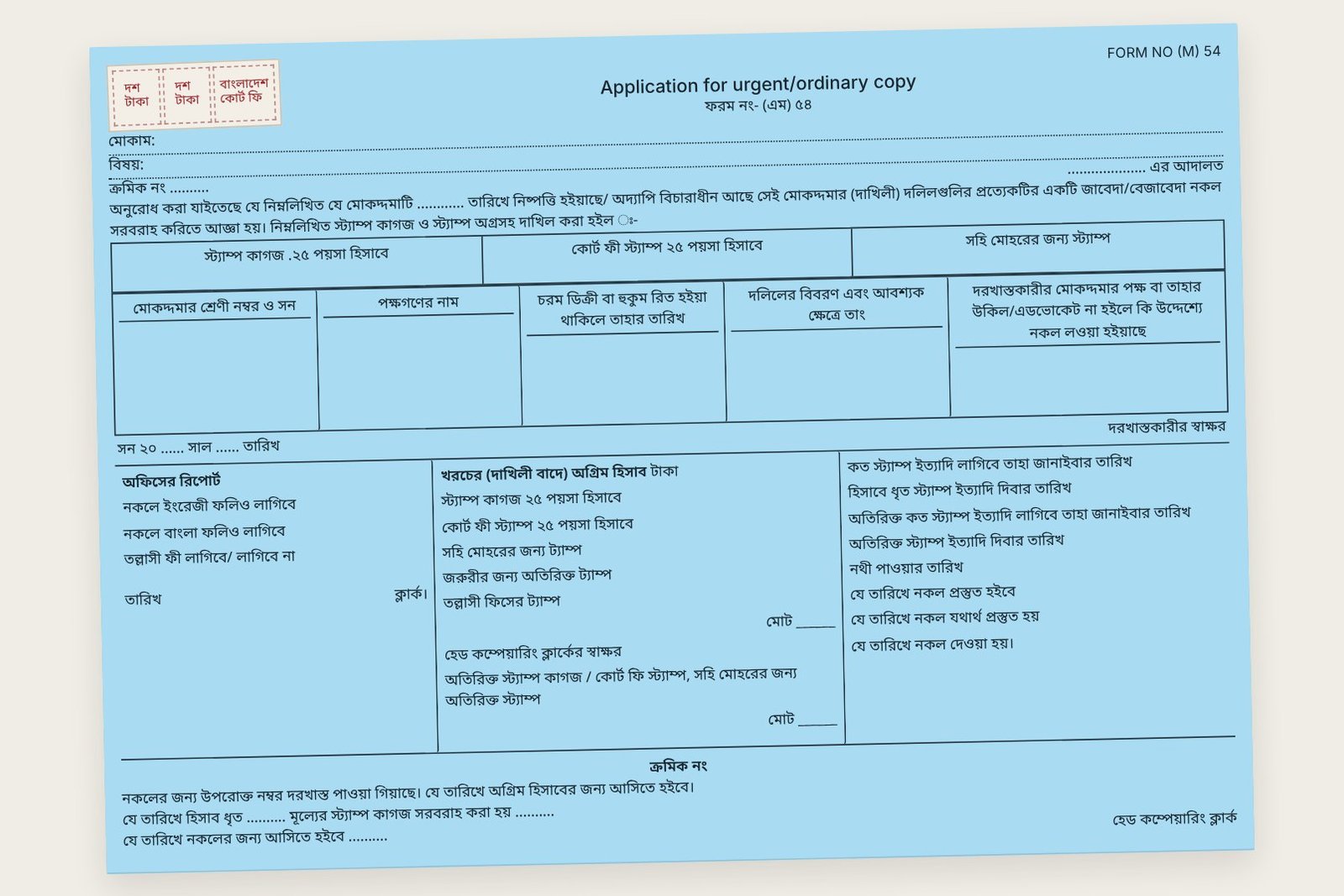
Summary: A certified copy is a copy of a public document certified as true by the officer who keeps it, and courts accept it in place of the original under sections 76 and 77 of the Evidence Act. Appeals under both procedure codes are normally filed with a copy of the judgment or decree. In subordinate courts the request is made on Form No. (M) 54, the copying section estimates stamps and folios, and the dates on the form show how much copy time limitation excludes.
Key point: Limitation keeps running until the certified copy application is filed: section 12 of the Limitation Act excludes only the time requisite for obtaining the copy, so apply on the day of judgment, file the stamps as soon as they are notified and collect the copy promptly.
At a glance
Proof without the original
A certified copy proves the contents of a court record under sections 76 and 77 of the Evidence Act.
Jabeda or bejabeda
The form asks for a certified (jabeda) or an uncertified (bejabeda) copy; only the certified version is accepted as proof and for appeals.
Stamps decide speed
Nothing is copied until the stamps and folios estimated by the copying section are filed.
Dates protect limitation
The dates recorded on the form and the copy show how much copy time is excluded from an appeal deadline.
Thirty days to appeal
A criminal appeal to a Sessions Judge must be filed within 30 days of the sentence, plus the excluded copy time.
Strangers state a purpose
An applicant who is not a party or the party's advocate must say on the form why the copy is wanted.
Table of Contents
What a certified copy is and why the law relies on it
The Evidence Act, 1872 divides documents into public and private. Documents forming the acts or records of the acts of official bodies, tribunals and public officers, including judicial officers, are public documents; all other documents are private.[1] A complaint petition once filed, the order sheet, depositions and the judgment all become part of a court record and so fall on the public side of that line.
Section 76 then gives any person who has a right to inspect a public document the right to a copy "on payment of the legal fees therefor", with a certificate at the foot stating that it is a true copy, dated and signed by the officer with his name and official title and sealed where the officer may use a seal. Such copies "shall be called certified copies".[1] Section 77 allows them to be produced in proof of the contents of the public document.[1]
When the original is a public document, a certified copy, "but no other kind of secondary evidence", is admissible under section 65, and section 79 presumes the genuineness of a certified copy substantially in the legal form.[1] A photocopy of a judgment has neither advantage.
Copies the parties are entitled to
Both procedure codes give parties a right to copies. Under section 548 of the Code of Criminal Procedure, 1898 (CrPC), any person affected by a judgment or order of a criminal court who wants a copy of an order, deposition or other part of the record "shall, on applying for such copy, be furnished therewith", provided he pays for it unless the court for special reason gives it free.[2]
Section 371 adds that the accused shall be given a copy of the judgment "without delay" on application, free of cost except in a case under Chapter XX of the Code (trial of cases by magistrates).[2] On the civil side, Order XX rule 20 of the Code of Civil Procedure, 1908 (CPC) says certified copies of the judgment and decree "shall be furnished to the parties on application to the Court, and at their expense".[3]
When you need a certified copy application
The most urgent reason is an appeal. Under section 419 of the CrPC, every criminal appeal must be a written petition which, unless the appellate court otherwise directs, "shall ... be accompanied by a copy of the judgment or order appealed against".[2] A civil appeal from an original decree must be presented as a memorandum accompanied by a copy of the decree and, unless the appellate court dispenses with it, of the judgment on which it is founded, under Order XLI rule 1 of the CPC.[3] Revisions and bail applications in a higher court rely on the same papers.
Other uses are common: a judgment of acquittal for a bank's compliance file, an order sheet showing an embassy or land office that a case has ended, or an earlier deposition or decree for a later suit. Each starts with the same certified copy application, and each fails if the documents column is vague.
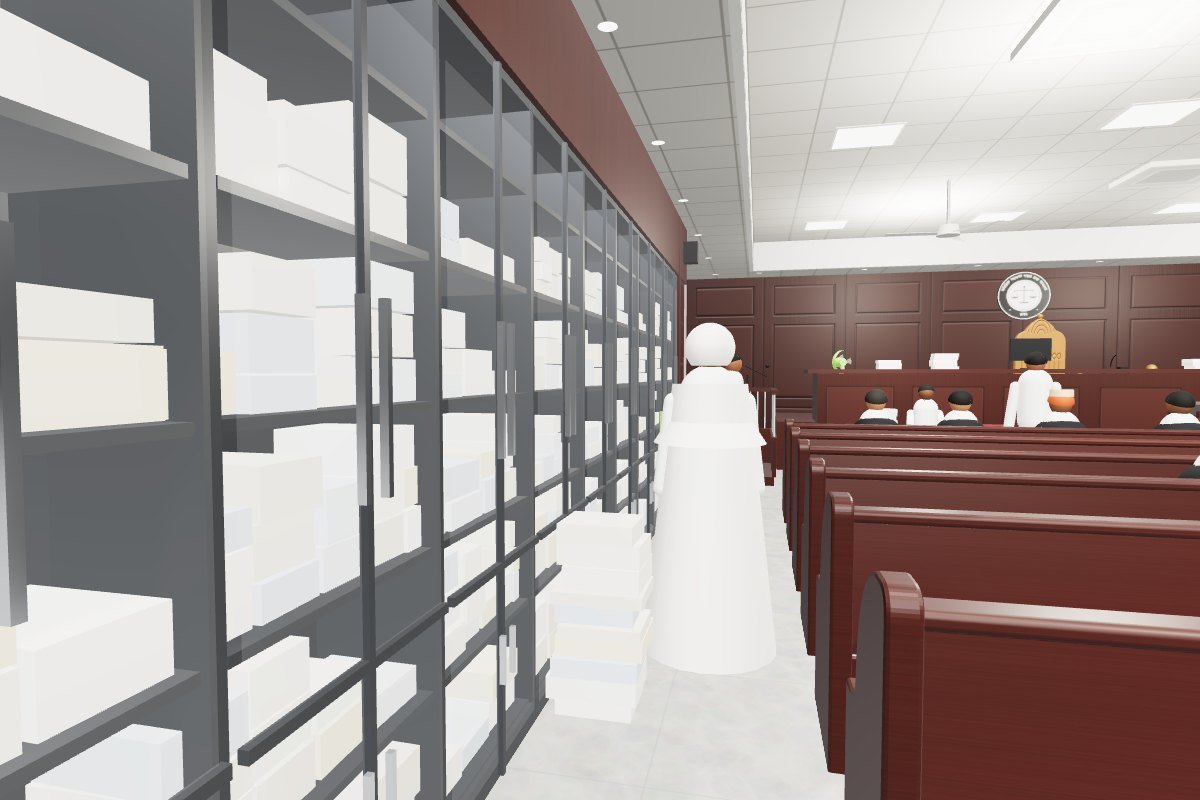
For a complaint case the usual set is the petition of complaint, the full order sheet and the judgment. See where each arises in our CR case process guide and the wider criminal case process in Bangladesh.
Jabeda, bejabeda, urgent and ordinary: the vocabulary of the nakol
The printed request on Form No. (M) 54 asks the court to supply "একটি জাবেদা/বেজাবেদা নকল", one jabeda or bejabeda copy, of each listed document. A jabeda copy is a certified copy: it carries the certificate, signatures and seal that section 76 of the Evidence Act requires.[1] A bejabeda copy is uncertified. It is cheaper and useful for reading and preparation, but it is not proof and should not be filed with an appeal. The applicant strikes out the word that does not apply.
The heading also offers an urgent or an ordinary copy. Urgency costs more: the form has a line in the cost estimate for "জরুরীর জন্য অতিরিক্ত স্ট্যাম্প", extra stamps for urgency. In the High Court Division, whose copying rules are published, an urgent copy is one required before three days from the application and attracts an extra fee of Tk 10 per page, collected in court fee stamps.[8] Subordinate courts apply their own rules, so ask the copying section.
A folio (ফলিও) is a page of the copy, in English or Bangla. Tallashi (তল্লাসী) means search: a search fee is payable when the record must be traced, typically from the record room. The head comparing clerk (হেড কম্পেয়ারিং ক্লার্ক) supervises comparison of each copy against the original.
Reading the form box by box
Form No. (M) 54 is printed on blue paper, mostly in Bangla, with an applicant's section at the top, three office panels below and a tear-off receipt at the foot. The applicant, or usually the advocate's clerk, fills the top half of the certified copy application; court staff fill the rest.
টাকাদশ
টাকাবাংলাদেশ
কোর্ট ফি
Header, stamps and the court's order
Two adhesive court fee stamps, each "দশ টাকা" (ten taka) and marked "বাংলাদেশ কোর্ট ফি", are fixed at the top left. Handwritten lines at the top usually read "মোকাম:" (the court) and "বিষয়:" (subject, meaning the case number). In criminal courts the magistrate often writes a short order near the top allowing the application, sometimes simply "as prayed", with signature, date and seal.
The printed request
Next come "ক্রমিক নং" (serial number, filled by the office) and "... এর আদালত" (the court of ...), where the court's full name is written. The printed request reads, in translation: "It is requested that one certified/uncertified copy be supplied of each of the documents filed in the case below, which was disposed of on [date] / is still pending; the stamp paper and stamps listed below are filed in advance." Strike out "jabeda" or "bejabeda", and "disposed of" or "still pending", as the case requires, and write the disposal date if there is one.
First table: what is filed in advance
Three boxes record what accompanies the application: "স্ট্যাম্প কাগজ .২৫ পয়সা হিসাবে" (stamp paper at 25 paisa), "কোর্ট ফী স্ট্যাম্প ২৫ পয়সা হিসাবে" (court fee stamps at 25 paisa) and "সহি মোহরের জন্য স্ট্যাম্প" (stamp for signature and seal, that is, the certification). The 25 paisa rates are historic printing and should not be treated as current fees. Write what is actually filed.
Second table: the five columns that matter most
- Column 1, "মোকদ্দমার শ্রেণী নম্বর ও সন" (class, number and year of the case): for example "CR Case No. [number] of [year]". Copy it exactly from the order sheet; a wrong class or year is the commonest reason a record cannot be traced.
- Column 2, "পক্ষগণের নাম" (names of the parties): in a criminal case usually "State v [accused]" or complainant v accused.
- Column 3, "চরম ডিক্রী বা হুকুম রিত হইয়া থাকিলে তাহার তারিখ" (date of the final decree or order, if made): the judgment date, which is also the starting point for limitation.
- Column 4, "দলিলের বিবরণ এবং আবশ্যক ক্ষেত্রে তাং" (description of documents and, where needed, their dates): list each document separately, such as the petition of complaint, the order sheet from first to last order, and the judgment and order with its date.
- Column 5, "দরখাস্তকারীর মোকদ্দমার পক্ষ বা তাহার উকিল/এডভোকেট না হইলে কি উদ্দেশ্যে নকল লওয়া হইয়াছে" (if the applicant is not a party or the party's pleader or advocate, the purpose of the copy): parties and their advocates usually sign or stamp here; a third party must state a genuine purpose.
Below the table come "সন ২০ সাল তারিখ" (the date) and "দরখাস্তকারীর স্বাক্ষর" (applicant's signature). In practice the advocate usually signs and places a chamber stamp in the applicant's column.
Office report and cost estimate
The lower left panel, "অফিসের রিপোর্ট" (office report), is filled by the clerk: "নকলে ইংরেজী ফলিও লাগিবে" (English folios needed), "নকলে বাংলা ফলিও লাগিবে" (Bangla folios needed), "তল্লাসী ফী লাগিবে/ লাগিবে না" (search fee payable or not payable) and "তারিখ ... ক্লার্ক" (date and clerk). The middle panel, "খরচের (দাখিলী বাদে) অগ্রিম হিসাব ... টাকা", is the advance estimate of cost excluding what was already filed: stamp paper, court fee stamps, stamp for signature and seal, extra stamps for urgency and search fee stamps, with a total, a date and the head comparing clerk's signature. A second block records any additional stamps.
Right-hand dates and the tear-off receipt
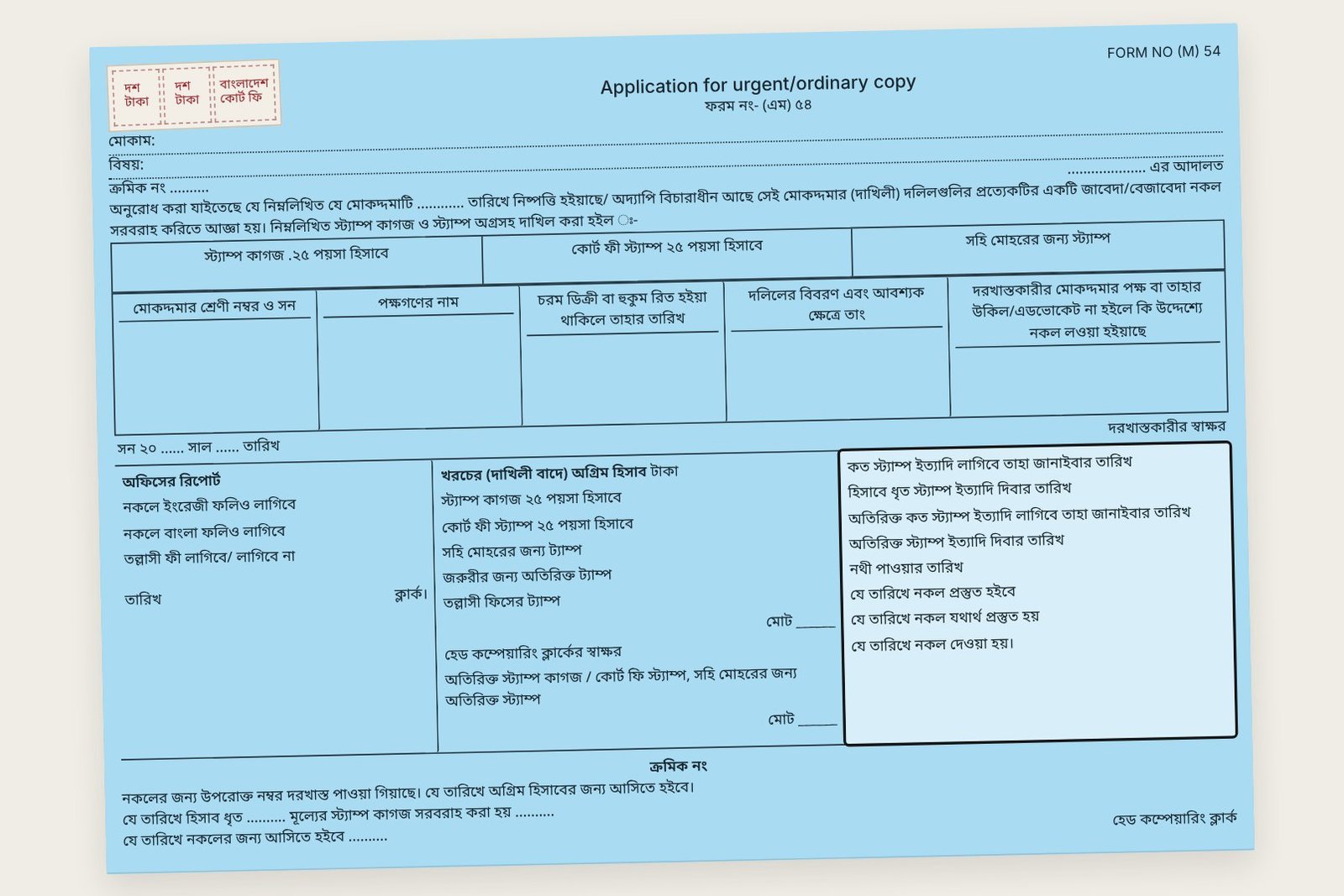
The right panel records, each with the applicant's signature: the date of being told how many stamps are needed; the date the estimated stamps were filed; the date of being told of additional stamps; the date they were filed; "নথী পাওয়ার তারিখ" (date the record was received); "যে তারিখে নকল প্রস্তুত হইবে" (date the copy will be ready); "যে তারিখে নকল যথার্থ প্রস্তুত হয়" (date it was actually ready); and "যে তারিখে নকল দেওয়া হয়" (date it was delivered). The tear-off receipt gives the serial number and the dates to return for the estimate and the copy. Keep it safe: you need it to collect the copy.
Who may apply and what the court decides
Parties and their advocates are the natural applicants, and the form assumes as much: only an applicant who is neither a party nor the party's advocate has to explain the purpose in column 5. Section 76 of the Evidence Act ties the right to a copy to a right to inspect the document, and section 548 of the CrPC extends it to "any person affected" by a criminal court's judgment or order.[1][2] A third party such as a bank, an employer or a purchaser of land therefore has no automatic entitlement and depends on the court accepting the stated purpose.
As a guide, the High Court Division's rules let a stranger obtain any judgment, decree or order once made, but not admitted exhibits without the producing party's consent.[8] In criminal courts the presiding officer's order allowing the certified copy application starts the copying section's work.
How a certified copy application moves through the copying section
Rule 225(1) of the Criminal Rules and Orders, 2009 provides that "there shall be a separate Copying Department for Sessions Courts, Judicial Magistrate Courts and Metropolitan Magistrates Courts each", and rules 225 to 301 govern how that copying office (nakal khana) is run.[7] A High Court Division circular of 11 July 2023 records that copies supplied by the courts of the District Judge and the Metropolitan Sessions Judge are signed by a certifying officer, a head comparing assistant, a comparing assistant and the copyist, and that at least three signatures are needed to complete a certified copy.[7]
The same circular gave interim directions for district-level courts and tribunals without a separate copying office: the administrative officer, where there is one, acts as certifying officer, with stenographers as copyists and bench assistants as comparing assistants; where there is no such officer, the judge acts as certifying officer.[7] In practice every certified copy application follows the same sequence.
Fill and file the form
Complete Form No. (M) 54 with the case class, number, year, parties, judgment date and each document, affix the court fee stamps and file it.
Obtain the court's order
The application goes before the presiding judge or magistrate, who allows it, often with a short order and seal on the form.
Receive the estimate
The copying section traces the record, notes folios and any search fee, and notifies the stamps and stamp paper needed.
File stamps at once
The advocate's clerk buys and files the notified stamps and stamp paper; the date is entered on the form and signed by the applicant.
Copying and comparison
The copy is typed, compared against the original under the head comparing clerk, and certified with signatures and seal.
Collect and check
Return on the date on the tear-off receipt, sign for delivery and read every page against the record before leaving.
Most delays happen between steps: the record is in court for a hearing, stamps are notified but not filed, or nobody returns on the date given.
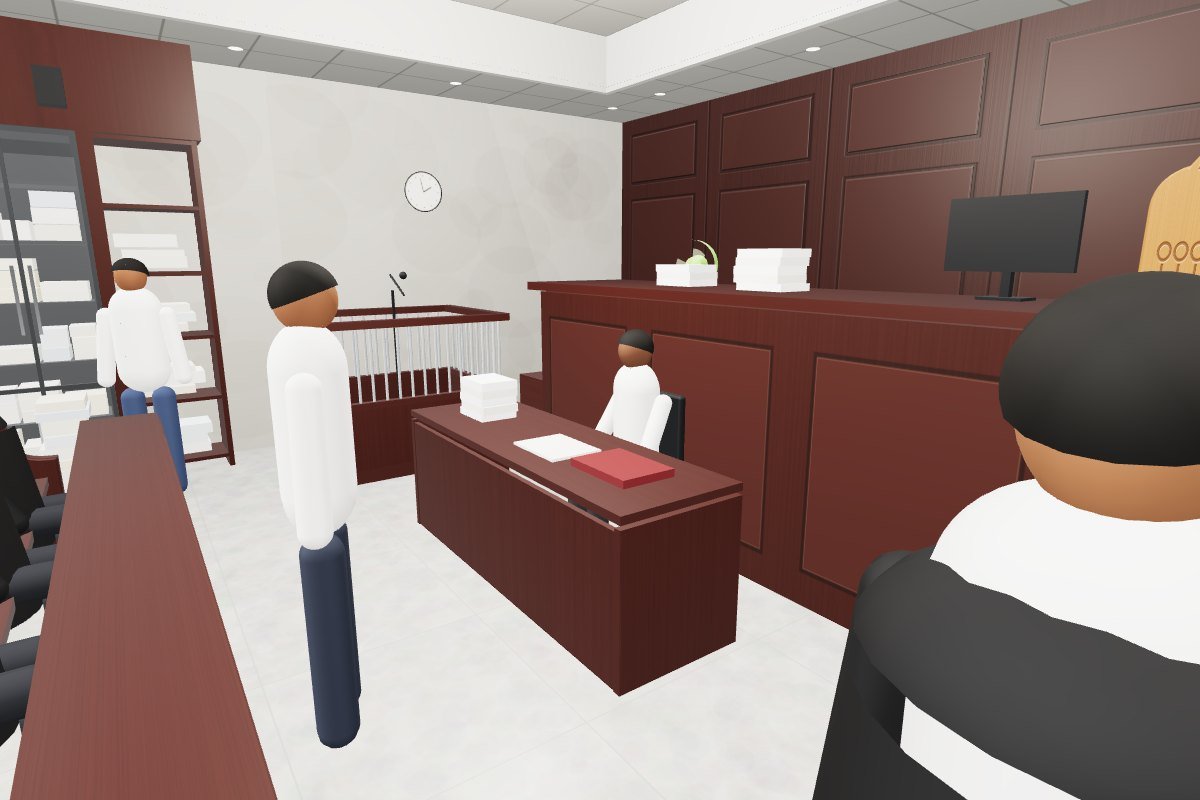
Fees, stamps and folios in 2026
The legal basis for charging is the Court-fees Act, 1870. Section 6 provides that no document of a kind chargeable under its first or second schedule shall be filed in any court, "or shall be received or furnished by any public officer", unless the proper fee has been paid.[6] Since the Court Fees (Amendment) Act, 2016, section 25 also allows fees to be collected by receipts, stamps or electronic or digital means, and the Government may appoint banks and mobile financial services to receive them.[6] Our court fee guide explains how court fees work more generally.
The cost of a copy depends on its pages, urgency, any search fee and the copying office's current rates. We have not verified current per-folio rates for subordinate courts from an official source, so we do not state them: the copying section computes the amount in the estimate panel, and the advocate's clerk buys and files the stamps.
The High Court Division's rules give a published benchmark. Copies are charged at Tk 2 for every 150 English or 200 Bangla words or part, paid in stamp sheets or folios and court fee stamps, with an authentication fee of Tk 5 per document; a search fee of Tk 5 is charged on each application if the record is in the record room, and an urgent copy costs an extra Tk 10 per page.[8] These figures apply in the High Court Division, not to the Form No. (M) 54 process in a magistrate's court.
Why the dates on the form decide limitation
Section 12(2) of the Limitation Act, 1908 provides that in computing the limitation period for an appeal, an application for leave to appeal or a review, the day the judgment was pronounced "and the time requisite for obtaining a copy of the decree, sentence or order appealed from" are excluded. Section 12(3) also excludes the time needed for a copy of the judgment on which a decree is founded.[4] The exclusion is for time requisite for obtaining the copy, so time that passes before the certified copy application is filed is generally not saved by it.
The periods themselves are short. Under the First Schedule, an appeal under the CrPC to any court other than the High Court Division must be filed within thirty days from the date of the sentence or order (article 154), and an appeal to the High Court Division within sixty days (article 155); an appeal from an order of acquittal has six months (article 157).[5] A civil appeal under the CPC to the court of a District Judge has thirty days from the decree or order (article 152).[5] Late appeals depend on section 5, which requires the appellant to satisfy the court that there was sufficient cause.[4]
That is why the right-hand panel matters. The High Court Division's rules require five dates to be recorded on any copy of a decree, judgment or order it grants: the application, the notice of folios and stamps, the delivery of folios and stamps, the date the copy was ready and the date it was made over.[8] Form No. (M) 54 records the same stages in its right-hand panel.
Suppose a judgment is delivered on 2 March, the certified copy application is filed on 3 March, stamps are notified on 6 March but filed on 13 March, and the copy is ready on 20 March. Days lost through the applicant's slowness in filing stamps may not be treated as time requisite.
Special Metropolitan Magistrates, summary trials and the appeal
Copies in Dhaka may come from the court of a Special Metropolitan Magistrate. Section 12(5) of the CrPC allows the Government, in consultation with the High Court Division, to confer Metropolitan Magistrate powers in respect of particular cases, classes of cases or cases generally in a metropolitan area; under section 12(6) the persons on whom those powers are conferred "shall be called Special Metropolitan Magistrates" and serve for a term fixed by the Government.[2] They are subordinate to the Chief Metropolitan Magistrate under section 17(3).[2]
Chapter XXII of the CrPC deals with summary trials. Section 260 provides that a Metropolitan Magistrate, and other listed magistrates, shall try in a summary way offences not punishable with death, transportation or imprisonment for more than two years, together with listed offences such as hurt under section 323 of the Penal Code and theft of property worth up to five lac taka, a limit raised from ten thousand taka by the Code of Criminal Procedure (Amendment) Act, 2026 with effect from 10 August 2025.[2]
The procedure for trials by magistrates in Chapter XX applies, and no sentence of imprisonment over two years may be passed (section 262(2)).[2] Where an appeal lies, the magistrate must record a judgment embodying the substance of the evidence, and that judgment is the only record (section 264).[2]
Where the appeal lies and the five thousand taka bar
Under section 408, a person convicted on a trial held by a Metropolitan Magistrate may appeal to the Sessions Judge; in a metropolitan area the Court of Session is called the Metropolitan Court of Session (section 9(1)).[2] There is one important bar. Section 414 provides that there is no appeal by a convicted person in a case tried summarily in which a magistrate empowered under section 260 passes "a sentence of fine not exceeding five thousand taka only" (two hundred taka before the 2026 amendment), although section 415 preserves an appeal where that punishment is combined with another.[2] Where no appeal lies, revision is the usual route.
The appeal must be filed within thirty days from the date of sentence under the First Schedule to the Limitation Act, plus the copy time excluded by section 12, and the petition of appeal must be accompanied by a copy of the judgment.[5][4][2] Because a summary trial judgment is the whole record, the certified copy of the judgment, with the order sheet, is the first document the appeal lawyer needs. Our guide to a criminal appeal to the Sessions Judge follows the appeal from filing to hearing.
Subordinate courts and the High Court Division compared
The High Court Division runs a different system under its own rules. Applications are made to the Superintendent of the Copying Section in Form No. 24 (Civil), Appendix I, stating the urgency and whether offset paper or folios are wanted; each sheet is initialled by the Assistant Registrar, and the last page carries a certificate "Certified to be a true copy as per section 76, Act I of 1872".[8] Uncertified copies are marked only "examined" and initialled.[8]
Time limits are also written down. An ordinary copy is to be furnished not later than 1 p.m. on the fifth day after the stamps and folios are filed; an urgent copy is ordinarily supplied within 72 hours of depositing the estimate; and if the stamps are not filed within seven days of notification, the application is rejected and a fresh one must be made.[8] Before applying, confirm the case number and status through the Supreme Court case search.
| Point | Subordinate criminal courts | High Court Division |
|---|---|---|
| Application form | Form No. (M) 54, Application for urgent/ordinary copy | Form No. 24 (Civil), Appendix I |
| Who prepares the copy | Separate copying department at district headquarters under rule 225(1), Criminal Rules and Orders 2009 | Copying Section under a Superintendent and Assistant Registrar |
| Certification | Certifying officer, comparing staff and copyist; at least three signatures | Certificate under section 76, Evidence Act, signed by an authorised officer with the court seal |
| Published fee rates | Computed by the copying section on the form | Tk 2 per 150 English or 200 Bangla words, Tk 5 authentication, Tk 5 search fee |
| Urgent copy | Extra stamps for urgency shown in the estimate | Extra Tk 10 per page; ordinarily within 72 hours of deposit |
| Ordinary time frame | Varies with the record and workload | By 1 p.m. on the fifth day after stamps and folios are filed |
| Failure to file stamps | Copy is not prepared until stamps are filed | Application rejected if stamps not filed within seven days |
Common problems with a certified copy application and how to fix them
Record not found. If a document cannot be traced because the description is insufficient or wrong, the High Court Division's rules require the application to be endorsed and sent at once to the officer in charge for orders.[8] Subordinate courts deal with this informally. Check the case class, number and year against the order sheet, ask whether the record is in the courtroom, with a higher court or in the record room, and pay the search fee if asked.
Missing or extra stamps. Preparation does not begin until the notified stamps and folios are filed, and in the High Court Division an application is rejected if they are not filed within seven days.[8] If the office later finds more pages, it notifies additional stamps; file them quickly and sign the entry on the form, because every unanswered notice adds days that may not count as time requisite.
Delay and unofficial payments. A November 2025 press report describes a single Supreme Court order copy passing through more than a dozen desks, and unofficial payments to intermediaries.[9] Pay nothing not reflected in stamps or a receipt. If a copy is overdue, ask for the register entry, escalate to the officer in charge, and near a deadline apply for an urgent copy or ask the appellate court for directions.
Errors in the copy. Read every page before leaving the counter, and ask for a corrected, recertified copy rather than marking it by hand.
No online route yet. Supreme Court orders are now online and bail orders can be sent electronically to prisons, but a November 2025 press report found litigants still facing long manual chains for copies.[9] An e-family court launched in November 2025 handles five types of family case online.[10] We have found no verified general online certified copy application for the subordinate criminal courts, so the paper form remains the route. Foreign clients should also ask the receiving authority whether translation or attestation is needed.
A practical checklist for clients and companies
- Apply on the day of judgment or the next working day, and ask for the judgment and the full order sheet together.
- Choose jabeda (certified) for anything that will be filed or relied on; take a bejabeda copy only for reading.
- Copy the case class, number and year exactly; list each document separately with its date.
- Keep the tear-off receipt, file stamps the day they are notified and sign each date entry.
- Diary the appeal deadline from the judgment date and recalculate it from the dates certified on the copy.
TRW regularly obtains certified copies for clients in appeals, revisions and bail applications. See also our guides to criminal appeals and civil appeals.
Test yourself
Frequently asked questions
What is Form No. (M) 54?
It is the printed "Application for urgent/ordinary copy" used in subordinate courts to request a certified (jabeda) or uncertified (bejabeda) copy of documents in a case. The applicant lists the case, parties, judgment date and documents; the copying section adds the stamp estimate and dates. A certified copy issued on it is proof of the record under sections 76 and 77 of the Evidence Act.[1]
What is the difference between a jabeda and a bejabeda copy?
A jabeda copy is certified: it bears a certificate that it is a true copy, dated and signed by the officer with his name and title and sealed, as section 76 of the Evidence Act requires. A bejabeda copy is uncertified. Only a certified copy can be used to prove a public document and should be filed with an appeal or revision.[1]
Who can file a certified copy application?
Parties and their advocates apply as of course, and section 548 of the CrPC entitles any person affected by a criminal court's judgment or order to a copy on payment. Anyone else must state on the form why the copy is wanted, and the court decides whether to allow it. The accused is entitled to a copy of the judgment under section 371.[2]
How much does a certified copy cost?
It depends on the number of pages, urgency, any search fee and the copying office's current rates, which we have not been able to verify from an official source for subordinate courts. The copying section fills in the estimate on the form. Court fees must be paid before a chargeable document is furnished, under section 6 of the Court-fees Act, 1870.[6]
How long does it take to get a certified copy?
In subordinate courts it varies with the size of the record and the copying section's workload; most delay comes from the record being unavailable or stamps being filed late. The High Court Division's rules set a benchmark: ordinary copies by 1 p.m. on the fifth day after stamps are filed, and urgent copies ordinarily within 72 hours of depositing the estimate.[8]
Does the time spent getting a copy count against my appeal deadline?
Section 12 of the Limitation Act excludes the day of judgment and the time requisite for obtaining a copy of the decree, sentence or order, and of the judgment on which a decree is founded. Time before the certified copy application is filed, or lost through the applicant's own delay, may not be excluded, so apply at once.[4]
What is a Special Metropolitan Magistrate and can I appeal a summary trial judgment?
A Special Metropolitan Magistrate is a person on whom the Government, consulting the High Court Division, confers Metropolitan Magistrate powers under section 12(5) and (6) of the CrPC. A conviction by a Metropolitan Magistrate is appealable to the Sessions Judge under section 408, but section 414 bars an appeal where a summary trial ends in a fine of no more than five thousand taka only.[2]
How long do I have to appeal to the Sessions Judge?
Thirty days from the date of the sentence or order appealed from, under article 154 of the First Schedule to the Limitation Act, for an appeal under the CrPC to any court other than the High Court Division. The time requisite for the certified copy is excluded under section 12, and a late appeal needs sufficient cause under section 5.[5][4]
Can an appeal be filed without a certified copy?
A criminal petition of appeal must be accompanied by a copy of the judgment or order unless the appellate court otherwise directs, and a civil memorandum of appeal must be accompanied by a copy of the decree and, unless dispensed with, the judgment. Where the copy is delayed, ask the appellate court for directions rather than missing the deadline.[2][3]
Is there an online certified copy application in Bangladesh?
Not generally for the subordinate criminal courts, as far as we can verify. Supreme Court orders are published online and bail orders can be sent to prisons electronically, but a November 2025 press report described copies still moving through many manual desks. Use Form No. (M) 54 at the copying section, and check the case online first.[9]
Source register
Primary legal and regulatory sources
Materials checked on 23 November 2026. Confirm the current official text before relying on any provision.
- The Evidence Act, 1872 (Act No. I of 1872), Laws of Bangladesh
- The Code of Criminal Procedure, 1898 (Act No. V of 1898), Laws of Bangladesh
- The Code of Civil Procedure, 1908: First Schedule (Orders and Rules), Laws of Bangladesh
- The Limitation Act, 1908 (Act No. IX of 1908), Laws of Bangladesh
- The Limitation Act, 1908: Schedule (First Schedule, periods of limitation), Laws of Bangladesh
- The Court-fees Act, 1870 (as amended by the Court Fees (Amendment) Act, 2016), Laws of Bangladesh
- Supreme Court of Bangladesh, High Court Division, Circular No. 04/2023 (Judicial) on supply of certified copies in district judge level courts and tribunals (11 July 2023)
- Supreme Court of Bangladesh (High Court Division) Rules, Chapter XIII: Copies
- Dhaka Tribune: Court digitization fails to spare litigants from bribery, red tape (10 November 2025)
- bdnews24 (Bangla): How to use the e-family court (25 November 2025)
Related TRW assistance
Move from information to a defined next step
If you need certified copies for an appeal, revision, bail application or an overseas authority, TRW's appellate litigation team can obtain them and diary the deadline. Contact our Dhaka lawyers with the case number and judgment date.











