
TRW Insight / Employment
Act No 43 of 2026 is now the settled labour law. It caps unions at three per establishment, keeps the secret ballot for the bargaining agent, ties the provident fund to a two-thirds demand or Progoti, and narrows who counts as a worker, while the new rules are still awaited.
Bangladesh Labour Amendment Act: the employer agenda for late 2026
The Bangladesh Labour Amendment Act is now the settled text that every employer outside the export processing zones must work to. Formally the Bangladesh Labour (Amendment) Act 2026, Act No 43 of 2026, it is dated 10 April 2026, took effect immediately and repealed the interim government's Bangladesh Labour (Amendment) Ordinance 2025, Ordinance No 65 of 2025.[1] Parliament did not simply re-enact the Ordinance. It cut the number of unions an establishment can host, rewrote the provident fund duty around the Progoti pension scheme and narrowed the definition of worker.
This client alert is about execution. Our earlier briefing on the Labour Act amendment 2025 Bangladesh maps every change the reform made to maternity, holidays, resignation pay, harassment committees and penalties. Here we focus on the five points on which employers are now being asked to make decisions: the three-union ceiling, the secret ballot that decides the collective bargaining agent, the provident fund or Progoti choice for establishments with 100 or more permanent workers, the reworked worker definition and the still-missing rules. We close with the implications for ready-made garment exporters and a checklist for the next two quarters.
Summary: Act No 43 of 2026 limits each establishment or group of establishments to three registered unions in each category, keeps the secret ballot as the route to a collective bargaining agent where more than one union exists, obliges employers with at least 100 permanent workers to form a provident fund when two-thirds of the workers demand one in writing unless interested workers are enrolled in Progoti on a 50:50 basis, and defines a worker by function while excluding persons given managerial, administrative or supervisory responsibility in writing. New labour rules have not yet been issued.
Key point: Policies, union protocols and pension decisions taken under the November 2025 Ordinance need a second review. The Act saves anything done under the Ordinance, but it changed the union cap from five to three, removed the words "employee" and "officer" from the worker definition and added a two-thirds written-demand trigger to the provident fund duty.[1] [3] [5]
At a glance
Status
Act No 43 of 2026, dated 10 April 2026, in force immediately; Ordinance No 65 of 2025 repealed with savings.
Union ceiling
No more than three registrations at any time in an establishment or group, for each category of union or association.
CBA ballot
One union is the bargaining agent automatically; with two or three, a secret ballot run by the Director of Labour decides.
Provident fund
Duty at 100 or more permanent workers on a two-thirds written demand, unless interested workers join Progoti with a 50 per cent employer share.
Rules pending
As at late October 2026 the government says new Labour Rules are its priority; the 2015 Rules have not been replaced.
Table of Contents
Where the Bangladesh Labour Amendment Act stands in October 2026
The legislative history is short but it matters for anyone relying on documents prepared in late 2025. The Ordinance was published on 17 November 2025.[3] After the February 2026 election, Labour and Employment Minister Ariful Haque Chowdhury moved the Bill, and the Jatiya Sangsad passed it by voice vote, converting the Ordinance into law with amendments.[4] The Act is recorded as Act No 43 of 2026, dated 10 April 2026, and section 1(2) brings it into force at once.[1] The Ministry of Labour and Employment posted the Act on its legislative information page on 16 April 2026.[7]
The repeal and savings clause
Section 93 of the Act repeals Ordinance No 65 of 2025 and provides that anything done, any step taken or any proceeding started under the Ordinance is treated as done, taken or started under the Act.[1] That saving protects the validity of past steps, but it does not convert an Ordinance-only rule into a continuing right. A fourth or fifth union registered under the Ordinance's higher ceiling, or a pension decision taken on the Ordinance's wording, should be reviewed against the Act as it now reads rather than assumed to continue unchanged.
Why employers should re-baseline rather than patch
The Act runs to 93 sections and replaces all three schedules to the Bangladesh Labour Act 2006.[1] A Labour Reform Commission member counts 93 amendments in 2026, against 87 in 2013 and 50 in 2018.[14] The practical answer is to treat the consolidated Bangla text of the 2006 Act, as amended, as the single source and to rebuild appointment letters, service rules and union protocols against it. English translations that pre-date 2026 are now unreliable on each of the points in this alert.
Three unions per establishment: managing the ceiling
New section 179(5) provides that no more than three registrations may be granted at any time in an establishment or group of establishments for each of the categories in section 175(1) and (2), that is, for workers, persons, officers or owners.[1] The Ordinance had set the ceiling at five, and Parliament restored three, which was the limit before the Ordinance.[3] [5] Registration itself remains open: at least 20 workers may jointly apply, and the union qualifies once its membership reaches 20, 40, 100, 300 or 400 depending on whether the establishment employs up to 300, 500, 1,500, 3,000 or more workers.[1]
How the ceiling works in practice
Under the Bangladesh Labour Amendment Act the ceiling is a cap on registrations, not a licence for an employer to choose which unions survive. Once three unions of workers are registered, the Director General cannot register a fourth in that establishment or group, but the employer has no role in deciding which applications succeed. Under replaced section 179(2A) the Director General or the responsible officer verifies the application by collecting a list from the establishment or by checking online through a digital system.[1] The employer's job is therefore narrow and evidential: keep the worker register accurate and answer verification requests fully and on time.
Headcount certification and delay
Verification is where friction now sits. In August 2026 union leaders reported that the Department of Labour was treating employer certification of total headcount as a required attachment, which in one garment-sector case delayed acceptance of an application filed on 25 November 2025 until 27 February 2026, about 95 days later.[11] An employer that slow-walks a headcount request risks the delay being characterised as interference. The Director General may now order an employer to stop an unfair labour practice or anti-union discrimination immediately and to compensate an affected worker for any loss.[4]
Groups of establishments
The cap applies to an establishment or a group of establishments.[1] Groups with several factories should map which units the Department of Labour treats as one establishment and which as separate ones, because that determines both the membership threshold and how many registrations each unit can carry. The answer also feeds directly into the collective bargaining agent process, which applies equally to a declared group of establishments.[2]

Secret ballot and the collective bargaining agent
Where more than one union exists, the three-union cap makes the collective bargaining agent decision more important, not less. Section 202 of the 2006 Act, as it now reads, governs the process, and its core is unchanged by the 2026 Act: where an establishment has only one trade union, that union is deemed to be the collective bargaining agent.[2] Where there is more than one, Parliament's text keeps the choice of agent with the workers, by secret ballot.[5]
Two routes to a ballot
Section 202(2) offers two routes. The unions may agree among themselves to nominate an election commissioner and arrange the election of the collective bargaining agent. Alternatively, on an application by any union or by the employer, the Director of Labour must hold a secret ballot within 120 days of receiving the application to decide which union will be the agent.[2] The second route matters to employers: an employer facing two or three rival unions, each claiming to speak for the workforce, can itself apply for a ballot rather than negotiate with all of them.
Notice, the voter list and non-interference
After an application, the Director of Labour gives every union notice, of not more than fifteen days, to say whether it will contest; a union that does not reply is treated as not contesting.[2] On request, the employer must supply a list of all workers, other than badli and casual workers, employed for at least three months, showing each worker's name, parents' names and age, section, workplace, ticket number and date of appointment.[2] The certified list becomes the voter list. The employer must provide the facilities needed for the election but must not interfere in or influence it, and nobody may canvass within 45 metres of a polling station.[2]
Result, term and disputes
The union with the most votes is declared the agent, but only if its votes equal at least one-third of all workers employed in the establishment.[2] An agent holds office for two years, or three years for a group of establishments, and no fresh application is entertained during that term. Disputes about the election go to the Labour Court, whose decision is final, and every employer must allot an office room to the elected agent in the manner the rules prescribe.[2] Our guide to trade union law in Bangladesh covers bargaining procedure and strikes.
What the 2026 Act changed around the agent
Section 47 of the Act revised the list of collective bargaining agent functions in section 202(24), deleting two items and restating the right to give notice of and declare a strike in accordance with section 211.[1] Section 49 inserted new section 203A on sectoral, national and other-level bargaining: federations or confederations may ask employers' organisations to bargain, employers' organisations may ask unions to bargain, and the party receiving a request must reply in writing within ten days.[1] For trade associations, that ten-day reply duty is a new governance obligation.
Provident fund or Progoti: the 100-worker rule
Replaced section 264(10) is the provision of the Bangladesh Labour Amendment Act most often misdescribed. It states that, notwithstanding anything else in section 264, the owner of an establishment with at least 100 permanent workers is obliged to form a provident fund for the workers' benefit if at least two-thirds of the workers submit a written application demanding one.[1] The owner is released from that duty if it ensures institutional participation in Progoti, the universal pension scheme introduced by the National Pension Authority, for those private-sector staff who express interest in writing.[1] The renamed section heading now refers to a provident fund or participation in the universal pension scheme.
The contribution provisos
Two provisos complete the rule. The employer pays 50 per cent of the Progoti contribution and the worker pays 50 per cent. If a worker declines membership in writing, the employer is not obliged to pay its 50 per cent share for that worker.[1] The Universal Pension Authority's own scheme summary confirms the institutional model: Progoti is for employees of private and non-government institutions, an enrolled institution pays half of each contribution, and monthly contribution slabs are Tk 2,000, Tk 3,000, Tk 5,000 or Tk 10,000.[13]
What Parliament changed from the Ordinance
The Ordinance had made a provident fund compulsory for every establishment with at least 100 permanent workers, with the same Progoti exemption and the same 50:50 provisos, but without any written-demand trigger.[3] Press reports of the April 2026 Bill described the change as an exemption where two-thirds of workers apply to join Progoti.[5] The enacted wording is different: the two-thirds threshold triggers the provident fund demand, and the Progoti exemption turns on the employer securing enrolment for interested workers.[1] Work from the statutory text, not the summary.
Making the choice
The decision is commercial as well as legal. A recognised provident fund requires trustees, investment governance and audit, and replaced section 264(12) now requires at least half of the fund's money to be invested in a government-owned investable sector.[1] Progoti shifts administration to the national scheme but locks the employer into a 50 per cent match for every enrolled worker. Whichever route is chosen, keep a dated register of every written demand, expression of interest and written refusal, because each statutory consequence depends on them. Our provident fund and gratuity guide covers fund rules and tax recognition.

Who is a worker now: a functional test
Replaced section 2(65) defines a worker as any person, including a trainee, whose terms of service are express or implied and who is employed in an establishment or industry, directly or through a contractor by whatever name called, for wages or money in skilled, unskilled, manual, technical, business development or clerical work. Every such person is included except a person appointed under section 2(49)(b).[1] The Ordinance's version added that the person could be employed "as an employee or officer, by whatever name called"; Parliament deleted those words.[3] [5]
The written-appointment exclusion
Section 2(49)(b), which defines who counts as an employer, was itself replaced. It now covers any person given written responsibility for the managerial, chief executive, manager, administrative or supervisory functions of the establishment.[1] Read together, the two provisions make the written delegation decisive. A manager with a genuine written mandate over hiring, appraisal or discipline sits outside the worker definition; a person with a managerial job title but no written responsibility is likely to be inside it. Labour advocates have criticised the exclusion of managerial officers as leaving many staff without the Act's protections.[14]
The wider definition for unions
For the trade union chapter only, replaced section 175(1) extends worker to self-employed workers, workers engaged on a daily or temporary basis and persons engaged through a digital labour platform, while excluding watch and ward or security staff, fire-fighting staff and confidential assistants. Section 175(2) allows persons with administrative, supervisory or managerial responsibilities to form separate associations for their own interests.[1] The three-union cap applies to each of those categories.
What to do with job titles
Audit every role that the business treats as outside the Bangladesh Labour Amendment Act. For each, confirm that a written instrument gives the holder real managerial, administrative or supervisory responsibility, and that practice matches the paper. Where it does not, either issue a proper written delegation or bring the role within the Act for leave, separation pay and union purposes. Our guide to employment contracts in Bangladesh explains how to draft appointment letters that support the classification.
Rules under the Bangladesh Labour Amendment Act: what is still waiting
The Act is in force, but much of its machinery depends on rules. As at 26 October 2026, the Ministry of Labour and Employment's legislative information page lists the Act and the Ordinance but no new or amended labour rules among its most recent entries.[7] The Bangladesh Labour Rules 2015 have therefore not been replaced, and they continue to supply forms and procedure so far as they are consistent with the amended Act.
The government's own timetable
The new government's 22-point labour action plan, adopted in February 2026, set 30 June 2026 as the target for completing labour rules under the amended law.[8] That target passed. In July 2026 the Labour Minister told the ILO Director-General that amendments to the Bangladesh Labour Rules 2015 were progressing, alongside a tripartite National Social Dialogue Forum and an alternative dispute resolution mechanism.[9] On 7 October 2026 the Prime Minister's Adviser on Labour and Employment, Mahdi Amin, said the government's main goal was now to formulate the Bangladesh Labour Rules quickly.[10]
What the gap means for employers
Employers' associations had flagged the gap as soon as the Bill passed. The BKMEA president said some ambiguities remained and would have to be clarified in the rules, and that further amendment might follow.[5] The absence of rules is not a defence. Statutory duties that do not depend on a prescribed form, such as the union ceiling, the worker definition and the provident fund trigger, apply now. Where a duty is expressed to operate "in the manner prescribed by rules", document a reasonable interim process and be ready to adjust it when the rules arrive.
What the Bangladesh Labour Amendment Act means for RMG exporters
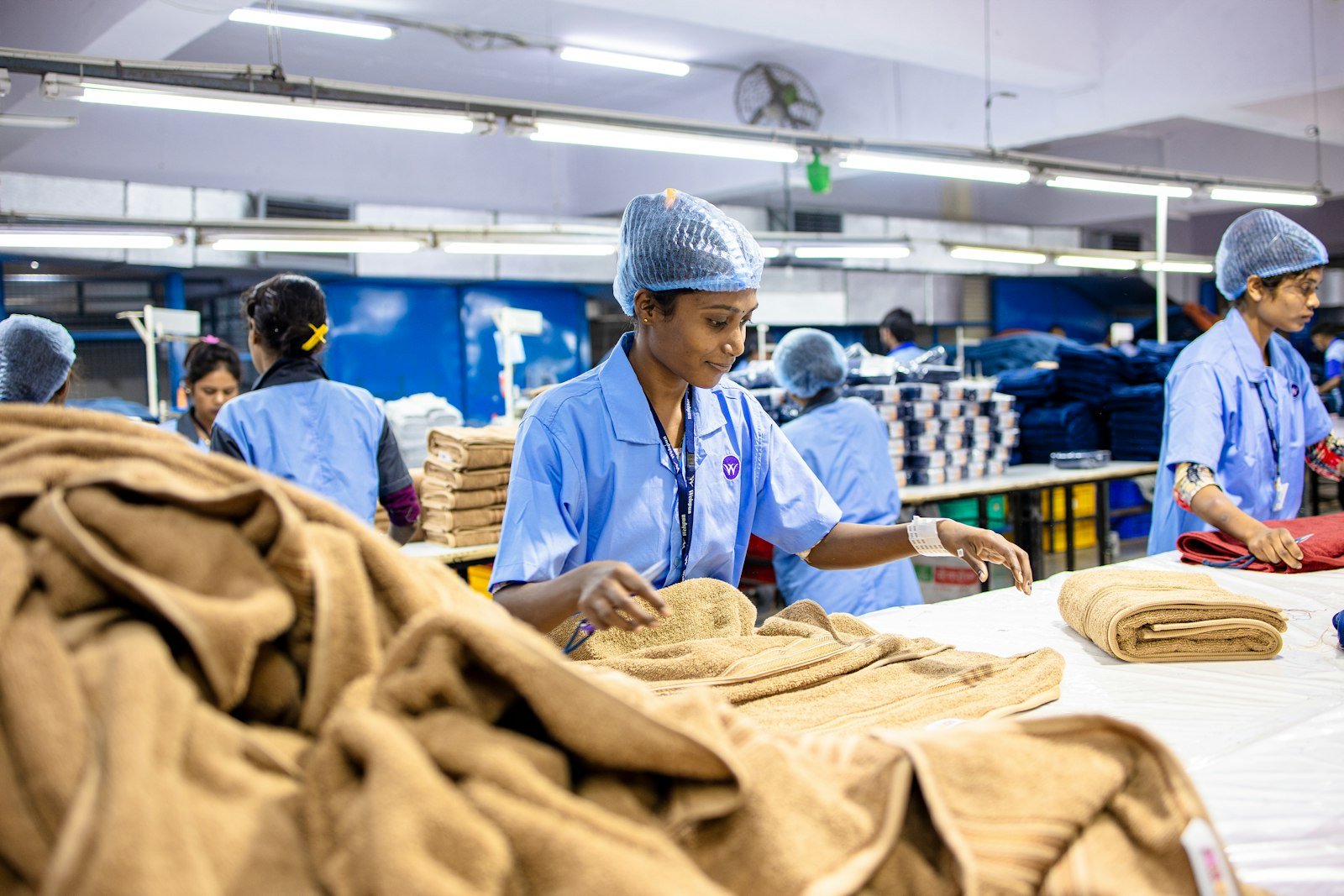
Ready-made garment manufacturers feel each of these changes at scale. The fixed-number union thresholds mean that in a 5,000-worker factory a union needs 400 members to register, where the pre-reform rule required a percentage of the whole workforce.[1] [14] More factories will host two or three unions, and so more will face the section 202 ballot. Union federations reported in August 2026 that registration was being slowed by documentation demands, a dispute that can sour relations long before any bargaining begins.[11]
The wage cycle
The reform shortened the minimum wage revision cycle to three years.[5] The entry-level garment wage of Tk 12,500 dates from December 2023. In August 2026 IndustriALL Bangladesh Council argued that the three-year period ends in December 2026, while the BKMEA president argued the new cycle could not apply retrospectively; the BGMEA president said his association was waiting for the rules under the amended law.[12] Exporters pricing 2027 orders should model a revision and its timing as a live risk rather than assume the current scale holds.
Sector-level bargaining and pension cost
New section 203A gives garment federations a statutory route to ask employers' associations to bargain at sector level, with a ten-day written reply duty.[1] For large exporters, the provident fund trigger is the other cost line: a two-thirds written demand from an establishment of 100 or more permanent workers creates a funding obligation unless the employer runs Progoti for interested workers at a 50 per cent match.[1] [13] Budget both scenarios before a demand arrives.
Zones and the ILO timetable
Factories inside export processing zones follow a separate statute, and the government told visiting labour organisations in October 2026 that it was discussing how to keep the zones' distinct status while sustaining employment.[10] The ILO will review Bangladesh's progress again in March 2027.[6] Groups with plants inside and outside a zone should keep two policy sets, and see our guide to minimum wage in Bangladesh for the wage-board process.
Department of Labour
Verifies and registers trade unions and, through the Director of Labour, conducts collective bargaining agent ballots.
DIFE
The Department of Inspection for Factories and Establishments inspects workplaces and brings complaints for breaches.
National Pension Authority
Runs the Progoti universal pension scheme that can replace a provident fund for interested workers.
Labour Court
Decides disputes about CBA elections, unfair labour practices and individual claims; its CBA election decisions are final.
Ministry of Labour and Employment
Drafts the new Labour Rules and leads tripartite consultation with employers and unions.
Compliance checklist: what employers must do now
The sequence below is the one we use when bringing an employer's documentation into line with the Bangladesh Labour Amendment Act. It front-loads the items that carry immediate legal effect and leaves rule-dependent items for a second pass.
Re-baseline the text
Work from the consolidated Bangla text of the Labour Act as amended by Act No 43 of 2026, not a pre-2026 translation or the Ordinance.
Audit Ordinance-era steps
List every policy, union recognition and pension decision taken between November 2025 and April 2026 and test each against the Act.
Fix the worker register
Make the section 9 register and headcount accurate, because union verification and CBA voter lists are built from it.
Map unions and units
Record which units form one establishment or group, how many registrations each carries and whether a ballot is due.
Prepare the ballot file
Hold a voter list in the section 202(6) format, an office-room plan and a written non-interference instruction to managers.
Decide the pension route
Choose provident fund or Progoti, price both, and open a dated register of written demands, opt-ins and refusals.
Paper the managers
Issue written managerial, administrative or supervisory mandates for every role treated as outside the worker definition.
Diary the rules
Assign an owner to track the new Labour Rules and re-run the checklist when they are published.
Documents to update this quarter
- Union protocol: who answers Department of Labour verification requests, within what time, and from which register.
- CBA election file: a ready voter list in the section 202(6) format, an office-room allocation and a non-interference instruction to line managers.
- Pension register: where 100 or more permanent workers are employed, written demands, expressions of interest in Progoti and written refusals, each dated and filed.
- Delegation letters: written managerial, administrative or supervisory mandates for every role treated as outside the worker definition.
- Service rules: re-based on the consolidated Bangla text and resubmitted where approval is required.
- Association governance: a named officer and a ten-day response process for sector-level bargaining requests under section 203A.
For registers, returns and inspection readiness more broadly, see our labour law compliance checklist, and for exits under the amended Act our guide to severance pay in Bangladesh.
Ordinance 2025 against Act 2026: where the text moved
The table sets out the provisions in this alert where the Act departs from the Ordinance. On a phone, scroll it sideways.
| Provision | Ordinance 2025 | Act 2026 | Practical effect |
|---|---|---|---|
| Union ceiling, s 179(5) | Five registrations per establishment or group | Three registrations, for each category | A fourth union cannot be registered |
| Worker, s 2(65) | Included persons employed as employee or officer | Words employee and officer deleted | Written managerial mandate decides exclusion |
| Provident fund, s 264(10) | Compulsory at 100 permanent workers | Compulsory at 100 if two-thirds demand in writing | Fund duty is triggered, not automatic |
| Progoti exemption | Available for workers who opt in writing | Available for workers who opt in writing | 50:50 contributions; none for decliners |
| Status | Repealed, with savings | In force from 10 April 2026 | Past steps valid but must be re-tested |
Two lines deserve emphasis. The union ceiling is the change most likely to shape industrial relations on the factory floor, and the provident fund trigger is the change most likely to surprise finance teams that budgeted on the Ordinance's flat duty.
What to watch next
Four developments will decide how the Bangladesh Labour Amendment Act works in practice: the new Labour Rules, which the government says are its immediate priority; the first section 202 ballots in multi-union factories under the three-union ceiling; the formation, or further delay, of a garment wage board under the three-year cycle; and the ILO's review in March 2027.[10] [12] [6] Employers that update documents now will hold the evidence they need when the first of those reaches them.
TRW's collective labour relations practice advises on union verification, collective bargaining agent ballots and sector bargaining, and our employment law compliance team re-bases service rules and pension decisions. To discuss your workforce, contact TRW in Dhaka.
Frequently asked questions
What is the Bangladesh Labour Amendment Act 2026?
It is the Bangladesh Labour (Amendment) Act 2026, Act No 43 of 2026, dated 10 April 2026. It amends the Bangladesh Labour Act 2006, came into force immediately and repealed Ordinance No 65 of 2025.[1]
How many trade unions can one factory have now?
How is the collective bargaining agent chosen?
A sole union is the agent automatically. Where there are more, the unions may run an election through an agreed election commissioner, or the Director of Labour holds a secret ballot within 120 days of an application by a union or the employer.[2]
How many votes does a union need to become the agent?
The highest number of votes, provided that number is at least one-third of all workers employed in the establishment.[2]
Can an employer apply for a CBA ballot?
Yes. Section 202(2) allows any union or the employer to apply to the Director of Labour. The employer must then supply the worker list and facilities but must not interfere in the election.[2]
When must an employer set up a provident fund?
Where at least 100 permanent workers are employed and at least two-thirds of them demand a fund in writing, unless the employer ensures that workers who express interest in writing are enrolled in Progoti.[1]
Who pays Progoti contributions?
Are managers covered by the amended worker definition?
Not if they have been given managerial, chief executive, administrative or supervisory responsibility in writing under section 2(49)(b). A job title alone is not enough.[1]
Have new Labour Rules been issued under the Act?
Source register
Primary legal and regulatory sources
Materials checked on 26 October 2026. Confirm the current official text before relying on any provision.
- Bangladesh Labour (Amendment) Act 2026 (Act No 43 of 2026), sections 1, 4, 32, 35, 47, 49, 56 and 93: Laws of Bangladesh
- Bangladesh Labour Act 2006 (Act No 42 of 2006), consolidated Bangla text, sections 175, 179 and 202: Laws of Bangladesh
- Bangladesh Labour (Amendment) Ordinance 2025 (Ordinance No 65 of 2025), published 17 November 2025: Laws of Bangladesh
- Dhaka Tribune, 9 April 2026: National Parliament passes labour bill
- Prothom Alo, 13 April 2026: Three, not five, unions per factory (Bangla)
- Prothom Alo English, 29 September 2026: Labour law, from paper to reality on the factory floor
- Ministry of Labour and Employment: legislative information (viewed 26 October 2026)
- The Daily Star, 23 February 2026: Labour ministry adopts 22-point action plan
- UNB, 19 July 2026: Dhaka urges visiting ILO chief to close Article 26 case
- Dhaka Tribune, 7 October 2026: Mahdi Amin, government committed to workers' rights
- The Financial Express, 31 August 2026: Trade unions face procedural and practical barriers
- The Financial Express, 23 August 2026: Garment unions push for urgent minimum wage revision
- Universal Pension Authority: Universal Pension Scheme brief (Progoti)
- The Daily Star, 30 April 2026: A closer look at Bangladesh's new labour law, gains and gaps
Related TRW assistance
Move from information to a defined next step
TRW advises employers on union verification, collective bargaining agent ballots, provident fund and Progoti decisions and service-rule updates under the amended Labour Act. Explore our collective labour relations practice and employment law compliance practice, or contact TRW in Dhaka.











