
TRW Insight / Bangladesh
BEPZA stayed outside the 2026 Invest Bangladesh merger and still sanctions, allots and supervises every project in its ten zones. For a foreign manufacturer, the permission letter, the allotment and the lease agreement set the rules for the life of the project, so getting them right decides how fast production starts.
EPZ investment in Bangladesh: the 2026 route from permission to production
EPZ investment in Bangladesh remains the most self-contained route for a foreign manufacturer that wants to export. One authority, the Bangladesh Export Processing Zones Authority (BEPZA), sanctions the project, allots the plot or factory space, issues import, export and work permits and oversees labour relations inside the zone. That integration is the attraction. It is also the discipline: the permission letter, the allotment letter and the lease agreement become the rulebook for the life of the project, and most later changes need BEPZA's consent.
This guide follows the route an investor actually takes, from choosing a zone to incorporation, the application, allotment, the lease, capital, imports, construction, staff, labour, reporting, changes and exit, and closes with a case study from a recent TRW mandate at Ishwardi EPZ. Approvals outside the zones are covered in our guide to investment approvals in Bangladesh after the Invest Bangladesh merger.
Summary: A foreign company that wants to manufacture for export in a Bangladesh export processing zone deals with BEPZA, not Invest Bangladesh. It incorporates locally, files a project proposal, receives a permission letter with conditions, is allotted a serviced plot on a 30-year lease or space in a standard factory building for two to ten years, pays the deposit and fees, and signs a lease agreement with BEPZA. Import permits, work permits, design approvals and most corporate changes then run through BEPZA.
Key point: The 2026 merger that created Invest Bangladesh absorbed BIDA, BEZA and the PPP Authority but left BEPZA outside. An EPZ project is sanctioned, allotted and supervised by BEPZA, and its permission letter, allotment letter and lease agreement should be read together as one set of binding conditions.
At a glance
One authority
BEPZA sanctions the project, allots space and issues import, export and work permits.
Ten zones
Eight EPZs, including Ishwardi EPZ in Pabna, and two BEPZA economic zones at Mirsharai.
Three categories
Type A fully foreign, Type B joint venture, Type C fully Bangladeshi.
Plot or factory
Serviced plots for 30 years, or a standard factory building for two to ten years.
Own labour law
The Bangladesh EPZ Labour Act 2019 governs employment and Workers Welfare Associations.
Table of Contents
Who regulates EPZ investment in Bangladesh in 2026
Under the Bangladesh Export Processing Zones Authority Act 1980, a person who wants to set up an industry in a zone applies to BEPZA, which grants permission if the applicant meets the requirements, and BEPZA may then allot or lease land and building space to that person.[6] The Act also lets BEPZA allot land on sale, lease or rent, allow allotted land to be mortgaged for bank finance, and sanction the employment of foreign nationals where local expertise is not available.[6]
BEPZA after the Invest Bangladesh merger
Invest Bangladesh began operating on 23 August 2026 as the apex investment promotion agency, bringing together BIDA, BEZA and the Public-Private Partnership Authority.[12] BEPZA and the Hi-Tech Park Authority remain outside it.[13] BEPZA has kept operating its zones since the merger, including the first exports from BEPZA Economic Zone-2 in September 2026.[14] For a project inside a BEPZA zone, permission, allotment and the lease come from BEPZA, and filings should not be addressed to Invest Bangladesh or the former BIDA. Our guide to investment approvals explains how the merger reshaped the map outside the zones.
BEPZA's one-window service does not displace every regulator. Bangladesh Bank, through the investor's authorised dealer bank, governs capital inflows and repatriation; customs supervises bonded goods; the Registrar of Joint Stock Companies and Firms (RJSC) holds the corporate record; and the Department of Environment issues environmental clearance.
BEPZA's zones: the eight EPZs and the newer economic zones
BEPZA operates eight export processing zones: Chattogram, Dhaka, Mongla, Ishwardi, Uttara, Cumilla, Karnaphuli and Adamjee.[1] It also runs the BEPZA Economic Zone at Mirsharai in Chattogram, a 1,138.55-acre site split into Economic Zone-1 and Economic Zone-2, giving ten operational zones in all.[14] Two further EPZs, at Patuakhali and Jashore, are under development.[1] The economic zones carry a different incentive set from the EPZs, so confirm which regime applies before comparing offers.
Ishwardi EPZ: where it is
Ishwardi EPZ is at Pakshi in Pabna district. BEPZA describes it as 308.97 acres with 324 plots, about 10.6 km from Ishwardi airport, 220 km from Dhaka and 280 km from Mongla port.[2] It sits in BEPZA's lower rent tier with Mongla and Uttara, and among the zones advertised with a seven-year tax holiday.[1] [2] For a project not tied to Chattogram port, that combination can materially reduce early occupancy costs.
Location drives the economics of EPZ investment in Bangladesh. The table summarises each zone's location, published rent tier and advertised tax holiday.[1] [2] On a phone, scroll it sideways.
| Zone | Location | Land rent (US$/sqm/year) | Factory rent (US$/sqm/month) | Advertised tax holiday |
|---|---|---|---|---|
| Chattogram EPZ | South Halishahar, Chattogram | 2.50 | 3.00 | 5 years |
| Karnaphuli EPZ | North Patenga, Chattogram | 2.50 | 3.00 | 5 years |
| Dhaka EPZ | Ganakbari, Savar | 2.50 | 3.00 | 5 years |
| Adamjee EPZ | Siddhirganj, Narayanganj | 2.50 | 3.00 | 5 years |
| Cumilla EPZ | Old airport area, Cumilla | 2.50 | 3.00 | 5 years |
| Ishwardi EPZ | Pakshi, Pabna | 1.40 | 1.75 | 7 years |
| Mongla EPZ | Mongla port area, Bagerhat | 1.40 | 1.75 | 7 years |
| Uttara EPZ | Shangalshi, Nilphamari | 1.40 | 1.75 | 7 years |
| BEPZA Economic Zone-1 and -2 | Mirsharai, Chattogram | 2.75 | 3.50 | 10 years |
Investment categories A, B and C
Type A is 100 per cent foreign ownership. Type B is a joint venture between Bangladeshi and foreign investors, with no limit on the foreign equity share. Type C is 100 per cent Bangladeshi ownership.[1] The category matters in practice: Type A enterprises may retain all repatriated export proceeds in a foreign currency account, while Type B and C enterprises may retain up to 80 per cent, or 75 per cent for garment units.[6] A share transfer that moves a company between categories therefore needs BEPZA's consent and a fresh look at banking arrangements.
Eligibility, the project proposal and the application
EPZs are reserved for export-oriented manufacturing. BEPZA assesses whether the product, process, machinery and space suit the zone and whether the sponsors can fund the project. The published procedure sets no minimum investment; credibility comes from the proposal, the machinery invoices and solvency evidence.
Incorporate before you apply
BEPZA's procedure lists three preliminary steps: obtain a visa and travel to Bangladesh, open a foreign currency account, and form a company registered with the RJSC.[5] The application must include the RJSC-certified certificate of incorporation, memorandum and articles, so the company must exist before BEPZA sanctions the project.[4]
The project proposal file
The process usually starts with a letter of interest, a visit to the zone and a short presentation to BEPZA.[5] The formal application uses BEPZA's prescribed project proposal form, which costs BDT 3,000.[3] The file includes a covering letter to the Executive Chairman, machinery pro-forma invoices, shareholders' bank solvency certificates, the RJSC documents, any joint venture agreement, and shareholders' passport copies and photographs.[4] BEPZA's citizen's charter sets five working days to issue the sanction letter and allot space once the file is complete.[4] The real time goes into making it complete, and its figures will be relied on for years.
The permission letter and its typical conditions
The permission letter, or sanction letter, records what BEPZA has approved and on what terms. It is the most important document in any EPZ investment in Bangladesh, because breach of its conditions is the usual ground for revocation. Conditions vary, but permission letters typically require the enterprise to:
- pay the security deposit, stamp duty and BEPZA registration fee in line with the allotment letter;
- import only modern, brand-new machinery on terms BEPZA accepts, and no waste, old or scrap material as raw material;
- export its products, keeping any domestic sales within the permitted ratio;
- submit monthly implementation progress reports, audited accounts within four months of each financial year end, and FDI returns to Bangladesh Bank;
- employ foreign nationals only under BEPZA work permits and comply with the EPZ Labour Act 2019, the EPZ Labour Rules 2022 and minimum wage notifications;
- meet environmental, effluent and fire-safety requirements, and bear the cost of its own electrical sub-station;
- obtain BEPZA's prior approval for new products, project revisions, share transfers and allotments, changes of directors or name, mergers, changes of ownership and any construction.
The permission is not transferable, and BEPZA may revoke it for non-implementation or breach. Turn each condition into an owner and a deadline.
Plot or standard factory building: allotment, deposits and rent
Fully serviced plots are leased for 30 years, renewable, and the investor builds its own factory. Standard factory buildings are rented from BEPZA for two to ten years, also renewable.[1] A plot suits a long horizon, specialised buildings or heavy machinery, and allotted land can be mortgaged for bank finance.[6] It also brings design approval, construction risk and a longer path to production. A standard factory building suits a project that wants to start quickly or keep capital for machinery, provided its floor loading, height, power and layout fit the production line. Check those before allotment, not after.
Security deposit, registration fee and stamp duty
BEPZA charges a registration fee of US$500 for land or factory space. The security deposit is one year's rent for land and four months' rent for a standard factory building, and stamp duty applies to land.[3] At signing, BEPZA asks for the original treasury challan for stamp duty, proof of the deposit and the registration fee receipt.[4] The allotment letter states the exact amounts for each project.
Rent, utilities and service charges
In Chattogram, Dhaka, Cumilla, Adamjee and Karnaphuli EPZs, land rents at US$2.50 per square metre per year and factory space at US$3.00 per square metre per month. In Mongla, Ishwardi and Uttara EPZs the rates are US$1.40 and US$1.75, and in the BEPZA Economic Zone US$2.75 and US$3.50.[1] Electricity, water and gas are billed separately at BEPZA's zone tariffs.[2] Service charges and any rent escalation follow BEPZA's current schedules and the lease, so confirm them in writing before signing.
The lease agreement: key terms and what to check before signing
The lease agreement turns the allotment into a contractual right to occupy. BEPZA's charter allows two working days to execute it once payments are made, and four working days to process an extension on application with a dues clearance certificate.[4] The lease is a standard form with little room to negotiate, so the value lies in understanding it and closing gaps between the lease, the permission letter and the business plan. Expect terms on the term and renewal, rent and escalation, the deposit and its refund, permitted use, alterations only with approval, restrictions on assignment and subletting, and BEPZA's termination rights.
What to check before signing
- The company name, category, products and space match the permission and allotment letters exactly.
- The commencement date, any fit-out period and the possession handover are documented.
- For a factory building, the floor area, loading, height, power and utility connections are recorded at handover.
- Responsibility for the sub-station, internal utilities and fit-out, and who owns them at expiry, is clear.
- For a plot, the mortgage route and BEPZA's consent process suit the lender.
- The signatory is authorised; BEPZA requires an authorisation letter where the signatory is not a shareholder.[4]
Where commercial points matter, such as a longer factory term or investor-funded improvements, raise them at allotment, not at the signing table.
Incorporation, bank account and inward remittance of capital
Because BEPZA requires RJSC-certified documents with the proposal, incorporation is the first critical-path task.[4] A private limited company is the usual vehicle. Its objects should cover the manufacturing and export business, its authorised capital should fit the planned investment, and its articles should anticipate BEPZA's consent requirements. The RJSC record and the BEPZA record must match from day one. Our guide to foreign company registration in Bangladesh covers the corporate filings.
Share capital must arrive through the banking channel. Shares may be issued to non-residents against foreign exchange remitted from abroad or against imported capital machinery. Outside the zones the remittance is normally encashed into taka, but Type A and B EPZ units may keep equity in their foreign currency accounts.[9] The authorised dealer bank must report the share issue to Bangladesh Bank within 14 days, with the BEPZA registration and the remittance certificate.[9] That trail later supports dividends, share transfers and capital repatriation.
Import permits, customs bond and duty-free imports
BEPZA states that EPZ enterprises need no Utilisation Declaration, Import Registration Certificate or Export Registration Certificate, and that import and export permits are issued the same day through automation.[2] The machinery duty exemption under SRO 56-Law/2017 requires the BEPZA import permit, and imports must generally be completed within one year, extendable to three for advanced large-scale industries.[6] Used machinery needs BEPZA's prior permission and an economic life certificate from a recognised surveyor, though many permission letters require new machinery.[4]
After possession, BEPZA's procedure moves through drawing approval, construction, machine installation, the trade licence and temporary bond registration, then permanent bond registration before production.[5] Under the Customs (Export Processing Zones) Rules 1984, customs carries out an annual stock-taking, and an importer who cannot account for goods pays the duties and taxes with penalties.[6] Imported machinery may not be sold locally without NBR's written approval.[6]
Construction, environment and fire approvals
No construction or structural alteration should start before BEPZA approves the drawings. BEPZA checks them against the Bangladesh National Building Code, its requirements for self-constructed buildings and the NFPA fire code, with a 15-day time limit.[4] For a plot, that is a full design process; for a factory building, it usually covers fit-out, effluent treatment and fire systems. Build the approval into the contractor's programme.
Environmental clearance comes from the Department of Environment, and since a 2021 memorandum with BEPZA, EPZ investors can obtain new clearances and renewals online.[11] Plan effluent treatment before installing machinery. Fire safety then becomes an operating discipline of systems, exits, drills and records that satisfy BEPZA and buyers' auditors. Our guide to environmental compliance in Bangladesh explains the clearance categories.
Work permits for foreign nationals under BEPZA
Inside an EPZ, foreign nationals work under BEPZA work permits, not permits from Invest Bangladesh.[1] A Work Permit Standing Committee meets monthly, and BEPZA aims to issue the permit within seven days of that meeting.[4] The file includes the prescribed form, the fee receipt, the passport and visa, the appointment letter, the visa recommendation letter, the original newspaper advertisement, the applicant list and qualifications. Renewal needs the original permit, the security clearance and an updated tax certificate, and departure requires cancellation.[4] A missed committee meeting adds a month, so plan the first appointments around it.
The labour regime: EPZ Labour Act 2019, WWAs and minimum wages
Employment in the zones is governed by its own statute, the Bangladesh EPZ Labour Act 2019 (Act No. 2 of 2019), with the EPZ Labour Rules 2022.[7] It has its own rules on employment, wages, an EPZ Minimum Wage Board, Workers Welfare Associations and an EPZ Labour Court, so employers should not assume the general regime applies. Our overview of labour law in Bangladesh covers the position outside the zones.
Workers Welfare Associations
An application to form a Workers Welfare Association for an enterprise needs the support of at least 20 per cent of its permanent workers. At least 30 per cent of the executive committee must be women where women are employed. Each company has one association, and an owner's units in the same zone count as one enterprise. Discriminating against workers who support an application is an unfair practice.[7]
Minimum wages and termination
Payroll is often the largest operating cost of EPZ investment in Bangladesh. BEPZA's December 2025 brochure lists entry-level monthly wages from Tk 12,800, rising by sector and grade, a 48-hour working week and yearly increments of 9 to 10 per cent.[2] Check the current wage notification before finalising payroll. An employer may end a permanent worker's employment otherwise than by dismissal on 120 days' notice, or 60 days for other workers, or pay in lieu, plus compensation of 30 days' wages per completed year for permanent workers. Terminating ten or more workers at once requires consulting the zone's Additional Chief Inspector.[8]
Domestic sales limits
BEPZA allows up to 10 per cent of finished products, except garments, to be sold domestically, with 10 per cent limits for defective goods and surplus raw materials.[1] Under the NBR standing order BEPZA cites, annual domestic sales must not exceed 10 per cent of the previous year's exports, need BEPZA approval and bear the applicable duties and taxes.[6] BEPZA advertises 20 per cent for the BEPZA Economic Zone.[2] A plan built on substantial local sales usually belongs outside the EPZs.
Reporting: BEPZA, auditors and Bangladesh Bank
Each authority compares its figures with the others, so the calendar should cover at least the following.
- BEPZA: monthly implementation progress reports, as permission letters typically require.
- Audited accounts: typically within four months of each financial year end.
- Share issues: reported to Bangladesh Bank through the authorised dealer bank within 14 days.[9]
- FDI returns: Bangladesh Bank's half-yearly FDI survey on Form FI-1 applies to fully foreign-owned and joint venture companies incorporated in Bangladesh.[10] Where the permission letter sets a shorter cycle, follow it.
- Customs: records that reconcile imports, consumption and exports for annual stock-taking.[6]
RJSC returns, tax and VAT filings run alongside. Across the life of an EPZ investment in Bangladesh, one register with one owner is the best safeguard against a missed deadline surfacing during a sale or renewal.
Changes, exit and revocation
Changes that need BEPZA's prior consent
Share transfers need a BEPZA no-objection certificate, on a board resolution signed by all shareholder directors and a dues clearance certificate, and BEPZA then acknowledges the completed transfer on Form 117 and the new shareholder's documents, each within four working days.[4] New products or raw materials also need approval.[4] Permission letters typically extend prior approval to allotments, directors, name changes, mergers and ownership changes. In an acquisition, BEPZA consent belongs in the conditions precedent.
Exit and revocation
Repatriating proceeds from a sale of unlisted shares needs Bangladesh Bank's prior approval, supported by an independent valuation and audited accounts, and only the accepted fair value may be remitted.[9] Closure involves cancelling the BEPZA licence with the original licence and the pay order deposited as security.[4] Permits must be cancelled, terminal benefits paid, bonded stock accounted for and the premises returned. Revocation for non-implementation or breach is the involuntary version, and the lease normally falls with it.
Incentives for EPZ investment in Bangladesh: what is current
BEPZA advertises a tax holiday of five to ten years.[1] The EPZ exemption in BEPZA's investor information is SRO 219-Law/2012: in the Dhaka and Chattogram divisions, 100 per cent of income is exempt in years one and two, 50 per cent in years three and four and 25 per cent in year five; elsewhere, 100 per cent in years one to three, 50 per cent in years four to six and 25 per cent in year seven.[6] BEPZA's December 2025 brochure applies the seven-year schedule to Uttara, Ishwardi and Mongla, and a ten-year schedule to the BEPZA Economic Zone.[2] Dividends to non-resident shareholders are exempt during the holiday.[6]
EPZ enterprises are exempt from import duties and VAT on construction and raw materials, and on listed machinery and spare parts under SRO 56-Law/2017, subject to its conditions.[6] BEPZA also lists duty-free export, full repatriation of profit and capital, no ceiling on foreign investment, double taxation relief and foreign currency loans.[1] Each rests on a statutory order reviewed in each budget, so confirm the operative order for your commencement date before pricing it in. See our guide to tax incentives for foreign investors.
From permission to signing: a TRW case study
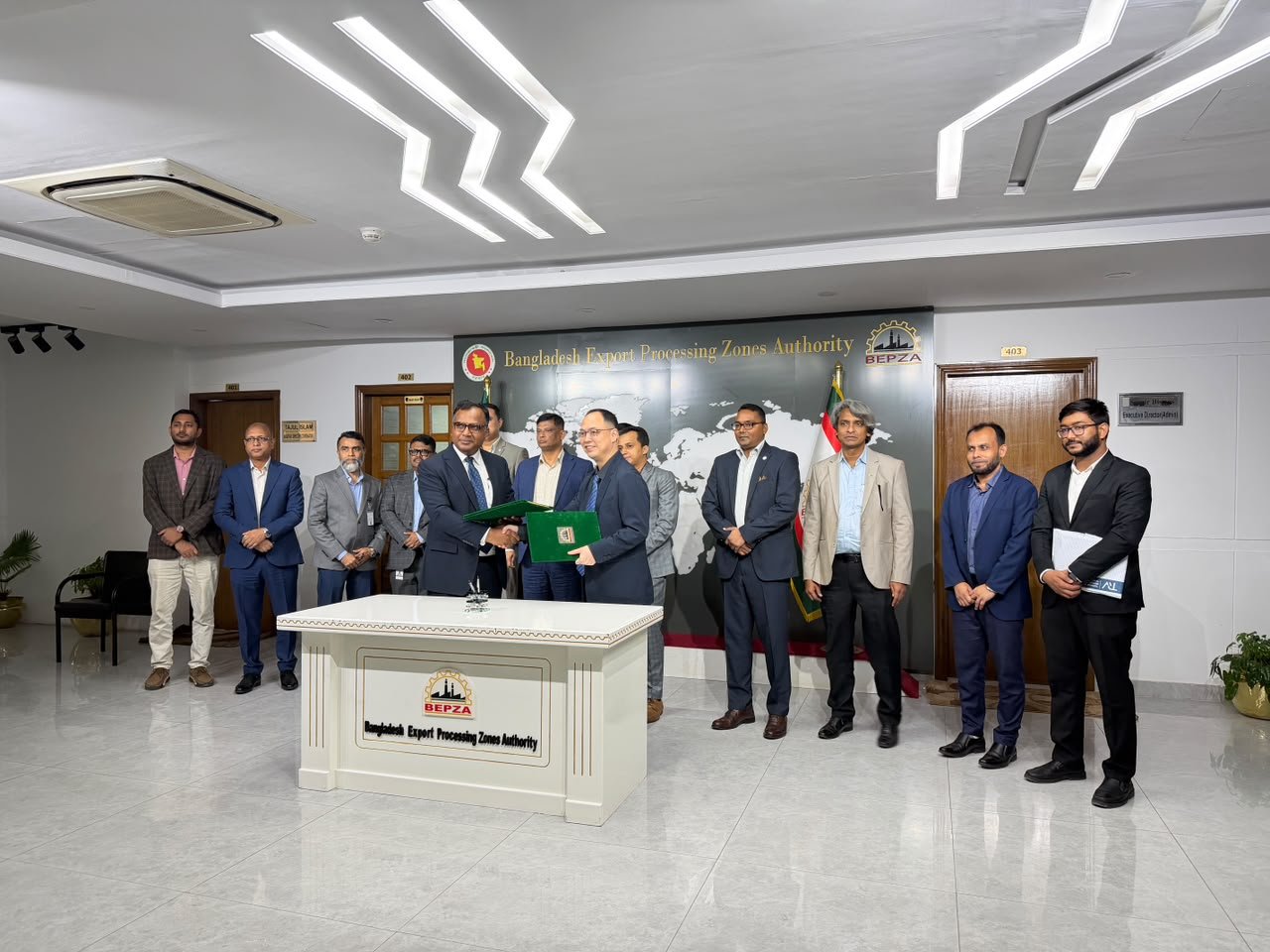
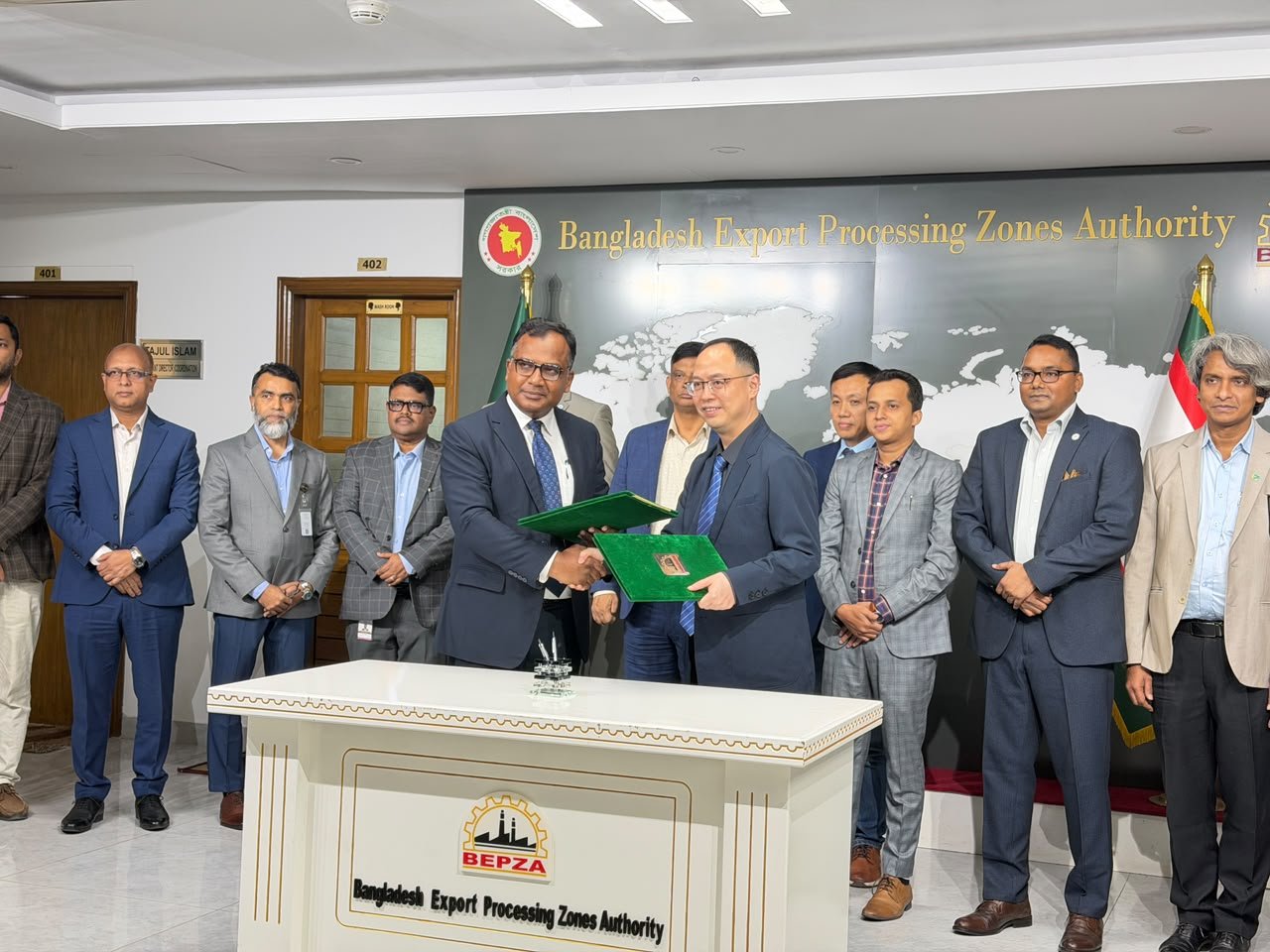
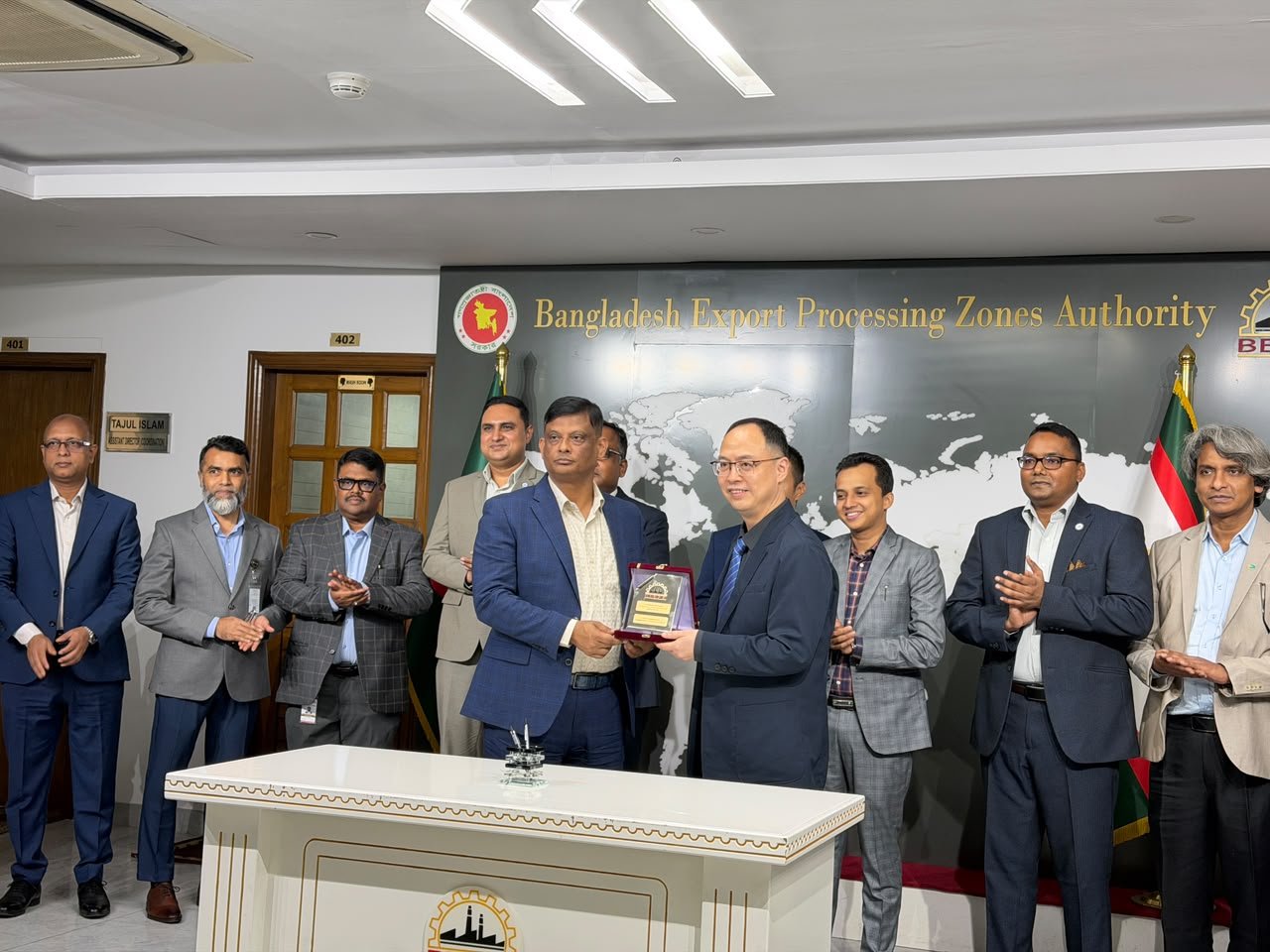
In November 2026, BD Lepachu Limited signed its lease agreement with BEPZA at BEPZA's headquarters in the BEPZA Complex, Dhanmondi, Dhaka. The signing is a milestone towards establishing manufacturing operations at Ishwardi EPZ in Pabna district, and followed the allotment of approximately 26,000 square feet of space in a standard factory building for a ten-year term.
TRW advised Pivot Point International and BD Lepachu Limited from scratch, from company incorporation to the lease signing. TRW was involved well before the ceremony: initiating the conversation, incorporating the company, progressing the BEPZA applications, securing the permission and factory-space allotment documents, addressing pre-signing requirements and coordinating execution of the lease agreement. The team worked closely with the investors and the authorities to bring the corporate, regulatory and contractual requirements together.
Founding Partner Advocate Syed Wahid attended with the project's team leads, Associates Sadia Binte Ishaque and Motassallimul Haque Mahi. TRW thanks BEPZA and the Ishwardi EPZ authorities for their cooperation, and congratulates BD Lepachu Limited and Pivot Point. Read the announcement of the BD Lepachu lease signing.
A workable sequence for EPZ investment in Bangladesh
A controlled sequence avoids the costliest rework: a later document that contradicts an earlier one. Keep one investment paper as the source for every filing.
Fix the project
Write one investment paper covering product, process, machinery, space, exports, workforce, shareholders and funding.
Choose zone and space
Visit the zones, compare rent tiers, logistics and utilities, and decide between a serviced plot and a standard factory building.
Incorporate and fund
Form the company with the RJSC, open the foreign currency account and remit capital through the banking channel.
File the proposal
Send a letter of interest, then the project proposal form with machinery invoices, solvency certificates and RJSC documents.
Clear the permission letter
Review every condition and pay the security deposit, registration fee and any stamp duty in the allotment letter.
Sign the lease
Check that the lease, permission and allotment letters align, confirm the signatory's authority and execute with BEPZA.
Build, bond and staff
Obtain drawing approval, install machinery, register the bond and secure work permits and environmental clearance.
Run the compliance calendar
File progress reports, audited accounts and Bangladesh Bank returns, and obtain BEPZA consent before any change.

Mistakes to avoid
- Applying before incorporation: BEPZA needs RJSC-certified documents with the proposal.
- Filing with the wrong authority: BEPZA was not merged into Invest Bangladesh.
- Choosing space on headline rent: a factory that cannot take the line costs more than it saves.
- Ordering used machinery or starting works without approval.
- Transferring shares before BEPZA's no-objection certificate.
- Pricing incentives from a brochure rather than the operative order.
What to watch in 2027
The earlier plan to bring BEPZA into a single investment authority was not carried through in August 2026; whether it returns matters to every EPZ investor.[13] BEPZA's capacity is growing through the Mirsharai zones and the Patuakhali and Jashore EPZs.[1] And the NBR keeps exemptions under review, so test incentive assumptions against each Finance Act.
TRW's BEPZA and EPZ investment practice takes projects from the first incorporation documents to the signing table. For the wider picture, see how to invest in Bangladesh.
Frequently asked questions
Was BEPZA merged into Invest Bangladesh?
How many EPZs are there, and where is Ishwardi EPZ?
Can a foreign investor own 100 per cent of an EPZ company?
Yes. Type A projects are fully foreign-owned, and Type B joint ventures have no cap on foreign equity.[1]
Must the company be incorporated before applying to BEPZA?
Yes. The application must include the RJSC-certified certificate of incorporation, memorandum and articles.[4]
What is paid before signing the lease agreement?
A US$500 registration fee and a security deposit of one year's rent for land or four months' rent for a standard factory building, with stamp duty where applicable.[3]
How long can a standard factory building be rented?
Two to ten years, renewable. Serviced plots are leased for 30 years, renewable.[1]
Can an EPZ company sell into the domestic market?
Is there still a tax holiday for EPZ investment in Bangladesh?
Who issues work permits for foreign staff in an EPZ?
BEPZA, through a monthly Work Permit Standing Committee.[4]
Can EPZ workers form an association?
Yes. A Workers Welfare Association needs the support of at least 20 per cent of permanent workers.[7]
Source register
Primary legal and regulatory sources
Materials checked on 15 November 2026. Confirm the current official text before relying on any provision.
- BEPZA — Why BEPZA: zones, investment types, rent and incentives
- BEPZA — Investment Promotional Brochure (English), December 2025
- BEPZA — How to apply: project proposal form, registration fee and security deposit
- BEPZA — Citizen's Charter: services, time limits and required documents
- BEPZA — Investment procedure for EPZs and EZs
- BEPZA — Information for Investors (BEPZA Act 1980, Customs EPZ Rules, NBR orders and foreign exchange rules), October 2025
- Bangladesh EPZ Labour Act 2019, section 94 (formation of Workers Welfare Association) — Laws of Bangladesh
- Bangladesh EPZ Labour Act 2019, section 22 (termination otherwise than by dismissal) — Laws of Bangladesh
- Bangladesh Bank — Guidelines for Foreign Exchange Transactions 2018, Vol 1 (published by BEPZA)
- Bangladesh Bank, Statistics Department — Survey forms, including FDI Survey Form FI-1
- BEPZA, June 2021 — BEPZA signs MoU with DoE to expedite One Stop Service
- Invest Bangladesh, 23 August 2026 — Invest Bangladesh begins journey as country's apex investment promotion agency
- Future Startup, 24 August 2026 — One agency, old bottlenecks: can Invest Bangladesh break the pattern?
- UNB, 9 September 2026 — Exports begin from BEPZA Economic Zone-2 with machinery shipment to Indonesia
Related TRW assistance
Move from information to a defined next step
TRW advises foreign investors on BEPZA applications, permission and allotment letters, EPZ lease agreements, work permits, bonded operations and corporate changes inside the zones. Explore our BEPZA and EPZ investment practice or contact our Dhaka team.











