
Village court case in Bangladesh: the full journey, step by step
A village court case in Bangladesh is heard at the Union Parishad by a five-member panel: the Chairman plus two members nominated by each side, under the Village Courts Act 2006 as amended in 2013 and 2024. It covers listed petty criminal disputes and small civil claims up to Tk 3 lakh, works without lawyers, must try compromise first and has strict time limits.
Only a 3:2 decision can be appealed, to a first class Judicial Magistrate in criminal matters or the Civil Judge (formerly Assistant Judge) in civil matters, within thirty days.
- Where it starts
- An application to the Chairman of the Union Parishad where the offence was committed or the cause arose (village courts…
- Main law
- Village Courts Act 2006 (Act 19 of 2006), as amended by Act 36 of 2013 and Act 3 of 2024, ss.3-17 and the Schedule; Village…
- Typical duration
- Compromise: about 1 month from formation. Contested hearing: up to 90 days, plus 30 with reasons. Appeal: roughly 2-9…
- Who can file
- Any party to a dispute listed in the Schedule; the panel includes nominees of both sides, and lawyers may not appear
Village court case in Bangladesh: walk through every stage
Press next, use your arrow keys or tap a court on the map. The gold marker shows where your case is, and the green trail shows the route it has taken. For the immersive version, play it full screen.
Read every step as text
 Step 1 · Is it a village court matter?
Check that the dispute belongs to the village court
Village courts exist only in Union areas. Part 1 of the Schedule lists petty criminal matters, such as minor hurt, wrongful restraint, small thefts, cheating, criminal breach of trust, mischief and insult. Part 2 lists civil claims: money due under a contract, receipt or document; recovery of movable property; possession of land within one year of dispossession; damage to movables; cattle trespass; farm workers' wages; and a wife's arrears of maintenance. Since 2024 the value limit is Tk 3 lakh. For listed matters the village court's jurisdiction is exclusive, and other courts cannot try them.
Where: Village court at the Union Parishad · Time: 1-3 days · Law: s.1(3) Village Courts Act 2006; s.3(1) Village Courts Act 2006; Schedule Parts 1 and 2 (as amended by Act 3 of 2024) · Documents: Note of the incident or claim, Estimate of the value involved
Tip: Value the claim honestly. A claim above Tk 3 lakh, or a dispute not in the Schedule, must go to the regular courts.
 Step 2 · Is it a village court matter?
Exclusions to check
A criminal matter cannot go to the village court if the accused has previously been convicted by a village court, or by any other court for a cognizable offence. A civil matter is excluded if a child's interest is involved, if the parties' contract has an arbitration or dispute-resolution clause, or if the Government, a local authority or a public servant acting in their duty is a party. A suit to establish title to land, or to recover possession of land the village court has ordered handed over, is not barred.
Where: Village court at the Union Parishad · Time: Same day · Law: s.3(2)(a)-(c) Village Courts Act 2006 (as amended 2013 and 2024); s.3(3) Village Courts Act 2006 · Documents: Any contract between the parties, Information about earlier convictions
Tip: If your contract contains an arbitration clause, the village court is not the right forum for a money claim under it.
 Step 3 · Is it a village court matter?
Apply within the short time limits
Despite the Limitation Act, a criminal application must be made to the Union Parishad Chairman within thirty days of the offence. A civil application must be made within sixty days of the cause of action, except a claim to recover possession of land, which must be brought within one year of dispossession under Part 2 of the Schedule. Missing these windows means the village court route is lost, though the regular courts may remain available within their own limitation periods.
Where: Village court at the Union Parishad · Time: 30 days (criminal); 60 days or 1 year (civil) · Law: s.6A Village Courts Act 2006 (inserted 2013); Schedule Part 2, serial 3 · Documents: Calendar of key dates, Proof of the date of the incident or dispossession
Tip: Count from the date of the incident, not from when talks with the other side broke down.
 Step 4 · Application and forming the court
Application to the Union Parishad Chairman
Any party may apply in the prescribed manner to the Chairman of the Union Parishad for a village court to be formed. Normally the court sits in the Union where the offence was committed or the cause arose, if the parties live there. If one party lives in another Union, the court still forms where the dispute arose, but that party may nominate members from their own Union. The Chairman must take steps to form the court unless he rejects the application with written reasons.
Where: Village court at the Union Parishad · Time: 1-7 days · Law: s.4(1) Village Courts Act 2006; s.6(1)-(2) Village Courts Act 2006; Village Courts Rules · Documents: Application in the prescribed form, Prescribed fee, Names and addresses of the other side and witnesses
Tip: Get a dated receipt for the application. The thirty- and sixty-day limits are measured to this date.
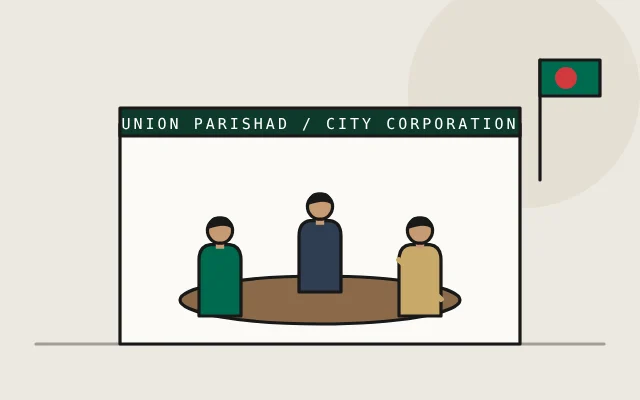 Step 5 · Application and forming the court
Forming the five-member court
Since the 2024 amendment, a village court has five members: the Chairman and two members nominated by each side, one of whom must be a member of that Union Parishad. Where a woman's interest is involved, each side must nominate a woman as one of its members. With the Chairman's permission a party may nominate someone else instead of a Parishad member. If a side fails to nominate within the prescribed time, the court is formed without that member and still acts validly.
If the Chairman cannot serve or his impartiality is questioned, another Parishad member presides.
Where: Village court at the Union Parishad · Time: 1-3 weeks · Law: s.5(1)-(5) Village Courts Act 2006 (s.5(1) and (5) substituted by Act 3 of 2024) · Documents: Nomination letters, Notice of formation
Tip: Nominate on time. If you do not, the court can lawfully proceed without anyone you chose.
 Step 6 · Compromise and hearing
First session and compromise
The first session must be held within fifteen days of the court's formation. The court hears both sides, frames the issues and tries to settle them by compromise. Since 2024, a compromise must be completed within fifteen days of that effort beginning. If agreed, both parties sign or thumb-print a compromise deed, witnessed by their nominated members, and the court records it in the prescribed form as its order or decree. No appeal or revision lies against a compromise. Most matters in a village court case in Bangladesh end at this stage.
Where: Village court at the Union Parishad · Time: Within 15 days of formation, then 15 days · Law: s.6B(1)-(5) Village Courts Act 2006 (s.6B(2) amended by Act 3 of 2024) · Documents: Compromise deed, Order in the prescribed form
Tip: Make sure every term of the compromise is written down, including payment dates; the order is enforced on its exact wording.
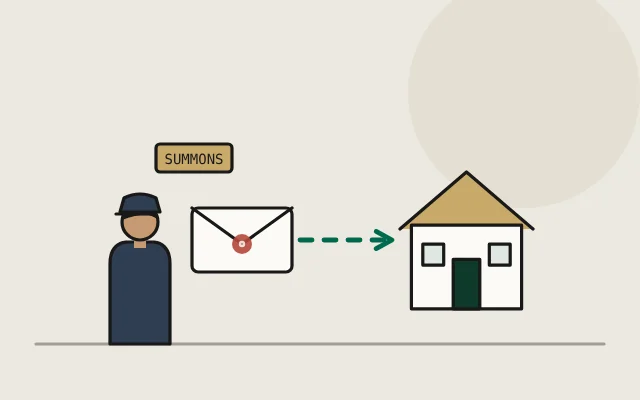 Step 7 · Compromise and hearing
Summons, witnesses and order in court
The village court can summon any person to attend, give evidence or produce a document, subject to exemptions such as those for people excused from personal appearance under the Civil Procedure Code. Wilful disobedience of a summons can be punished with a fine of up to Tk 1,000, after the person is heard. Insulting the court, disrupting it, refusing to produce documents, answer questions or take the oath is contempt, also punishable with a fine of up to Tk 1,000. Unpaid fines are recovered by the Union Parishad as a tax.
Where: Village court at the Union Parishad · Time: During the hearing · Law: s.10(1)-(2) Village Courts Act 2006; s.11 Village Courts Act 2006; s.12 Village Courts Act 2006 (substituted 2013) · Documents: Summons, Fine order, if any
Tip: If a key witness lives outside the Union, deposit their travel costs, otherwise the court will not compel them to attend.
 Step 8 · Compromise and hearing
Hearing without lawyers
No party may engage a lawyer in a village court. Unless the Act says otherwise, the Evidence Act, the Code of Criminal Procedure and the Civil Procedure Code, apart from its ss.10 and 11, do not apply, so proceedings are informal, though the Oaths Act applies. A public servant, a woman observing purdah, an elderly woman or a person with a disability can be represented by an unpaid authorised person. Prosecuting a public servant for an act in official duty needs the employing authority's prior sanction.
Since 2024, heirs or nominees can be substituted if a party dies.
Where: Village court at the Union Parishad · Time: One or more sittings · Law: s.13(1)-(3) Village Courts Act 2006; s.14 Village Courts Act 2006; s.15 Village Courts Act 2006; s.15A Village Courts Act 2006 (inserted 2024) · Documents: Written statements, Documents relied on, Authorisation for any representative
Tip: Prepare a short written account and bring your documents in order; you will be presenting the case yourself.
- Step 9 · Compromise and hearing
Strict time limits for a decision
If there is no compromise, the court must start hearing the case within fifteen days. Before the hearing starts, a party may, with the Chairman's permission and for good reason, replace a nominated member. The case must be decided within ninety days of the start of the hearing, or within a further thirty days with reasons recorded. If it is not, the village court is automatically dissolved. Unless a natural disaster caused the delay, the aggrieved party may then file in the proper court within sixty days of the dissolution.
Where: Village court at the Union Parishad · Time: 15 days to start; 90 + 30 days to decide · Law: s.6C(1)-(4) Village Courts Act 2006 (s.6C(2) amended by Act 3 of 2024) · Documents: Record of hearing dates, Order of extension
Tip: Note the date the hearing started. If the court is dissolved, the sixty-day window to go to the regular court starts immediately.
 Step 10 · Decision and enforcement
The decision and how votes count
A decision taken unanimously, by four to one, or by three to one when four members are present, binds the parties and is enforced under the Act, with no appeal. Since 2024, if a four-member court is split two to two, the Chairman has a casting vote. A decision taken by three to two can be appealed by the aggrieved party within thirty days. Once a village court has decided a matter, no other court, including another village court, can try it again.
Where: Village court at the Union Parishad · Time: At the end of the hearing · Law: s.8(1), (1A), (2) and (4) Village Courts Act 2006 (s.8(1A) inserted 2024) · Documents: Written decision, Record of votes
Tip: Ask that the vote count be recorded in the decision; it decides whether you can appeal.
 Step 11 · Decision and enforcement
What the court can order
In criminal matters a village court cannot imprison or fine the accused. It can only order compensation of up to Tk 3 lakh to the person harmed. In civil matters it can order payment of an amount within the Schedule limit, or the return of property or its possession to the true owner. The court may allow compensation to be paid in instalments. A village court case in Bangladesh is therefore about restoring the victim rather than punishing the wrongdoer.
Where: Village court at the Union Parishad · Time: With the decision · Law: s.7(1)-(2) Village Courts Act 2006 (s.7(1) amended by Act 3 of 2024); s.9(5) Village Courts Act 2006 · Documents: Compensation or restoration order
Tip: If punishment matters to you, the village court may be the wrong forum; ask whether the matter should go to a criminal court instead.
 Step 12 · Decision and enforcement
Enforcing the decision
The village court records its order and any payment or handover in its register. If compensation is not paid in the time set, the Chairman recovers it as arrears of Union Parishad tax under the Local Government (Union Parishad) Act 2009 and pays it to the person harmed. If the order can be carried out only in another way, such as handing over property, the matter is placed before the Civil Judge, who enforces it as if it were that court's own decree.
Where: Village court at the Union Parishad · Time: 1-6 months · Law: s.9(1)-(4) Village Courts Act 2006; Local Government (Union Parishad) Act 2009 · Documents: Register entry, Application for enforcement, Certified copy of the order
Tip: If payment is late, write to the Chairman asking for recovery under s.9(3) rather than starting a fresh case.
 Step 13 · Decision and enforcement
Penalty for a false case
A person who brings or causes a case under the Act, knowing there is no just or lawful ground and intending to harm the other side, can be fined up to Tk 5,000. The fine is treated as compensation for the person harmed by the false case and is recovered in the same way as compensation, through the Union Parishad.
Where: Village court at the Union Parishad · Time: With or after the decision · Law: s.9A Village Courts Act 2006 (inserted 2013) · Documents: Application for a false-case fine, Evidence of malice
Tip: Raise a false-case point only with evidence. It is a short, practical deterrent, not a separate trial.
- Step 14 · Transfers and finality
Transfer to or from the regular courts
The Chief Judicial Magistrate can withdraw a pending criminal matter from a village court and send it to a criminal court where public interest and justice require. The District Judge has the same power for civil matters. A village court that thinks the offender deserves punishment can also send the case to a criminal court. Police investigation of a cognizable offence is not stopped because the matter is village-court triable, and a criminal court may in turn send a suitable case to a village court.
Where: Chief Judicial Magistrate / Judicial Magistrate (first class) · Time: Weeks · Law: s.16(1), (1A) and (2) Village Courts Act 2006; s.17 Village Courts Act 2006 · Documents: Transfer application, Order of withdrawal or transfer
Tip: If a matter is more serious than it looks, such as repeated violence, ask the Chief Judicial Magistrate to withdraw it to a criminal court.
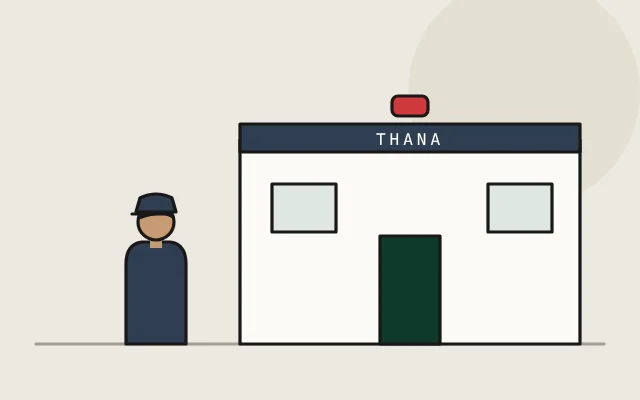 Step 15 · Transfers and finality
Police cases and village courts
Where the same incident is reported to the police as a cognizable offence, the police may continue to investigate even though the matter appears in Part 1 of the Schedule. When such a case reaches a criminal court, the court may send it to a village court formed under the Act if it thinks fit. The two routes should not be pursued side by side for the same dispute, because once a village court case in Bangladesh is decided, no other court can try the same matter.
Where: Police station · Time: Varies · Law: s.17 Village Courts Act 2006; s.8(4) Village Courts Act 2006 · Documents: FIR or general diary entry, Court's transfer order
Tip: Tell the village court about any police case for the same incident, and vice versa, to avoid wasted proceedings.
Walk through it from your side
Pick your side. The step-by-step journey above and the full-screen player will then show what you do at every stage.
Applicant
You want compensation of up to Tk 3 lakh, payment of money due, or the return of property or possession, quickly and without lawyers. You must show that the dispute is listed in the Schedule, within the value limit and within the thirty- or sixty-day filing window, and back it with documents and witnesses. Your biggest risk is applying late or choosing this forum for a dispute it cannot hear.
Check that the dispute belongs to the village court
You check that the incident or claim falls within Part 1 or Part 2 of the Schedule, that the value is within Tk 3 lakh and that the dispute arose in a Union area. Value the claim honestly.
Watch outA dispute outside the Schedule or above Tk 3 lakh must go to the regular courts.
Exclusions to check
You make sure no exclusion applies: in a criminal matter, that the accused has no previous conviction by a village court or for a cognizable offence; in a civil matter, that no child's interest, arbitration clause or public body is involved.
Watch outA matter barred by s.3(2) can be challenged later as outside jurisdiction.
Apply within the short time limits
You apply within thirty days of the offence, or within sixty days of the cause of action for a civil claim, or within one year of dispossession for a land possession claim.
Watch outThe Limitation Act does not extend these windows; a late application loses the village court route.
Application to the Union Parishad Chairman
You apply in the prescribed manner to the Chairman of the Union where the offence or cause arose, pay the fee and get a dated receipt.
Watch outIf the Chairman refuses in writing, a revision lies to the Civil Judge, who must decide within thirty days.
Forming the five-member court
You nominate your two members on time, one of them a Union Parishad member, and a woman if a woman's interest is involved. If you doubt the Chairman's impartiality, say so in the prescribed manner.
Watch outIf you do not nominate within the prescribed time, the court is formed without your nominee and still acts validly.
First session and compromise
At the first session, within fifteen days of formation, you explain your claim and consider any reasonable compromise. If agreed, make sure every term, including payment dates, is written into the compromise deed.
Watch outA compromise recorded as the court's order cannot be appealed or revised, so read it carefully before signing.
Summons, witnesses and order in court
You give the court the names of witnesses and documents you need summoned, and arrange for witnesses who live outside the Union as the court directs.
Watch outThe court may decline to summon a witness who cannot attend without undue delay, cost or inconvenience.
Hearing without lawyers
You present the case yourself with a short written account and organised documents, since lawyers cannot appear. If you qualify, you may be represented by an unpaid authorised person.
Watch outDo not try to bring a lawyer; it is barred under s.14.
Strict time limits for a decision
You note the date the hearing started and press for a decision within ninety days, or 120 with recorded reasons. If the court is dissolved, file in the proper court within sixty days.
Watch outThe sixty-day window to go to the regular court starts as soon as the village court is dissolved.
The decision and how votes count
You ask that the vote count is recorded in the decision. If you lose by 3:2, consider an appeal within thirty days.
Watch outUnanimous, 4:1 and 3:1 decisions bind you with no appeal.
What the court can order
You ask for compensation or payment that reflects your actual loss within the limit, or for the return of property or possession, and propose instalments if that makes payment realistic.
Watch outThe village court cannot imprison or fine the accused, so if punishment matters, consider whether the case belongs elsewhere.
Enforcing the decision
If payment is late, you write to the Chairman asking for recovery as Union Parishad tax arrears. If the order requires handing over property, ask for it to be placed before the Civil Judge for enforcement as a decree.
Watch outAsk for recovery under s.9 rather than starting a fresh case.
Penalty for a false case
Bring the application only on genuine grounds and keep evidence of your claim.
Watch outA case brought knowingly without just ground, intending harm, can attract a fine of up to Tk 5,000.
Transfer to or from the regular courts
If the matter is more serious than it looks, such as repeated violence, you may ask the Chief Judicial Magistrate (criminal) or District Judge (civil) to withdraw it to a regular court.
Watch outWithdrawal is discretionary and depends on public interest and justice.
Police cases and village courts
If you have also reported the incident to the police, tell the village court, and decide which route to pursue.
Watch outOnce the village court decides, no other court can try the same matter.
Respondent / accused
You want the claim dismissed or settled fairly, with any compensation kept to what is justified. You can nominate two members of the panel, raise exclusions such as a child's interest or an arbitration clause, offer a compromise and, if a decision goes 3:2 against you, appeal within thirty days. Your biggest risk is failing to nominate members or attend, because the court can lawfully proceed without you.
Check that the dispute belongs to the village court
If you expect a claim, check whether the dispute is really one the village court can hear and gather receipts, agreements and other papers that show your side.
Watch outIf the matter is within the Schedule, other courts cannot try it, so be ready to respond at the Union Parishad.
Exclusions to check
You check whether an exclusion applies, such as a previous conviction, a child's interest, an arbitration clause in your contract or a public body as a party, and raise it at the first session with documents.
Watch outRaise any exclusion early; waiting until after the decision makes it harder to rely on.
Apply within the short time limits
You note the date of the incident or cause of action and check whether the application was made in time.
Watch outIf the application is out of time, point this out to the Chairman at once.
Application to the Union Parishad Chairman
When notified, you confirm which Union the dispute arose in and where you live; if you live in another Union you may nominate members from your own Union.
Watch outDo not ignore the notice from the Union Parishad.
Forming the five-member court
You nominate your two members on time, one of them a Union Parishad member, and a woman where a woman's interest is involved. With the Chairman's permission, you may nominate someone else instead of a Parishad member.
Watch outFailing to nominate in time lets the court proceed lawfully without anyone you chose.
First session and compromise
You state your side at the first session and consider whether a fair compromise is available. If you agree, check that the deed records exactly what you will pay or do and when.
Watch outOnce recorded, the compromise is final and enforceable on its exact wording.
Summons, witnesses and order in court
You attend when summoned, bring the documents asked for and ask the court to summon your own witnesses.
Watch outWilful disobedience of a summons or contempt can be fined up to Tk 1,000.
Hearing without lawyers
You present your defence yourself with a short written account, receipts and witnesses. A public servant, a woman observing purdah, an elderly woman or a person with a disability may be represented by an unpaid authorised person.
Watch outSpeak to the facts and bring documents; the procedure is informal, but the Oaths Act applies.
Strict time limits for a decision
Before the hearing starts you may, with the Chairman's permission and good reason, replace a nominated member. Keep track of the time limits.
Watch outIf the court is dissolved, a fresh case can follow in the regular court within sixty days.
The decision and how votes count
You ask that the vote count is recorded. If the decision goes against you by 3:2, you may appeal within thirty days.
Watch outOnce decided, the same matter cannot be tried again by any court, including another village court.
What the court can order
You argue for a fair amount and, if ordered to pay, ask for instalments that you can meet.
Watch outCompensation is capped at Tk 3 lakh, but missing instalments leads to recovery through the Union Parishad.
Enforcing the decision
You pay or hand over property as ordered and get the payment or handover recorded in the village court register.
Watch outUnpaid compensation is recovered from you as Union Parishad tax arrears.
Penalty for a false case
If you believe the case was brought falsely to harm you, raise it with evidence before the village court.
Watch outRaise a false-case point only with real evidence; it is a short deterrent, not a separate trial.
Transfer to or from the regular courts
If a transfer is sought, you respond with reasons why the village court is the proper forum, or agree if the regular court suits you better.
Watch outOnce withdrawn, the case runs under ordinary procedure with lawyers and different time limits.
Police cases and village courts
If there is also a police case for the same incident, tell both forums, and ask the criminal court to consider sending the matter to the village court where suitable.
Watch outDo not let two proceedings run side by side on the same facts without raising it.
What if…? How the village court case in Bangladesh can change course
Choose a scenario. The map animates the route up the hierarchy and, where a case is sent back, down to the lower court and up again.
What if the decision was by a 3:2 vote and I want to appeal?
- 1Chief Judicial Magistrate / Judicial Magistrate (first class)
Criminal appeal to a first class Judicial Magistrate
For a criminal matter, the party aggrieved by a 3:2 decision may appeal within thirty days to the first class Magistrate's court with jurisdiction. If satisfied that the village court failed to do justice, the Magistrate may set aside or vary the decision, or send it back for reconsideration.
2-6 monthss.8(2)(a) and (3) Village Courts Act 2006s.4A(2)(a) CrPC (judicial functions under other laws go to a Judicial Magistrate) - 2Civil Judge (formerly Assistant Judge)
Civil appeal to the Civil Judge
For a civil matter, the appeal lies within thirty days to the court of the Assistant Judge with jurisdiction, now styled Civil Judge. Where there are several, the Act points to the most junior. The court has the same powers to set aside, vary or remit.
2-9 monthss.8(2)(b) and (3) Village Courts Act 2006s.2(d) Village Courts Act 2006Civil Courts (Amendment) Act 2026
Where it ends up: The appeal court confirms, sets aside or varies the decision, or sends it back to the village court.
What if the Chairman refuses to form a village court?
- 1Civil Judge (formerly Assistant Judge)
Revision before the Civil Judge
A person aggrieved by the Chairman's written refusal to form a village court can file a revision in the court of the Assistant Judge, now Civil Judge, with jurisdiction, in the prescribed manner and time. The court must dispose of the revision within thirty days of receiving it.
Within 30 days of filings.4(2)-(3) Village Courts Act 2006 (s.4(3) inserted 2013)
Where it ends up: The Civil Judge either upholds the refusal or directs that a village court be formed.
Can the village court review its own decision?
- 1Village court at the Union Parishad
No review power
The Act gives a village court no power to review its decision, and the Civil Procedure Code, apart from ss.10 and 11, does not apply, so Order XLVII review is unavailable. A compromise cannot be appealed or revised, and a decided matter cannot be tried again. Only the Appellate Division, at the very top, can review its own judgments under Article 105.
Not applicables.13(1) Village Courts Act 2006s.6B(5) and s.8(4) Village Courts Act 2006Article 105 Constitution
Where it ends up: The decision stands unless it is appealable as a 3:2 decision or set aside by a higher court.
Is there a reference to a higher court, or a transfer instead?
- 1District Judge's Court
Withdrawal by the District Judge
The Act has no reference procedure. Its substitute is transfer: the District Judge may withdraw a pending civil matter from the village court and send it to a proper civil court where public interest and justice require, and the Chief Judicial Magistrate may do the same for criminal matters. The regular court then hears the case under ordinary procedure.
Weekss.16(1) and (1A) Village Courts Act 2006
Where it ends up: The dispute leaves the village court and is tried by the regular civil or criminal court.
What if the appeal court sends the case back?
- 1Civil Judge (formerly Assistant Judge)
Case returned for reconsideration
On appeal, the Magistrate or Civil Judge may, instead of deciding the matter, send it back to the village court for reconsideration where the village court failed to do justice, for example by ignoring a key document.
With the appeal decisions.8(3) Village Courts Act 2006 - 2Village court at the Union Parishad
Fresh decision and possible second appeal
The village court reconsiders and gives a fresh decision. If that decision is again by three to two, the aggrieved party can appeal again within thirty days.
1-3 monthss.8(1)-(2) Village Courts Act 2006
Where it ends up: A fresh decision is made and may return to the appeal court if again split 3:2.
Can the case reach the High Court Division or the Appellate Division?
- 1High Court Division
Writ petition in the High Court Division
The Act provides no appeal beyond the Magistrate or Civil Judge. Where a village court or the appeal court acted without jurisdiction, for example on a claim above Tk 3 lakh or a matter excluded by s.3(2), a writ petition under Article 102 is the usual route. Whether ordinary revision lies against the appellate order is not settled by the Act itself.
6 months to 2 yearsArticle 102 Constitutions.3(2) Village Courts Act 2006 - 2Appellate Division of the Supreme Court
Leave to appeal in the Appellate Division
A party who loses the writ can seek leave to appeal to the Appellate Division within the time set by its Rules. Leave is granted only on a substantial question of law, which is rare in village court disputes.
1-2 yearsArticle 103 ConstitutionSupreme Court of Bangladesh (Appellate Division) Rules 1988
Where it ends up: The Appellate Division's decision is final and binds all courts.
How the village court case in Bangladesh moves up the court hierarchy
A village court case in Bangladesh never starts in a regular court. It is heard at the Union Parishad by a panel of five: the Union Parishad Chairman and two members nominated by each side. Subject matter and value decide the forum. Only matters listed in the Schedule to the Village Courts Act 2006 qualify, the money limit has been Tk 3 lakh since the 2024 amendment, and within that scope the village court's jurisdiction is exclusive. Village courts operate only in Union areas, so there are none inside city corporations.
There is no appeal from a unanimous, 4:1 or 3:1 decision, or from a compromise. A 3:2 decision can be appealed within thirty days, to a first class Judicial Magistrate in criminal matters or to the Civil Judge, formerly the Assistant Judge, in civil matters. Those courts review whether justice was done and may vary, set aside or send the case back. The Chief Judicial Magistrate and the District Judge can withdraw cases to the regular courts. Above that, the High Court Division is reached by writ, and the Appellate Division by leave.
- Appellate DivisionAppellate Division of the Supreme Court
- High Court DivisionHigh Court Division
- Appellate levelDistrict Judge's Court
- First instanceChief Judicial Magistrate / Judicial Magistrate (first class) · Civil Judge (formerly Assistant Judge)
- Start · outside courtVillage court at the Union Parishad · Police station
Where your case is heard
Addresses are for Dhaka. Every district has equivalent courts at its own district judgeship.
Supreme Court of Bangladesh (Appellate Division and High Court Division)
Supreme Court of Bangladesh, Shahbag, Ramna, Dhaka-1000Hears appeals, revisions, references, writ petitions under Article 102, company matters and death references (High Court Division), and appeals by leave from the High Court Division (Appellate Division).
Both Divisions sit in the Supreme Court complex; many High Court Division benches sit in the Annex Building. Check the daily cause list for the bench and court room. Postal contact is the Registrar General, Supreme Court of Bangladesh, Ramna, Dhaka-1000.
Court of the District and Sessions Judge, Dhaka (Dhaka Judge Court)
Dhaka Judge Court premises, 16 Johnson Road, Sadarghat, DhakaSeat of the Dhaka District Judge and Additional District Judges (civil appeals, probate, district-level civil and sessions work outside the metropolitan area) and the civil courts of first instance (Joint District Judge, Senior Civil/Assistant Judge courts).
Official judiciary portal gives '16 Johnson Road, Sadarghat, Dhaka'. Many civil courts (Additional District Judge courts, Joint District Judge and Senior Assistant Judge courts, Artha Rin Adalat No.1, insolvency court) are in the new 8-storey District Judge Court building in the same premises. The 2026 judgeship list names the first-instance civil courts 'Senior Civil Judge' / 'Civil Judge' (formerly Senior Assistant Judge / Assistant Judge); some pages still use the old names. Every district has an equivalent court at its district judgeship.
Chief Judicial Magistrate Court, Dhaka
18 Johnson Road, Kotwali, Dhaka-1100Handles criminal cases from police stations in Dhaka district outside the metropolitan area (e.g. Savar, Ashulia, Dhamrai, Keraniganj, Dohar, Nawabganj) through Senior Judicial and Judicial Magistrate courts.
The CJM court building also houses some Dhaka Metropolitan Magistrate courts. Every district has a Chief Judicial Magistrate court at its district headquarters.
Union Parishad offices (Village Courts)
Union Parishad office of the union where the dispute arose (no single address)Village courts under the Village Courts Act 2006 sit at the Union Parishad office and decide small civil and criminal disputes within the union, with the Union Parishad Chairman and members nominated by the parties.
Village courts exist only in union (rural) areas, for example in Savar, Keraniganj, Dhamrai, Nawabganj and Dohar upazilas of Dhaka district; there are none inside city corporation or pourashava areas. Apply to the Union Parishad of the union where the dispute arose.
Police station
Where this happens depends on your district or the office concerned. Ask us for the exact courtroom and address.
How long each stage takes
These are indicative ranges based on typical Dhaka practice. Adjournments, case backlogs and appeals can stretch them.
Documents checklist and key terms
Tick off what you have. Your ticks stay saved in this browser. Bring the list to your first meeting with your lawyer.
- Village court (gram adalat)
- A five-member court formed at the Union Parishad under the Village Courts Act 2006 to resolve listed petty criminal and civil disputes.
- Union Parishad
- The lowest tier of rural local government; its Chairman normally presides over the village court.
- Schedule
- The list in the Act of criminal matters (Part 1) and civil claims (Part 2) a village court may decide, now up to Tk 3 lakh.
- Compromise deed (apos-nama)
- The signed settlement recorded under s.6B, which becomes the court's order or decree and cannot be appealed.
- Casting vote
- The Chairman's deciding vote when a four-member court is split two to two, added in 2024.
- Civil Judge
- The new name, under the Civil Courts (Amendment) Act 2026, for the Assistant Judge who hears civil appeals and revisions from village courts.
- Automatic dissolution
- The ending of a village court that fails to decide within the time limits in s.6C, after which the party may go to the regular court within 60 days.
- Exclusive jurisdiction
- The rule in s.3(1) that matters within the Schedule cannot be tried by any other civil or criminal court.
Village court case in Bangladesh: common questions
What is the money limit for a village court case in Bangladesh?
Can I bring a lawyer to the village court?
Can the village court send someone to jail?
How long does a village court case in Bangladesh take?
Who sits on the village court?
Can I appeal a village court decision?
What if the other side does not pay the compensation?
Is there a village court in Dhaka city?
Law and sources
- Village Courts Act 2006 (Act 19 of 2006), consolidated Bengali text, Laws of Bangladesh mirror
- Village Courts Act 2006 — Laws of Bangladesh
- Village Courts (Amendment) Act 2024 (Act 3 of 2024), Laws of Bangladesh mirror
- Village Courts (Amendment) Act 2024 — Laws of Bangladesh
- Local Government (Union Parishad) Act 2009 — Laws of Bangladesh mirror
- Civil Courts (Amendment) Act 2026 — Laws of Bangladesh
- The Constitution of the People's Republic of Bangladesh (Articles 102, 103, 105)
This Case Journey is a general guide to procedure in Bangladesh as of October 2026. It is not legal advice. Procedure, fees and time limits change, and every case turns on its own facts. Timelines are indicative. Speak to a lawyer about your own matter.
Run this case from outside Bangladesh
You can usually start and run this case without travelling. You sign a power of attorney abroad, the Bangladesh High Commission or Embassy attests it, and your attorney and lawyer act for you in Dhaka. Some steps, such as giving evidence in person, may still need you or a commission. See how a case runs through a power of attorney →
Want to know where your case stands?
Book a consultation. A TRW lawyer will place your matter on this map, explain the next step and the realistic timeline, and tell you what to prepare.











